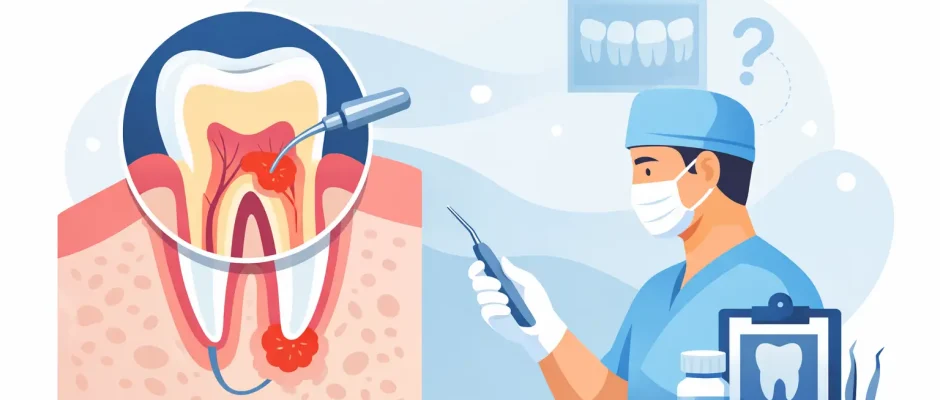
A root canal is supposed to end the infection story. When pain, swelling, or a persistent shadow on the X-ray remains at the tip of the root, the question becomes more specific: isapicoectomy surgery when neededthe right next step, or is extraction the safer choice?
For many patients, this is the moment when treatment starts to feel uncertain. The tooth has already been treated once. Symptoms may be mild, intermittent, or completely absent, yet the scan still shows inflammation around the root tip. In that setting, an apicoectomy is not a routine add-on. It is a microsurgical tooth-saving procedure used in selected cases, when preserving the natural tooth is realistic and the problem is localized near the root end.
What apicoectomy surgery means
An apicoectomy is also called root-end surgery or root-end resection. The goal is to remove the infected or inflamed tissue around the tip of the root, resect a small portion of that root end, and seal it from the surgical side. Instead of entering the tooth through the crown, as in conventional root canal treatment, the surgeon approaches the problem through the gum and bone.
This matters because not every persistent infection can be solved from inside the canal. Some teeth have complex anatomy, accessory canals, calcified pathways, separated instruments, posts or crowns that make retreatment difficult, or previous treatment that is technically acceptable but still followed by a lesion at the apex. In those situations, microsurgery can offer a more direct solution.
Apicoectomy surgery when needed: the main indications
The phraseapicoectomy surgery when neededonly makes sense if the indication is clear. This procedure is usually considered when a tooth has had root canal treatment, but inflammation persists near the root tip and there is a reasonable chance to save the tooth.
A common scenario is a chronic apical lesion visible on X-ray or CBCT after previous endodontic treatment. Sometimes the patient feels pressure, tenderness when biting, or occasional swelling. Sometimes there are no symptoms at all, and the problem is found during imaging. A radiolucency alone does not automatically mean surgery, but if it does not heal over time or has signs of persistence, further treatment is warranted.
Another important indication is when orthograde retreatment is unlikely to solve the problem or would require dismantling a high-quality restoration. For example, a tooth may have a well-fitting crown, a post, or a complex prosthetic role in the bite. Removing that restoration to redo the root canal may weaken the tooth or create additional cost and risk. In carefully selected cases, apical microsurgery can preserve both the tooth and the restoration.
There are also anatomical reasons. Some root-end pathologies are associated with cystic change, apical delta complexity, root-end leakage, or a localized perforation near the apex. Surgery allows direct visualization and management of these issues.
When an apicoectomy is not the best option
Not every tooth should be saved surgically. That is an important part of responsible treatment planning.
If the tooth has a vertical root fracture, severe mobility, advanced periodontal bone loss, or extensive destruction below the gum line, an apicoectomy will not fix the underlying problem. The same applies when the remaining tooth structure is too weak for long-term function. In those cases, extraction and replacement may be more predictable than repeated attempts to rescue a compromised tooth.
It also depends on which tooth is involved and the local anatomy. Posterior teeth can be more technically demanding because of access, root shape, and proximity to important structures. Upper molars may be close to the sinus. Lower posterior teeth may be near the mandibular canal. None of that automatically rules surgery out, but it changes planning and risk assessment.
How the decision is made
A proper decision starts with diagnosis, not with the procedure itself. Clinical examination and 3D imaging are often central here. A CBCT scan can show the exact size and position of the lesion, the quality of the previous root canal filling, cortical bone involvement, root morphology, and the relationship to adjacent anatomical structures.
At this stage, the key question is not simply “Can this tooth be treated?” but “What gives the most predictable result with the least biological cost?” Sometimes retreatment by an endodontist is the better first step. Sometimes surgery is the more conservative choice because it avoids removing an otherwise successful crown or post. Sometimes the honest answer is that extraction offers the best long-term prognosis.
This is where microsurgical experience matters. The decision is not only about eliminating infection today. It is about keeping the tooth stable and functional for years.
What happens during the procedure
An apicoectomy is usually performed under local anesthesia. From the patient’s perspective, it should feel numb, controlled, and much more precise than the word “surgery” suggests.
A small incision is made in the gum, and the surgeon gains access to the root tip through the surrounding bone. The inflamed tissue is removed, the end of the root is resected, and the root-end cavity is prepared and sealed with a biocompatible material. The site is then irrigated and sutured.
Modern root-end surgery is not the same as older, more traumatic approaches. Magnification, microsurgical instruments, and careful flap design reduce unnecessary tissue trauma and improve accuracy. In selected cases, regenerative supportsuch as PRFmay be used to support healing of soft and hard tissues. The exact protocol depends on the size of the defect, the tooth involved, and the local biology.
Recovery and what patients usually notice
Most patients expect severe postoperative pain and are often surprised that recovery is manageable. The first few days usually involve some soreness, mild swelling, and sensitivity in the surgical area. The extent depends on the tooth, the size of the lesion, and the complexity of access.
The most important part of recovery is not heroically tolerating discomfort. It is following instructions carefully. Good oral hygiene around the area, appropriate medication use, and keeping follow-up visits all contribute to uncomplicated healing.
Soft tissue healing happens relatively quickly. Bone healing takes longer and is assessed over time with follow-up imaging. That is why a successful apicoectomy is not judged the day after surgery. It is judged by symptom resolution, healthy tissue behavior, and radiographic healing over the months that follow.
Success rates and the real trade-offs
Apicoectomy can be highly successful when case selection is correct and modern microsurgical protocols are used. But success is not automatic, and this is where patients deserve a clear explanation rather than sales language.
A tooth may look restorable and still carry hidden risks. There may be missed anatomy, root cracks too fine to detect initially, or healing limitations related to smoking, systemic health, or periodontal status. Even technically perfect surgery cannot overcome every biological limitation.
On the other hand, extraction is not a neutral alternative. Removing a tooth can mean bone remodeling,added restorative steps, longer treatment timelines, and in some cases more complex reconstruction later. For that reason, preserving a natural tooth is often worth serious consideration when the prognosis is favorable.
The trade-off is simple: saving a tooth is valuable, but only when the result is expected to be durable. The best treatment plan is not the most aggressive one or the one that sounds most advanced. It is the one that matches the actual condition of the tooth.
Why surgical planning matters in complex cases
Incomplex dental surgery, precision is not a luxury. It directly affects safety, comfort, and predictability. That applies to implant placement, bone grafting, and tooth-preserving microsurgery alike.
When an apicoectomy is planned properly, the surgeon is not simply reacting to inflammation. The procedure is mapped around root anatomy, bone thickness, previous treatment quality, soft tissue condition, and restorative value of the tooth. That kind of planning reduces unnecessary trauma and helps preserve future options.
For patients seeking treatment in Israel, especially in cases where previous treatment failed or the diagnosis remains unclear, a consultation with imaging and a structured surgical plan often changes the entire conversation. At Implantolog.co.il, that philosophy is built around clear diagnostics, microsurgical technique, and a practical question that matters to every patient: can this tooth be saved safely and predictably?
The right question to ask before agreeing to surgery
Before scheduling an apicoectomy, ask one direct question: what makes this tooth a good candidate for preservation?
A good answer should include the reason the lesion persists, why root canal retreatment is or is not preferred, what the long-term prognosis looks like, and what the alternatives are if surgery fails. If those points are explained clearly, the treatment path usually becomes much less intimidating.
The goal is not to perform surgery whenever a root canal has failed. The goal is to keep the right tooth, for the right reasons, with a treatment plan that remains predictable after healing is complete. That is where confidence comes from – not from the procedure name, but from the quality of the diagnosis behind it.


Comments (0)