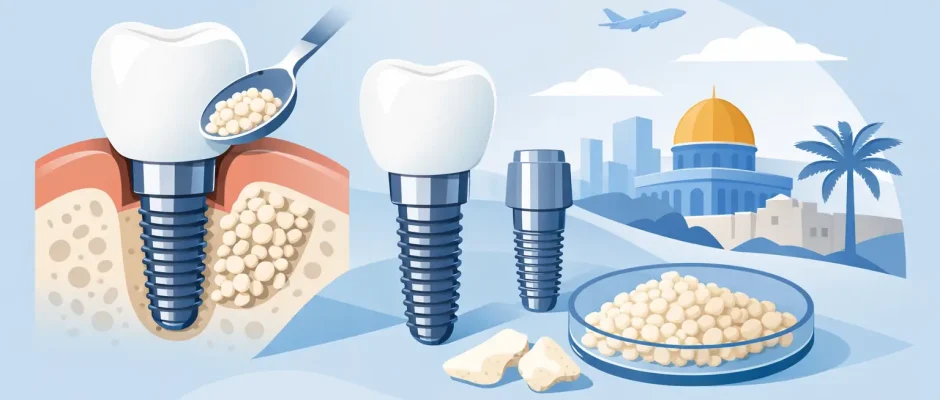
When a patient is told, “You need a bone graft before an implant,” the first reaction is often disappointment. Many people come in expecting a single straightforward implant procedure, and instead hear that the jawbone is too thin or too low. In practice, this is not unusual. Bone loss after extraction, chronic infection, trauma, or long-term denture use can leave too little support for a stable implant. The good news is that this problem is often treatable.
For patients considering bone graft for dental implants in Israel, the real question is not just whether grafting is possible. It is whether it can be done in a way that is safe, biologically sound, and planned around a predictable final result.
When bone grafting is needed before implants
A dental implant needs enough bone in three dimensions. It is not only about height. Width matters just as much, and so does the quality of the bone itself. Sometimes the ridge looks acceptable from the outside, but a CBCT scan shows that the available bone is too narrow for correct implant positioning. In other cases, the upper back jaw has lost height because the maxillary sinus has expanded after tooth loss.
This is why implant planning should begin with imaging and a surgical assessment, not with guesswork. A patient may be a candidate for immediate implantation, simultaneous grafting and implant placement, or a staged approach where the bone is rebuilt first and the implant is placed later. The right choice depends on anatomy, infection history, bite forces, soft tissue condition, and the esthetic demands of the case.
A graft is commonly recommended in several situations. The first is ridge atrophy after a tooth has been missing for months or years. The second is bone destruction caused by cysts, periodontitis, failed endodontic treatment, or traumatic extraction. The third is the upper posterior jaw, where sinus lift procedures are often required before or during implant placement.
Bone graft for dental implants Israel – what the treatment may include
In clinical practice, bone grafting is not one single procedure. It is a group of techniques used to create a stable foundation for implantation.
Guided bone regeneration
This is one of the most common methods for localized horizontal or vertical defects. Bone substitute material is placed in the deficient area and protected with a membrane. The membrane helps maintain space and guides healing so the body can form new bone where it is needed. In selected cases, PRF may be used as part of the healing protocol to support soft tissue recovery.
Socket preservation after extraction
When a tooth must be removed, the extraction site can often be preserved immediately. This reduces post-extraction collapse of the ridge and may simplify future implantation. It does not guarantee that no additional grafting will be needed later, but it often improves the starting conditions significantly.
Sinus lift
If an implant is planned in the upper premolar or molar region and the sinus floor is too close, a sinus augmentation may be necessary. Some cases allow for a simultaneous implant. Others require staged healing before the implant can be placed safely. The decision depends on residual bone height and primary stability.
Block grafting or more advanced reconstruction
In severe defects, especially after trauma, long-term tooth loss, or failed previous treatment, particulate grafting may not be enough. A larger reconstructive approach may be required. These cases demand careful planning and a surgeon who is comfortable with complex bone deficiency, not only straightforward implant placement.
One-stage or two-stage treatment – it depends
Patients often ask whether the graft and implant can be done at the same appointment. Sometimes yes. Sometimes that would create unnecessary risk.
If there is enough native bone to stabilize the implant mechanically, simultaneous grafting may be appropriate. This can shorten overall treatment time and reduce the number of surgeries. But if primary stability is doubtful, if there is active infection, or if the defect is large, staging the treatment is often the safer choice. It may take longer, but it usually improves predictability.
This is where experience matters. A treatment plan should not be built around speed alone. It should be built around long-term implant survival, correct prosthetic positioning, and healthy tissue contours.
How planning is done in a modern implant practice
For complex cases, the quality of diagnosis is as important as the surgery itself. Clinical examination, CBCT imaging, digital planning, and evaluation of the future prosthetic position all shape the grafting strategy.
A modern approach does not look only at where bone is missing. It looks at where the implant must ultimately stand in relation to neighboring teeth, gum architecture, smile line, and chewing load. If the implant is placed in compromised bone or in the wrong axis just to avoid grafting, the result may be functional but still biologically or esthetically weak.
Digital planning and, when indicated, surgical guides help transfer the plan accurately to the operating field. In more demanding cases, microsurgical technique also matters. Gentle tissue handling, stable wound closure, and control over flap design are not minor details. They directly affect healing and graft stability.
Recovery and healing time
Healing is one of the most misunderstood parts of treatment. Patients sometimes hear that bone grafting takes “a few months” and assume every case follows the same timeline. It does not.
A small socket preservation may heal relatively quickly. A sinus lift or larger ridge augmentation may require a longer maturation period before implant placement or loading. General health, smoking, diabetes control, oral hygiene, previous infection, and defect size all influence healing speed and predictability.
Discomfort after grafting is usually manageable, especially when the procedure is planned carefully and performed atraumatically. Swelling and temporary soreness are common. Severe pain is not expected in routine healing and should always be assessed. Clear postoperative instructions and follow-up visits are part of safe surgical care, not an optional extra.
Risks, limitations, and honest expectations
Bone grafting is highly useful, but it is not magic. Not every defect can be corrected with a minimal procedure, and not every patient is a candidate for the same protocol.
Grafts can partially resorb. Membranes can become exposed. Healing can be delayed. In smokers and in patients with poor hygiene or uncontrolled systemic disease, complication rates are higher. There are also cases where the anatomical limitation is so significant that the treatment plan must be modified rather than forced.
That is why careful case selection and informed consent matter. A responsible surgeon explains not only what can be done, but also what the trade-offs are. Sometimes the best plan is a staged reconstruction. Sometimes it is a shorter implant in native bone. Sometimes it is a full-arch concept designed around the available anatomy rather than an attempt to rebuild every missing contour.
Why patients seek bone graft for dental implants in Israel
For many patients, Israel is attractive not because of low-cost dentistry, but because they are looking for high-level surgical care, modern diagnostics, and a structured treatment pathway. This is especially relevant for people who have already been told that they have “not enough bone” or who have been offered simplified solutions without a detailed explanation.
In these cases, the value lies in precise diagnosis, transparent planning, and a surgeon who routinely works with deficient bone rather than avoiding it. That includes difficult extractions, sinus lifting, guided bone regeneration, immediate protocols when appropriate, and implant placement in anatomically demanding situations.
At https://www.implantolog.co.il, this approach is built around a full surgical workflow – consultation, imaging review, treatment planning, and execution with attention to comfort, safety, and long-term function.
What to ask at your consultation
A useful implant consultation should leave you with more than a price quote. You should understand whether the graft is minor or extensive, whether the implant can be placed immediately or later, what materials and techniques are being considered, and what the realistic healing timeline looks like.
It is also reasonable to ask how the final tooth or prosthetic restoration is being taken into account during planning. Good implant surgery is not separate from prosthetics. The bone is rebuilt to support a restoration that functions well, is easy to clean, and remains stable over time.
If you have been told you are not a candidate for implants because of bone loss, that statement may be true in one clinic and incomplete in another. The decisive factor is often not the diagnosis alone, but the level of surgical planning behind the proposed solution.
The right next step is not to rush into treatment. It is to get a clear anatomical assessment and a plan that makes sense for your case, your health, and the result you want to live with for years.


Comments (0)