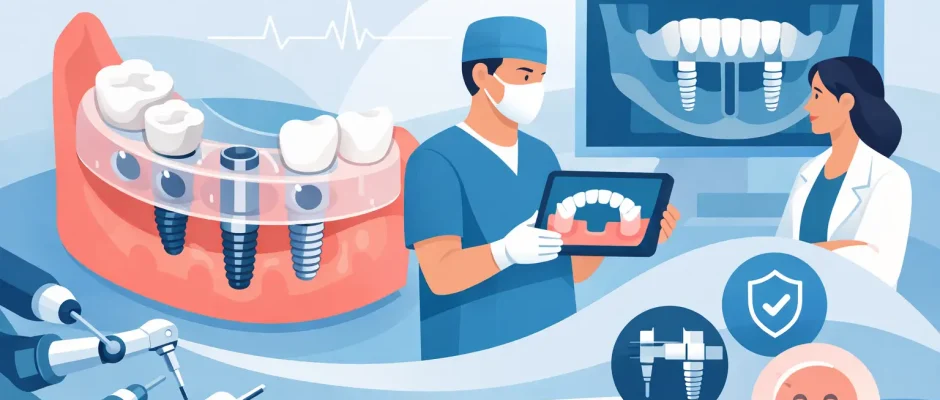
A dental implant can look simple on paper – replace a missing tooth with a titanium fixture and restore the crown. In surgery, it is rarely that simple. The implant has to be positioned within millimeters, while respecting bone volume, neighboring roots, the maxillary sinus, and the inferior alveolar nerve. That is exactly where guided planning changes the quality of treatment.
Computer-guided implant surgery benefits are not about making treatment “high-tech” for its own sake. The real value is clinical control. When planning is based on a CBCT scan, digital impressions, and a surgical guide, the implant is placed according to a prosthetically driven plan rather than a rough estimate made chairside. For patients, that usually means a more predictable path from diagnosis to final restoration.
What computer-guided implant surgery actually means
In guided implant surgery, the case is planned digitally before the procedure begins. A three-dimensional CBCT scan shows the bone anatomy and important structures. Digital impressions or intraoral scans show the teeth and soft tissue. These datasets are combined so the surgeon can choose the ideal implant position, angulation, and depth before entering the surgical field.
A surgical guide is then fabricated to transfer that plan to the mouth. In many cases, the guide directs the drilling sequence and helps the surgeon place the implant exactly where it was intended. This is not a substitute for surgical judgment. It is a tool that makes good planning more reproducible.
The main computer guided implant surgery benefits
1. More accurate implant positioning
The most obvious benefit is precision. Implant placement is not only about getting into bone. The implant should be positioned for the future crown, bridge, or full-arch prosthesis. If an implant is too far buccal, too deep, too angled, or too close to adjacent anatomy, the final restoration may be compromised even if the implant itself integrates.
Guided planning helps reduce those errors. It allows the surgeon to evaluate bone availability in three dimensions and place the implant where both biology and prosthetics make sense. This is especially valuable in the esthetic zone, where a small positional error can affect gum contours and the visual result.
2. Better protection of important anatomical structures
One of the strongest computer guided implant surgery benefits is safety. In the posterior mandible, the inferior alveolar nerve must be protected. In the upper jaw, the sinus often limits available height. Around adjacent teeth, roots and periodontal support matter as well.
Digital planning makes those boundaries visible before the procedure. That does not eliminate risk completely, because anatomy and bone quality still vary, but it gives the surgeon a much clearer operating map. In cases with limited bone or reduced safety margins, that extra control is clinically meaningful.
3. Less invasive surgery in selected cases
A guided approach often makes flapless or minimally invasive implant placement possible when conditions are appropriate. If the bone volume, soft tissue profile, and surgical access are favorable, the implant can sometimes be placed through a small tissue punch or a limited incision instead of a wider flap.
For the patient, that may translate into less postoperative swelling, less bleeding, and a more comfortable recovery. It depends on the case. When bone augmentation, contour correction, or direct visualization is needed, raising a flap is still the right choice. Precision should never come at the expense of proper access.
4. More predictable immediate implant protocols
Immediate implant placement after extraction can be an excellent solution, but only when the case is selected carefully. The surgeon has to account for the extraction socket anatomy, remaining bone walls, soft tissue stability, and implant primary stability.
Guided planning helps anticipate these factors. It can be particularly useful when the goal is to place the implant in the ideal restorative position rather than simply following the axis of the extracted root. In immediate cases, that distinction matters. It can improve prosthetic emergence, support the soft tissue more effectively, and reduce compromise in the final result.
5. Better planning in complex and bone-deficient cases
Not every patient presents with generous bone volume and straightforward anatomy. Many people seeking implants have been missing teeth for years, have sinus pneumatization, or show horizontal and vertical bone loss. In these situations, treatment is less about “putting in an implant” and more about building a sequence that is biologically sound.
Guided planning helps determine whether the case can be treated with implant placement alone, whether simultaneous grafting is realistic, or whether staged bone augmentation is the safer route. It also helps in full-arch rehabilitation, including All-on-4 type concepts, where implant angulation and prosthetic support must be coordinated from the start.
This is one of the less advertised computer guided implant surgery benefits, but for a surgeon it is one of the most valuable. It improves decision-making before the day of surgery.
Why patients often feel more comfortable with a guided approach
Patients usually do not ask for a surgical guide. They ask whether treatment will be safe, painful, and predictable. Guided surgery addresses all three concerns indirectly.
When the plan is made in advance, the procedure tends to be more organized. Surgical steps are clearer. In many cases, chair time is reduced because fewer decisions need to be made in the middle of the operation. That can make the experience feel calmer for the patient and more controlled for the team.
This matters even more for anxious patients or those undergoing complex extractions and implant placement in the same appointment. A calm procedure is not just about comfort. It also supports better execution.
When guided surgery is especially useful
Guided implant placement is helpful in many routine cases, but it becomes particularly valuable when the margin for error is small. That includes single implants in the smile zone, limited inter-root spaces, proximity to the nerve or sinus, immediate implants after extraction, and full-arch rehabilitation.
It is also useful when several procedures need to work together, such as extraction, implantation, guided bone regeneration, and provisional restoration. In these situations, the treatment plan has to be coherent from beginning to end. Digital planning helps connect those steps rather than treating them as separate events.
For international patients or busy adults who want fewer surprises, this kind of planning also makes consultations more productive. The anatomy, risks, and treatment sequence can be explained more clearly when everything is visible in advance.
The trade-offs and limitations patients should know
Guided surgery is not automatically better in every case, and it should not be marketed as a magic solution. The quality of the result still depends on diagnosis, surgical skill, and case selection.
A guide is only as accurate as the data and planning behind it. If the scan is distorted, the soft tissue is unstable, the guide does not seat properly, or the surgical plan ignores biological realities, the technology will not save the case. In some situations, freehand adjustments during surgery are necessary because the clinical picture differs from the digital model.
There is also a practical consideration: guided workflows add diagnostic and laboratory steps. That can mean additional planning time and cost. For many patients, the extra control is worth it, especially in complex or esthetically demanding cases. In a simple case with abundant bone and low anatomical risk, the benefit may be less dramatic.
A responsible surgeon does not use a guide because it looks advanced. The guide should serve a clear clinical purpose.
How guided surgery fits into a modern implant protocol
The best results usually come from combining digital planning with sound surgical principles. That means careful diagnosis, realistic prosthetic planning, atraumatic technique, stable primary fixation, and thoughtful management of hard and soft tissue.
In modern implantology, guided surgery often works alongside microsurgical methods, PRF protocols, and bone augmentation rather than replacing them. If soft tissue thickness is poor, if the socket walls are damaged, or if bone regeneration is required, those issues still need to be managed directly. Technology improves precision, but biology still sets the rules.
That is why an experienced surgical implantologist may recommend a guided approach in one case and a conventional open approach in another. The decision should be based on anatomy and treatment goals, not on a one-size-fits-all workflow.
What to ask at your consultation
If you are considering implants, ask how the position of the implant will be planned, whether a CBCT scan is needed, and whether guided placement is useful in your specific case. Also ask what happens if bone volume is insufficient, whether immediate placement is realistic, and how the surgical plan affects the final crown or bridge.
The right consultation should make the treatment feel less abstract. You should come away understanding not only what will be done, but why that approach was chosen for your anatomy.
For patients seeking implant treatment in Israel, this kind of planning-focused discussion is part of the standard expected from advanced surgical care. At https://implantolog.co.il, the emphasis is not on technology as a sales point, but on using digital tools and microsurgical protocols to make treatment safer, calmer, and more predictable.
The best benefit of guided implant surgery is not that it looks modern. It is that, when used for the right case and by the right surgeon, it reduces guesswork at the stage where guesswork should have no place.


Comments (0)