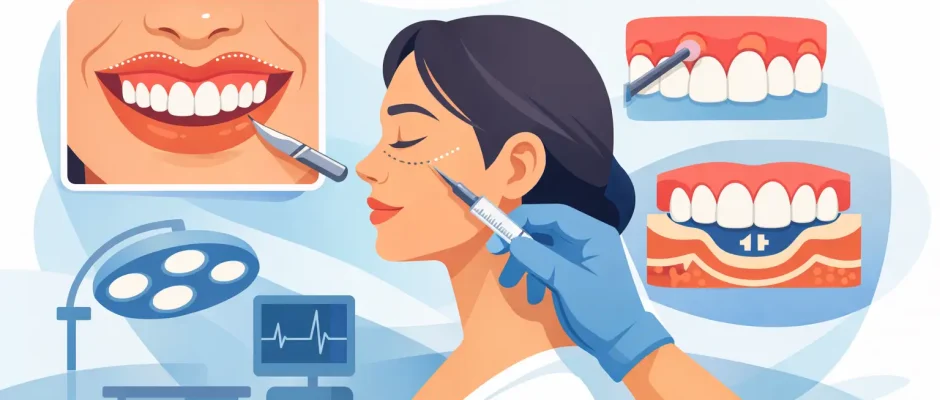
A smile can look “gummy” for very different reasons, and that is exactly why gummy smile surgery options should never be chosen by photo alone. In one patient, the issue is excess gum covering the teeth. In another, the upper lip rises too high. In a third, the upper jaw itself is positioned differently. The treatment can be relatively minor or genuinely major, and the best result depends on identifying the real cause before touching the tissue.
What makes a smile look gummy
Clinically, a gummy smile usually means that an excessive amount of gingiva is visible above the upper teeth during smiling. That visible gum may come from one factor or several at the same time. The most common causes are altered passive eruption, vertical maxillary excess, a hypermobile upper lip, short clinical crowns, gingival enlargement, or a dentoalveolar eruption pattern that changed the tooth-gum relationship.
This distinction matters because the same appearance can require very different treatment plans. If the teeth are anatomically normal but hidden under excess gum tissue, periodontal esthetic surgery may solve the problem. If the upper lip elevates too strongly, soft tissue repositioning or targeted muscle-modulating treatment may be discussed. If the upper jaw is overgrown vertically, orthognathic surgery is the definitive option, while smaller procedures may only camouflage the issue.
How gummy smile surgery options are chosen
A proper workup starts with more than a smile photograph. The surgeon evaluates the amount of gingival display at rest and in full smile, upper lip length, lip mobility, tooth proportions, periodontal health, and the position of the gingival margin relative to the underlying bone. Bite analysis and facial proportions also matter. In some cases, digital imaging and CBCT help clarify anatomy and improve planning.
This step is where expectations become realistic. Patients often ask for the least invasive solution, which is understandable. But the least invasive treatment is not always the most stable or proportionate one. A good plan balances the esthetic goal, surgical burden, healing time, and long-term predictability.
Crown lengthening for excess gum coverage
When it works best
Among gummy smile surgery options, esthetic crown lengthening is one of the most common when teeth appear short because gum tissue covers too much of the enamel. This can happen with altered passive eruption, where the teeth erupted normally but the gum margin did not recede to its ideal position.
In these cases, the goal is not to make the teeth larger, but to expose the full natural crown in a healthy way. If only soft tissue is removed without respecting biologic width and bone anatomy, the gum may rebound or become chronically inflamed. That is why precise diagnosis is essential.
What the procedure involves
Crown lengthening may include reshaping the gingiva alone or, more often, a combination of gingival contouring and conservative bone recontouring around the teeth. The amount of bone removal is planned carefully to create stable gingival margins and symmetrical tooth proportions.
Performed with a microsurgical mindset, this surgery can be highly precise and very esthetic. Healing is usually manageable, but the final gum contour takes time to mature. Patients should know that the immediate postoperative appearance is not the final result.
Lip repositioning surgery
Who is a candidate
If the main problem is a hypermobile upper lip, lip repositioning may be considered. In these patients, the upper lip rises excessively when smiling, exposing more gingiva than expected even though tooth size and gum levels may be acceptable.
Lip repositioning works by limiting the upward pull of the smile muscles through a controlled soft tissue procedure in the vestibule. It effectively lowers the resting position of the upper lip during smiling. This can be a good option when the jaw is normal and the issue is mostly lip dynamics.
Limits and trade-offs
This is not the right answer for severe skeletal discrepancy. It can improve the smile line, but it does not change jaw position or tooth proportions. There is also a recurrence risk in some cases because muscle activity and tissue memory vary from patient to patient.
That does not make it a weak treatment. It means patient selection matters. For mild to moderate lip-related gummy smile, it can offer meaningful improvement with less morbidity than jaw surgery.
Orthognathic surgery for skeletal causes
The definitive option for vertical maxillary excess
When the upper jaw is vertically overdeveloped, the most definitive of all gummy smile surgery options is orthognathic surgery, typically Le Fort I impaction of the maxilla. This is a major procedure performed in a hospital setting and usually coordinated between an oral and maxillofacial surgeon and an orthodontic team.
This option addresses the root cause rather than masking the appearance. It can dramatically improve gingival display, facial balance, and bite relationships. For patients with significant vertical maxillary excess, anything less may deliver only partial correction.
Why not everyone chooses it
The trade-off is obvious: this is real jaw surgery, with higher cost, longer recovery, and a more involved treatment pathway. For some patients, the problem is severe enough that the benefits justify that burden. For others, especially if the gummy smile is moderate and bite function is acceptable, a less invasive compromise may be more appropriate.
This is one of those situations where the “best” treatment depends not only on anatomy, but also on patient priorities, tolerance for surgery, and the importance of a full correction versus a visible improvement.
Botox and non-surgical alternatives
Not every patient needs surgery. If excessive lip elevation is the main factor, botulinum toxin can reduce upper lip lift and decrease gingival show. It is quick and minimally invasive, which makes it attractive to many patients testing whether they even want a more permanent change.
The limitation is duration. The effect is temporary and maintenance is required. It also does not correct short teeth, excess gum coverage, or skeletal discrepancy. In practical terms, Botox can be a useful diagnostic step or a reasonable long-term choice for patients who prefer reversibility over permanence.
Orthodontic treatment may also help in selected cases, especially where tooth position contributes to gingival display. Again, this is highly case-dependent. Teeth can be moved, but orthodontics cannot replace periodontal surgery when the issue is excessive gingival coverage, and it cannot replace orthognathic surgery when the main problem is the maxilla.
Can procedures be combined?
Yes, and often they should be. A patient may have altered passive eruption plus a hypermobile lip. Another may need orthodontic preparation before any surgical correction. In these mixed cases, combining procedures creates a more balanced result than relying on one method alone.
This is where experienced planning makes a visible difference. A technically successful crown lengthening can still look incomplete if lip dynamics were ignored. A lip repositioning procedure can look underwhelming if the teeth remain too short. The esthetic zone is unforgiving, and combination treatment is often what turns an acceptable result into a convincing one.
What recovery is usually like
Recovery depends entirely on the procedure. Crown lengthening and lip repositioning are typically office-based surgeries with localized postoperative soreness, temporary swelling, and a soft-diet period. Most patients return to routine activities relatively quickly, although the tissues need longer to mature esthetically.
Orthognathic surgery is different. It involves a more substantial recovery, diet modification, swelling, and a staged follow-up process. Patients considering this path need a clear explanation of timelines, not just the final benefit.
Whatever the procedure, predictable healing depends on good planning, atraumatic technique, and close postoperative follow-up. In esthetic surgery, precision is not only about the incision. It is also about controlling inflammation, preserving blood supply, and respecting tissue biology throughout the healing phase.
Choosing a surgeon for gummy smile surgery options
This is not simply a cosmetic decision. The surgeon must understand periodontics, soft tissue behavior, occlusion, facial proportions, and when the case crosses into skeletal surgery. A narrow approach can lead to under-treatment or the wrong treatment.
For patients seeking care in Israel, especially in Tel Aviv, it is reasonable to look for a surgeon who combines digital planning with microsurgical technique and gives a clear explanation of what is causing the gummy smile in the first place. That kind of consultation often reduces anxiety because the treatment stops feeling generic and starts making anatomical sense. If you are comparing opinions, a structured surgical assessment at implantolog.co.il can help clarify whether the right path is periodontal, soft tissue, orthodontic, orthognathic, or a combination.
A good smile result is not about removing gum because it looks excessive. It is about restoring proportion in a way that remains healthy, stable, and believable on the face. That is why the smartest next step is not choosing a procedure. It is choosing a diagnosis you can trust.


Comments (0)