You have a tooth that cannot be saved, and you want one thing: to get through the extraction and move forward without months of “missing-tooth time.” That is exactly where an immediate implant after tooth extraction can be a very good option – when it is planned correctly and the biology is respected.
This approach is not a shortcut and it is not “one-size-fits-all.” In the right case, it can reduce total treatment time and help preserve tissue contours. In the wrong case, it can compromise stability, increase complication risk, or simply lead to a less predictable outcome. The difference is case selection and execution.
What “immediate implant after tooth extraction” actually means
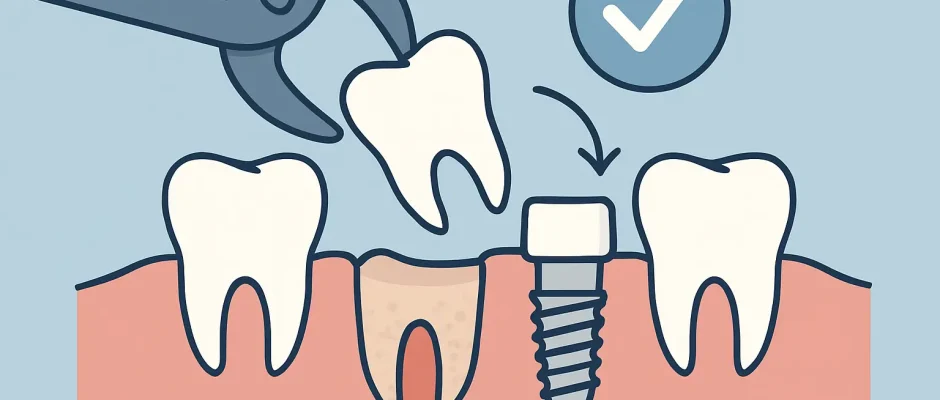
An immediate implant means the implant fixture is placed in the same appointment as the tooth extraction, directly into the fresh socket. It is different from early placement (a few weeks later) and delayed placement (typically after 2-4+ months of healing).
Patients often mix two separate concepts:
Immediate placement (implant goes in right away) and immediate loading (a temporary tooth is attached right away). You can have an immediate implant without an immediate crown, and in many clinical situations that is the safer choice.
Why timing matters after an extraction
After a tooth is removed, the bone and gum begin remodeling immediately. Some shrinkage of the ridge is normal, especially on the front (facial) side of the socket. Waiting months can mean placing an implant into a narrower ridge, sometimes requiring bone grafting to rebuild the lost volume.
Immediate placement aims to take advantage of existing bone anatomy and reduce the period of collapse. It does not “freeze” the tissues in place, but it can help maintain contours when combined with the right protocol, often including grafting the gap around the implant and careful soft tissue management.
The real criteria: who is a good candidate
The most common assumption is that immediate implants are mainly about convenience. Clinically, the decision is mostly about primary stability and infection control.
You are more likely to be a good candidate when the extraction can be performed atraumatically (without damaging the socket walls), the remaining bone can hold the implant firmly, and the site can be cleaned to a predictable level if there was infection.
Bone and stability come first
An implant must be stable at placement. In immediate cases, that stability usually comes from engaging bone beyond the socket (apical bone) or the socket walls in a way that provides mechanical anchorage.
If the socket is wide, the bone is soft, or the walls are damaged during extraction, achieving stability can be challenging. In those cases, staged treatment may be safer.
Infection: sometimes yes, sometimes no
A tooth can be removed because of decay, a fracture, or periodontal disease – and sometimes there is an abscess. Many infected sites can still be treated with immediate implants if the infection is localized, the site can be thoroughly debrided, and the surgeon can achieve stability with appropriate adjuncts.
But there are also situations where immediate placement is a poor choice: uncontrolled acute infection with significant pus drainage, inability to clean the area adequately, or extensive bone destruction that prevents stable placement.
Gum and esthetics matter most in the smile zone
Immediate implants in the front of the upper jaw can deliver excellent esthetic outcomes, but they are also the most demanding. Thin tissue biotypes, a thin facial bone plate, and high smile lines raise the stakes.
In this region, the question is not only “Can we place an implant today?” but “Can we predictably support the soft tissue shape months from now?” Sometimes the most esthetic choice is to delay, build tissue, and then place the implant in a more controlled environment.
What the appointment typically includes
A properly planned immediate implant procedure is more than “pull tooth, place implant.” It is a sequence of surgical steps designed to protect the socket, reduce trauma, and control healing.
First comes diagnostics and planning. A 3D scan (CBCT) is usually essential to assess bone volume, root anatomy, proximity to the sinus or nerve, and to plan implant position. In many cases, digital planning with a surgical guide helps translate the plan into the exact angulation and depth needed.
Then the extraction is performed as gently as possible. Preserving the socket walls is one of the biggest predictors of a smooth immediate protocol.
After extraction, the site is cleaned carefully. Granulation tissue and inflammatory tissue are removed, and the socket is irrigated.
The implant is then placed in a prosthetically driven position – meaning it is positioned for where the future tooth needs to be, not only where bone is easiest. In immediate cases, it is common to place the implant slightly palatal/lingual to protect the facial wall.
Finally, the “jumping gap” (the space between implant and socket walls) is evaluated. If the gap is significant, grafting is commonly used to support contour. Soft tissue closure can be achieved with sutures, and many surgeons use biologic adjuncts such as PRF to support healing and patient comfort.
Immediate tooth (temporary crown) – when it is safe
Many patients ask if they will leave with a tooth the same day. The answer depends on stability, bite forces, and esthetic demands.
If the implant achieves excellent primary stability and the bite can be controlled, a temporary restoration may be possible. In the front, this is often done as a non-functional temporary – it looks like a tooth but is kept out of heavy contact to protect the implant.
If stability is borderline, or if you have heavy bite forces, clenching, or a complex occlusion, it may be wiser to use a removable temporary (like an Essix retainer) or a temporary bridge while the implant integrates.
The goal is not speed. The goal is integration first, esthetics second, and function last – in that order.
Healing timeline: what to expect
Immediate placement can shorten the overall timeline, but it does not eliminate healing biology.
In many straightforward cases, soft tissue initial healing occurs over 1-2 weeks, with sutures removed around that time if non-resorbable. Bone integration typically takes several months, often around 3-4 months in the lower jaw and 4-6 months in the upper jaw, depending on bone quality and the specific protocol.
If bone grafting was performed, or if the case involves sinus proximity, thin facial bone, or major periodontal defects, healing periods can be longer.
Trade-offs and risks you should know about
Immediate implants can be predictable, but they are not “risk free,” and patients deserve a clear explanation of the main trade-offs.
One risk is recession or tissue contour change, especially in the upper front. Even when the implant integrates perfectly, the gum line can remodel during healing. That is why socket preservation measures, careful implant positioning, and soft tissue management are important.
Another risk is lack of primary stability. Without stability, immediate placement should be postponed or converted to a staged approach.
A third risk is sinus or nerve proximity. In the upper posterior region, the sinus floor may limit implant length. In the lower posterior region, the inferior alveolar nerve must be respected. Digital planning and guided surgery reduce surprises, but they do not replace clinical judgment.
Finally, there is the general risk profile of any implant surgery: swelling, bruising, temporary discomfort, and rarely infection or implant failure. A disciplined protocol and close follow-up are what keep these risks low.
How digital planning and micro-surgical technique change predictability
For immediate implants, millimeters matter. The difference between a stable, esthetic result and a compromised outcome can be the exact 3D position of the implant and the way the extraction was performed.
Digital planning with CBCT allows assessment of socket walls and anatomic structures. When appropriate, a surgical guide helps control angulation and depth so the implant emerges where the restoration needs it.
Micro-surgical principles – gentle tissue handling, precise flap design when needed, and meticulous debridement – reduce trauma and help the tissues heal with fewer surprises.
Biologic adjuncts such as PRF are not magic, but in many cases they support soft tissue healing and can improve patient comfort, especially when combined with careful suturing and a controlled surgical field.
Questions I encourage patients to ask before choosing immediate placement
If you are deciding whether to proceed with an immediate implant after tooth extraction, ask how the team will confirm primary stability, whether grafting is planned and why, and what temporary tooth option is safest for your bite.
Also ask what the backup plan is if the socket wall cracks during extraction or stability is not achieved. A confident clinician should be comfortable telling you, “If X happens, we switch to Y,” because flexibility is part of safe surgery.
Where this is done in Tel Aviv
If you are considering treatment in Israel, this protocol is part of modern surgical implant dentistry, but results depend on planning, experience with complex extractions, and comfort with tissue management. On Implantolog.co.il, I outline how I approach digital planning, guided surgery, PRF protocols, and staged alternatives when immediate placement is not the best option.
A helpful closing thought: if your priority is a predictable long-term tooth replacement, choose the timing that fits your biology, not the calendar – the fastest plan is the one that does not need to be redone.


Comments (0)