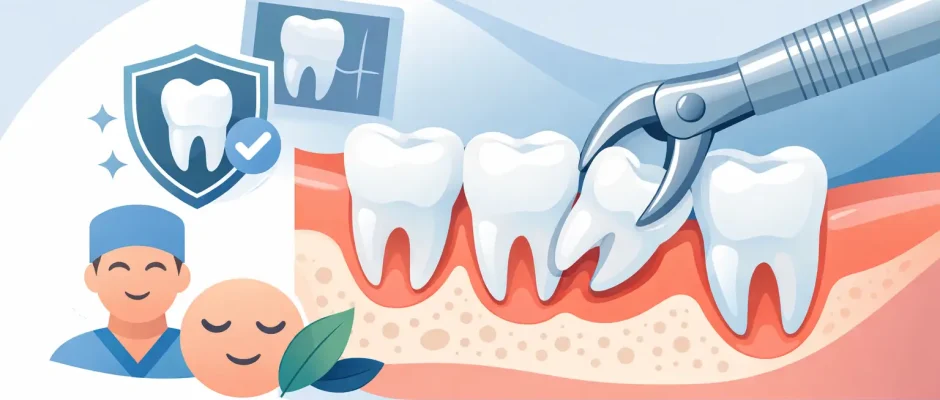
A wisdom tooth can look quiet on the surface and still create a very real surgical problem underneath. That is why impacted wisdom tooth removal without complications is not about luck. It depends on precise diagnostics, the right surgical plan, careful technique, and clear postoperative guidance.
A dystopic wisdom tooth is not simply a tooth that “came in crooked.” It is a third molar positioned incorrectly in the jaw so that it presses against the neighboring tooth, grows toward the cheek or tongue, stays partly trapped under the gum, or sits too deep in bone at an unfavorable angle. Some patients feel obvious pain and swelling. Others only learn about the problem after a scan shows damage beginning around the second molar, repeated inflammation, food impaction, or pressure in the jaw.
When a dystopic wisdom tooth should not be watched any longer
There are cases where observation is reasonable. But with a dystopic third molar, waiting often stops being conservative care and starts becoming delayed treatment. If the tooth is repeatedly inflamed, difficult to clean, damaging the adjacent tooth, associated with a cystic change, or creating periodontal destruction behind the second molar, surgery is usually the more predictable option.
The key point is this: the earlier the anatomy is properly assessed, the more controlled the procedure tends to be. A tooth that causes mild episodes of gum infection today may become a more traumatic extraction later if inflammation spreads, access worsens, or the roots continue developing in an unfavorable direction.
What makes impacted wisdom tooth removal without complications realistic
Patients often hear the phrase “complex extraction” and assume complications are almost inevitable. That is not how modern oral surgery should be approached. Risk can rarely be reduced to zero, but it can be meaningfully lowered when each stage is planned and executed correctly.
The first factor is imaging. A panoramic X-ray may be enough in straightforward cases, but a cone beam CT is often the study that changes the quality of planning. It shows root shape, bone volume, the exact angle of impaction, and the relationship between the tooth and critical structures such as the inferior alveolar nerve or maxillary sinus. Without that information, surgery becomes less precise than it should be.
The second factor is surgical access. Good surgery is not aggressive surgery. It is controlled surgery. The flap design, amount of bone removal, and whether the tooth should be sectioned are decisions made to reduce unnecessary pressure on the jaw and adjacent tissues. In many difficult wisdom tooth cases, sectioning the tooth into smaller parts is not a sign of a worse situation. It is the safer and more tissue-sparing method.
The third factor is soft tissue and socket management. Gentle handling matters. Stable clot formation matters. In selected cases, biologic support such as PRF can be used to support healing and improve postoperative comfort. These details may sound minor to a patient before surgery, but they often influence swelling, soreness, and recovery quality afterward.
Why complications happen
Complications are not random. Most have understandable causes. Infection risk rises when there is active inflammation before surgery, poor oral hygiene, smoking, or incomplete postoperative care. Dry socket is more likely when the clot is disrupted, especially after difficult lower extractions. Nerve-related symptoms are more relevant when roots are close to the mandibular canal. Limited mouth opening and swelling tend to be linked to surgical trauma, preexisting infection, and the length or complexity of the procedure.
This does not mean every difficult wisdom tooth removal leads to problems. It means a realistic discussion before surgery is part of good care. An experienced surgeon does not promise magic. He explains the anatomy, the specific risks in your case, and what is being done to minimize them.
The consultation: where safety starts
A proper consultation is more than a quick look at the tooth and a price quote. This is where the surgical strategy is built. Symptoms are reviewed, imaging is analyzed, medical history is checked, and anesthesia is chosen based on the procedure and the patient’s level of anxiety.
For some patients, the biggest issue is not pain but uncertainty. They want to know how long the surgery will take, whether stitches are needed, how many days they may be out of routine, and when they can fly, train, or return to work. These are not secondary questions. They directly affect preparation and recovery.
In a clinic focused on surgical dentistry, the consultation should translate a complicated case into a clear treatment pathway: what will be done, why it is recommended now, what alternatives exist, and what healing is expected over the next days and weeks.
How the procedure is usually performed
When a dystopic wisdom tooth is removed surgically, the goal is not speed at any cost. The goal is precision with minimal unnecessary trauma. After local anesthesia takes full effect, the gum is carefully opened to create access. If bone is covering part of the tooth, a limited and controlled amount is removed. If the angle or root anatomy makes extraction risky as a single unit, the tooth is sectioned.
This step-by-step approach reduces force on the jaw and lowers the chance of collateral damage to the neighboring tooth or surrounding bone. Once the tooth is removed, the socket is cleaned, the area is checked, and sutures are placed when needed to protect the site and support healing.
For patients, the surprising part is often that a technically complex procedure does not necessarily feel dramatic. With adequate anesthesia and calm surgical control, the experience is typically defined more by pressure than by pain.
Recovery: what helps and what delays healing
The first 48 to 72 hours matter most. Swelling usually peaks during this period, especially after lower wisdom tooth surgery. Ice, prescribed medications, hydration, and a soft diet are standard, but compliance is what makes them effective.
Patients sometimes create problems by trying to “check” the site constantly, rinsing too aggressively, smoking, exercising too soon, or stopping medication early because they feel better on day two. Healing is not linear. It is normal to have improvement followed by a day that feels slightly tighter or more sore.
A smooth recovery depends on a few practical decisions: protect the blood clot, keep the mouth clean without traumatizing the area, avoid heat and heavy exertion at first, and follow the surgeon’s timeline rather than advice from forums or friends who had a different case.
When the case is more complex than average
Not all dystopic wisdom teeth carry the same level of risk. Lower third molars near the nerve canal deserve especially careful planning. Upper third molars close to the sinus require a different kind of caution. Teeth with curved roots, dense surrounding bone, previous infection, or partial eruption through inflamed gum can all change the protocol.
This is why “simple extraction” and “surgical removal” are not interchangeable terms. The more the tooth deviates from normal position and eruption, the more important surgeon experience becomes. In those cases, microsurgical discipline, high-quality imaging, and a controlled operative field are not extras. They are part of what makes the result predictable.
For patients seeking care in Israel, especially in complex surgical cases, it is reasonable to choose a surgeon who works routinely with difficult extractions and implant surgery rather than someone who performs wisdom tooth removals only occasionally. The same planning mindset used in advanced oral surgery often improves outcomes in third molar cases as well.
Signs you should call your surgeon after extraction
Some swelling, soreness, and limited mouth opening are expected. Progressively worsening pain after initial improvement, foul taste, fever, persistent bleeding, numbness that does not begin to settle as expected, or difficulty swallowing are reasons to contact the clinic promptly.
Early follow-up is not overreaction. It is good surgical care. Many postoperative issues are easier to manage when addressed early rather than after several days of self-treatment.
Choosing the right surgeon for impacted wisdom tooth removal without complications
The best question is not “Can this tooth be removed?” In most cases, it can. The better question is “How will this specific case be planned to reduce risk and make recovery easier?” Look for a surgeon who explains imaging findings clearly, discusses the relationship to nerves or sinus when relevant, uses a tissue-sparing approach, and gives detailed postoperative instructions.
That combination of diagnostics, technique, and follow-up is what turns a difficult extraction into a controlled procedure. On https://www.implantolog.co.il, this approach is built around surgical planning, modern imaging, and a careful patient experience from consultation through recovery.
If you have been told to keep watching a wisdom tooth that is already creating pressure, inflammation, or damage nearby, it may be time for a more precise opinion. The right moment for surgery is usually before the tooth forces the issue.


Comments (0)