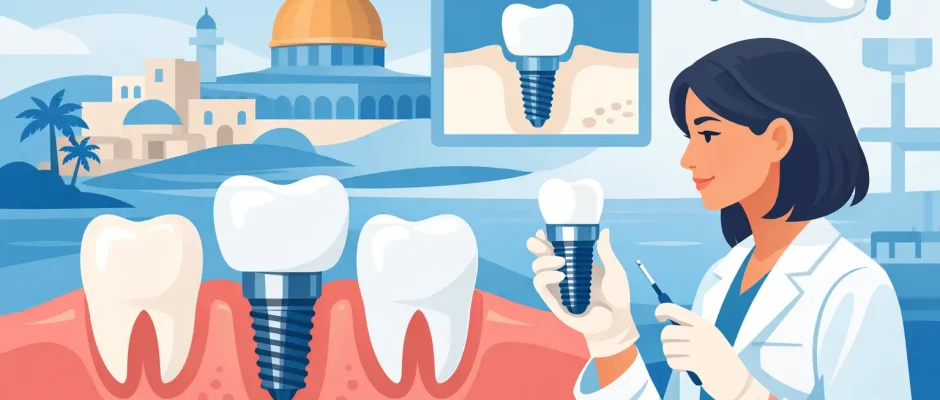
Most patients are not only asking about the implant itself. They want to know how the process actually feels, how many visits it takes, whether bone loss changes the plan, and how predictable the result is. That is exactly what people mean when they search for как проходит имплантация зубов в Израиле – not a marketing promise, but a clear medical pathway from diagnosis to function.
In Israel, implant treatment is typically organized around precision planning, strict surgical protocols, and a strong emphasis on safety. That matters because implant success is not defined by placing a titanium fixture into bone. It is defined by choosing the right indication, preparing the tissues correctly, placing the implant in a prosthetically driven position, and managing healing without unnecessary trauma.
How как проходит имплантация зубов в Израиле in real practice
The process begins before surgery. A proper implant case starts with consultation, clinical examination, and 3D imaging, usually CBCT. This stage determines whether the case is straightforward or complex. A single missing tooth with preserved bone is very different from a long-standing extraction site with significant atrophy, sinus pneumatization, gum recession, or chronic infection.
At the planning stage, the surgeon evaluates bone volume, bone quality, bite relationships, soft tissue condition, adjacent teeth, and general health factors such as diabetes, smoking, periodontal history, and medications. If needed, digital planning is used to position the implant according to the future crown, not just according to the available bone. In many cases, a surgical guide helps transfer that plan accurately into the mouth.
For patients, this is often the moment when anxiety decreases. Instead of hearing a vague statement like “we will see during surgery,” they receive a structured treatment plan with timing, stages, and realistic alternatives.
The diagnostic stage: what determines the plan
Implant treatment in Israel often follows a protocol-based approach. That means the surgeon first answers several practical questions. Is the tooth already missing, or does it need extraction? Is there enough bone for immediate implant placement? Will bone grafting be required? Can a temporary tooth be placed right away, or is delayed restoration safer?
This is where experience matters. The shortest plan is not always the best one. In some cases, immediate implantation after extraction is an excellent option because it reduces treatment time and helps preserve tissues. In other cases, especially with active infection, thin bone walls, or unfavorable soft tissue conditions, delaying the implant may provide a more stable long-term result.
A careful surgeon explains these trade-offs clearly. Faster is attractive, but predictability comes first.
When extraction and implant can be done together
If the tooth is non-restorable but the socket walls are reasonably preserved, extraction and implant placement may sometimes be performed in one appointment. This is called immediate implantation. It can be combined with bone graft material, membrane techniques, and PRF to support healing and reduce tissue collapse.
The main advantage is efficiency. The main limitation is that not every site is suitable. Immediate placement requires enough primary stability and favorable anatomy. If those conditions are not present, trying to force a one-stage solution may increase risk.
When bone grafting is part of the treatment
Many adults who have been missing teeth for years no longer have enough bone for ideal implant placement. That does not automatically make treatment impossible. It means the plan becomes more technical.
Depending on the area, the surgeon may recommend guided bone regeneration, ridge augmentation, socket preservation, or sinus lift procedures. In the upper posterior jaw, sinus augmentation is common because the sinus often expands after tooth loss, reducing available bone height. In other areas, horizontal or vertical augmentation may be needed to rebuild a stable foundation.
This adds time and cost, but it often improves implant position and long-term esthetics. Patients should understand that bone grafting is not an “extra.” In the right case, it is part of doing the job correctly.
The surgery itself: what happens on the day
The surgical appointment is usually much more controlled than patients expect. Local anesthesia is the standard. In selected cases, additional sedation options may be discussed depending on the clinical setting and patient anxiety.
Once anesthesia is effective, the surgeon prepares the site according to the digital or clinical plan. If a guide is used, it helps control angulation, depth, and position. The implant is then inserted into the prepared bone bed with attention to primary stability. If the case requires it, simultaneous grafting or soft tissue management is performed.
In straightforward cases, surgery can be relatively quick. More complex cases involving extraction, socket debridement, grafting, sinus lift, or multiple implants naturally take longer. Duration alone does not say much about quality. What matters more is atraumatic technique, tissue handling, sterility, and adherence to protocol.
After placement, the implant may be covered under the gum for submerged healing or fitted with a healing abutment that shapes the soft tissue during recovery. Which option is chosen depends on implant stability, bite forces, esthetic demands, and the overall treatment plan.
Healing after implant placement
Healing occurs in two parallel ways. The first is soft tissue recovery in the first days and weeks after surgery. The second is osseointegration, the biological process in which bone bonds to the implant surface over a period of weeks to months.
Mild swelling, soreness, and limited discomfort are common after surgery, especially if extraction or grafting was involved. Significant uncontrolled pain is not expected in a properly managed case. Patients usually receive detailed instructions about hygiene, diet, medications, and follow-up.
The timeline depends on the procedure. A straightforward implant in a healed site may be ready for restoration relatively quickly. A complex case with major grafting may require a longer integration period before the final prosthetic phase. This is one of the areas where patients benefit from realistic expectations. Rushing the restoration phase can compromise the result.
Can you leave with teeth the same day?
Sometimes yes, but this needs careful qualification. Immediate temporary teeth are possible in selected cases, especially full-arch concepts such as All-on-4 or some single-tooth situations with strong primary stability and controlled bite conditions.
The key point is that “same day teeth” does not mean the biological healing is finished. It means a temporary restoration may be placed while integration is still ongoing. For some patients this is very useful functionally and emotionally. For others, especially those with parafunction, unstable bite, or poor bone quality, a delayed loading protocol is safer.
The prosthetic phase: where function and esthetics come together
An implant is only one part of treatment. The final crown, bridge, or full-arch prosthesis determines how the patient chews, speaks, and cleans around the restoration. That is why a good implant result depends on surgical and prosthetic planning together.
Once integration is confirmed, impressions or digital scans are taken. The restoration is then fabricated with attention to bite, contact points, emergence profile, and cleansability. In esthetic areas, soft tissue contour is especially important. Even a well-integrated implant can look unnatural if the gum architecture is not managed properly.
This stage should not feel like an afterthought. The most predictable cases are planned backward from the final prosthetic goal.
What makes implant treatment in Israel attractive to patients
For many patients, Israel stands out because implant dentistry is often highly technology-driven and closely integrated with surgical disciplines. Complex cases that involve extractions, bone deficiency, sinus augmentation, or soft tissue reconstruction can be managed within a structured surgical framework rather than as isolated procedures.
That said, the quality of care depends far more on the clinician and protocol than on geography alone. Patients should look for clear diagnostics, transparent staging, experience with complex anatomy, and a willingness to explain why a particular treatment sequence is recommended. If the explanation sounds oversimplified, caution is reasonable.
This is also why a personal consultation matters. Two patients with the same missing tooth may need very different solutions.
Cost, timing, and what patients should ask
Implant pricing varies because cases vary. A single implant in a healed site is not comparable to extraction with immediate placement, bone grafting, membrane use, PRF, temporary restoration, and final crown fabrication. Patients should ask what is included at each stage, how many visits are expected, and whether additional regenerative procedures are likely.
Timing also depends on biology. Some cases can move efficiently from diagnosis to surgery to restoration. Others require staged treatment to improve safety and predictability. The honest answer to “How long will this take?” is often: it depends on the condition of your bone and soft tissues, the presence of infection, and whether immediate loading is appropriate.
For patients seeking care in Tel Aviv, a clinic such as Implantolog.co.il may be chosen not simply for implant placement, but for a complete surgical pathway – diagnostics, atraumatic extraction when needed, bone reconstruction, guided placement, and follow-up under one treatment philosophy.
The right implant plan should leave you with fewer unknowns, not more. If your consultation ends with a clear sequence, realistic timing, and an explanation that makes clinical sense, you are usually in the right place to move forward calmly.


Comments (0)