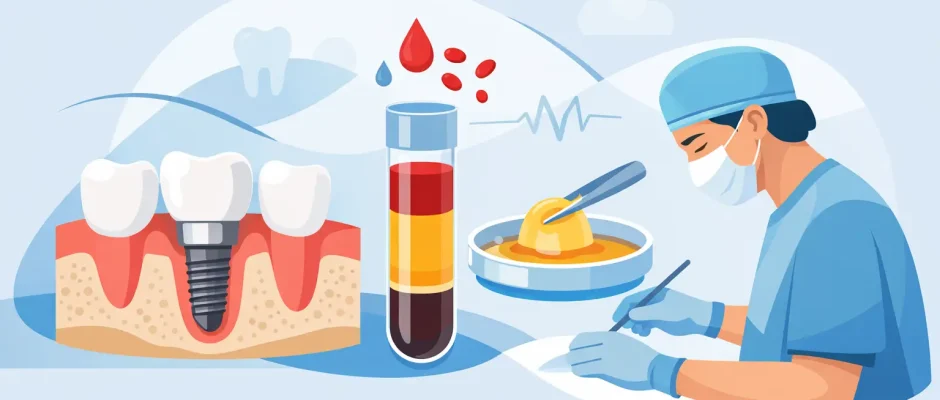
Patients often ask about PRF after hearing that “your own blood can help healing.” That description is not wrong, but it is too simple to be useful when you are deciding on implant surgery. What matters is not the slogan. What matters is where PRF actually helps, where it does not replace other techniques, and how it fits into a predictable surgical plan.
In implant dentistry, PRF is best understood as an adjunct, not a shortcut. It can improve the biological environment around a surgical site, support soft tissue healing, and be especially useful when extractions, bone grafting, sinus lift procedures, or immediate implant placement are involved. But it is only one part of the protocol. Good diagnostics, careful case selection, atraumatic surgery, and stable implant positioning still decide the result.
What PRF means in implant treatment
PRF stands for platelet-rich fibrin. It is produced from a small sample of the patient’s own blood, processed in a centrifuge according to a specific protocol. The result is a fibrin matrix that contains platelets, leukocytes, and growth factors.
For the patient, the practical meaning is straightforward. PRF is an autologous material, which means it comes from your own body. It is often used during oral surgery to support tissue repair and to improve handling of grafted areas. In many implant procedures, PRF can be prepared chairside within minutes and added immediately to the surgical workflow.
That said, PRF is not a magic membrane and not a substitute for bone. If there is a true lack of bone volume, a patient may still need guided bone regeneration, a sinus augmentation, a connective tissue procedure, or a staged treatment plan. PRF can support those procedures. It does not eliminate the biological limits of the case.
How PRF in dental implant surgery is used
The role of PRF depends on the clinical scenario. In a straightforward implant placed into a healed site with good bone and thick soft tissue, its contribution may be modest. In more demanding situations, the value becomes more obvious.
After tooth extraction, PRF can be placed into the socket to support clot stability and early soft tissue closure. In immediate implant placement, it may be used around the implant or combined with graft material when there is a residual gap between the implant and socket walls. In guided bone regeneration, PRF is sometimes mixed with particulate bone graft to improve handling and create a more cohesive graft mass.
In sinus lift surgery, PRF may be used to support the Schneiderian membrane and the grafted compartment. In soft tissue management, PRF membranes can be placed under the flap to encourage more favorable healing. This is particularly relevant when the goal is not only osseointegration, but also stable gum contours around the final restoration.
From a surgical perspective, PRF is attractive because it is simple, biocompatible, and integrated into the procedure without adding foreign biologic agents. From a patient perspective, the main interest is usually reduced swelling, improved comfort, and better tissue healing. Those are reasonable expectations, but they should be presented honestly. Some patients notice a clear difference. Others experience a more subtle benefit.
What benefits patients can realistically expect
The strongest argument for PRF is biological support during healing. It may help the early phases of tissue repair by releasing growth factors over time within the fibrin network. Clinically, this can translate into better soft tissue quality, more stable clot formation, and improved management of extraction or grafted sites.
Many surgeons also use PRF because postoperative recovery can be more comfortable, especially in extraction sites, wisdom tooth surgery, and implant procedures combined with grafting. Less swelling and improved soft tissue closure are common goals. However, recovery is always multifactorial. Surgical technique, duration of surgery, flap design, infection control, and patient factors such as smoking or systemic disease all influence healing.
This is why PRF should never be marketed as a guarantee. It can support biology. It cannot compensate for poor oral hygiene, uncontrolled diabetes, traumatic surgery, or an unstable implant position.
PRF in dental implant surgery and bone grafting
This is one of the most relevant areas to discuss in detail, because many implant patients are not dealing with a simple one-step case. They may have bone loss after a long-missing tooth, infection around a failing tooth, or sinus expansion in the upper jaw that limits implant placement.
When bone augmentation is needed, the surgeon must create conditions where graft material remains stable, protected, and well integrated into the healing site. PRF can help by improving graft handling and by supporting the soft tissue side of healing. When mixed with particulate graft, it can create a more cohesive material that is easier to place precisely. That matters in narrow defects and in contour augmentation.
But there is an important limitation. PRF is not a structural graft. It does not maintain space the way mineralized graft material, cortical support, tenting methods, or rigid membranes can. If the defect is large or the bone deficiency is three-dimensional, the treatment plan still depends on proven regenerative principles. In those cases, PRF is useful because it complements the reconstruction, not because it replaces it.
This distinction is especially important in advanced implantology. Patients with severe atrophy often search for “less invasive” solutions and may assume biologic additives can avoid grafting. Sometimes treatment can indeed be simplified with a well-designed implant strategy. Sometimes it cannot. A responsible surgeon explains that difference before surgery, not after.
Who may benefit most from PRF
PRF is often most helpful in cases where healing support matters more than speed alone. That includes immediate implants after extraction, sites with thin soft tissue, combined implant and grafting procedures, sinus lifts, and patients who want a more biologically supportive protocol.
It can also be valuable when the treatment goal includes preserving or rebuilding the gum architecture around the implant, especially in visible areas. In the esthetic zone, small differences in soft tissue healing can affect the final appearance.
On the other hand, a very simple implant case in excellent bone may not change dramatically because PRF was added. That does not make its use wrong. It simply means the magnitude of benefit depends on the starting conditions.
Patients should also understand that not every person is an ideal candidate for every blood-derived protocol. The quality of the fibrin clot and platelet component can be influenced by general health, medications, and protocol details. This is one reason PRF should be part of a disciplined surgical workflow rather than an optional marketing add-on.
Does PRF make implant surgery safer?
PRF can make the healing environment more favorable, but safety in implant surgery begins much earlier. It begins with diagnosis, imaging, surgical planning, and knowing when not to place an implant immediately.
A safe implant procedure requires evaluation of bone volume, soft tissue conditions, bite forces, neighboring anatomy, and the reason the tooth was lost in the first place. If a site had chronic infection, root fracture, periodontal destruction, or severe bone loss, the protocol must be adapted accordingly. PRF may improve the local biology, but it does not erase these risks.
This is where experience matters. The value of PRF is highest when it is used as part of a coherent treatment plan that includes CBCT-based assessment, precise implant positioning, atraumatic extraction when needed, tension-free closure, and careful follow-up. In complex cases, combining microsurgical technique with digital planning often contributes more to predictability than any single adjunct on its own.
Common misconceptions about PRF
One common misunderstanding is that PRF “speeds up osseointegration” in a way that changes the entire implant timeline. In reality, implant integration still follows biological rules. Loading decisions depend on implant stability, bone quality, insertion torque, prosthetic design, and risk factors. PRF may support healing, but it does not justify rushing a case that needs time.
Another misconception is that PRF can replace membranes or grafts in every regeneration procedure. In smaller defects, it may reduce the amount of additional material needed or improve the handling of the site. In larger defects, it is an adjunct, not a substitute.
Patients also sometimes assume that because PRF is natural, it is automatically necessary. Not always. Good surgery is not about adding every available tool. It is about choosing the tools that fit the defect, the anatomy, and the treatment objective.
If you are considering implant treatment and PRF has been mentioned in your plan, the right question is not whether it is “good.” The right question is what specific role it will play in your case – socket preservation, graft support, soft tissue healing, sinus augmentation, or postoperative comfort. A clear answer usually tells you a lot about the quality of the planning.
When implant surgery is performed with careful diagnostics, precise technique, and a biologically sound protocol, PRF can be a valuable part of making treatment more comfortable and healing more predictable. If you want that conversation in practical, case-specific terms, that is exactly how we approach it at Implantolog.co.il.


Comments (0)