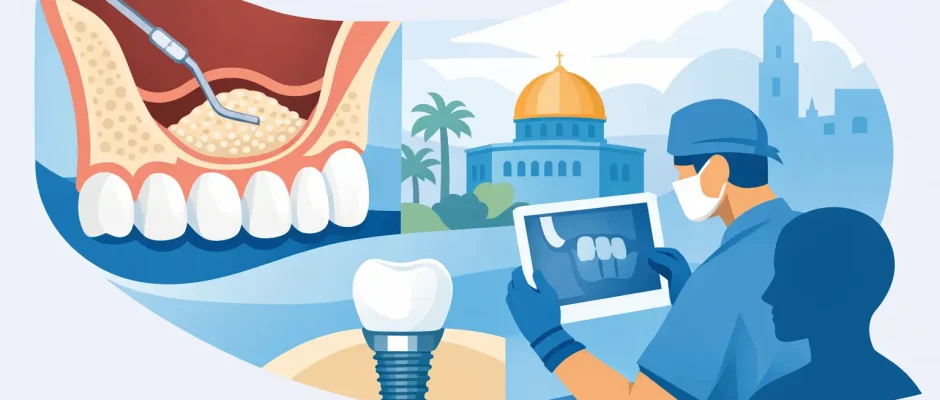
If you’ve been told you need a sinus lift before getting an implant, the real question isn’t whether the procedure sounds scary. The question is whether there is enough bone in the back of the upper jaw for safe and predictable implant placement. This is where the topic of sinus lift Israel becomes practical for patients – not as an abstract surgical term, but as a decision that impacts implant stability, long-term function and the overall treatment plan.
Many patients experience this problem after many years of missing upper molars or premolars. After tooth loss, the bone in this area begins to shrink. In the upper jaw, the maxillary sinus also tends to expand downwards over time. The result is simple: vertical bone may not be sufficient to securely hold the implant. A sinus lift is a bone augmentation procedure designed to create the volume necessary to place an implant in that area.
Sinus lift in Israel – what the procedure actually solves
A sinus lift is not a routine addition and is not something that every implant patient needs. It is used when the height of the remaining bone under the sinus is not sufficient for stable placement of the implant in the posterior part of the upper jaw. In practical terms, this usually affects the area of the upper premolars and molars.
The goal is to gently lift the sinus membrane and place the graft underneath, creating space for new bone to form. Over time, this area develops into a more suitable base for implants. In some cases, an implant can be placed during the same surgery. In other cases, it is safer to carry out the treatment in stages and install the implant after healing.
This distinction matters. The appropriate treatment plan depends on the anatomy, residual bone height, sinus status, bite stress, implant position, and overall restoration goal. A patient who requires a single implant in the upper first molar area is not planned in the same way as someone who is preparing for a larger reconstruction.
When is a sinus lift necessary before implantation?
The need for a sinus lift is usually determined after a clinical examination and 3D imaging, most often using CBCT. A regular dental x-ray can indicate a problem, but it does not provide the same information about bone height, sinus anatomy, septa, membrane condition, or the exact trajectory of the implant.
The most common reasons why a sinus lift is recommended are that upper back teeth have been missing for a long time, significant bone loss after extraction, naturally large sinuses, or previous failed implant attempts in an area with limited bone. Sometimes the bone appears acceptable at first glance, but is still not sufficient for the length and position of the implant needed for a long-lasting result.
This is where oversimplified promises can be misleading. Not every case can be solved with a short implant, and not every bone deficiency requires aggressive grafting. The right choice depends on the case. Good planning is often less about doing more operations and more about doing precise operations that produce a predictable outcome.
Types of sinus lift and why technique is important
There are two main approaches: the crestal approach andapproach through the side window. They are not interchangeable, and the choice depends on the bones available and surgical goals.
Crestal sinus lift
The crestal approach is usually used when a moderate amount of native bone is still present and only limited vertical growth is required. Access is through the implant site, and the sinus floor is elevated in a more conservative manner. This may be less invasive and in some cases may allow simultaneous implant placement.
Lateral window sinus lift
The lateral approach is used when the bone deficiency is more significant. A small window is created in the lateral wall of the upper jaw, the membrane is carefully lifted and the graft is placed under it. This method provides better visibility and control in more complex cases.
In experienced hands, both methods can work well. The real difference lies in case selection, membrane handling, soft tissue management, and the ability to plan implant placement in three dimensions rather than simply adding bone where possible.
Sinus lift in Israel – what patients can expect
For patients considering a sinus lift in Israel, the standard should be a diagnostic-based process rather than a one-size-fits-all protocol. A proper consultation should provide clear answers to several questions: Do you really need a sinus lift? Can an implant be installed at the same time? Which grafting method is appropriate? How long will it take to heal? What are the alternatives
A well-managed surgical process usually begins with CBCT-based clinical assessment and planning. If the anatomy is appropriate, treatment can often be arranged to minimize surprises on the day of surgery. More advanced practices use digital planning and surgical protocols to improve accuracy and reduce variability.
Patient comfort is as important as technical performance. Local anesthesia is standard and the procedure is usually well tolerated. Most patients are surprised that the discomfort is easier to manage than they expected. Swelling and pressure may occur, but severe pain is not normal as long as surgery is performed carefully and post-operative instructions are followed.
Recovery and healing time
Recovery from sinus lift surgery depends on the technique used, the degree of augmentation, and whether implants were placed at the same time. Swelling, pressure, and mild to moderate soreness are common in the first few days. Bruising may occur, especially after a lateral approach. Most patients return to daily activities fairly quickly, but they still need to protect the surgical site.
Often it is not the first week that is most important, but the biological healing phase. Bone maturation takes time. If the implant is placed simultaneously, follow-up focuses on both graft integration and implant stability. If the surgery is staged, implant placement may be scheduled several months later, depending on the amount of augmentation and the quality of healing.
Patients also need to understand the practical limitations. Avoid vigorous nose blowing, closed-mouth sneezing, smoking, and anything that significantly increases sinus pressure during the early healing period. These instructions are not cosmetic. They directly affect graft stability and membrane healing.
Risks, limitations and fair compromises
Sinus lift surgery has a track record of success, but it is still surgery. The most common intraoperative complication is perforation of the sinus membrane. Small perforations can often be successfully repaired during the procedure, but larger ones may require a change in plan. This is one reason why a surgeon’s experience has a very specific meaning.
Other considerations include infection, graft failure, delayed healing, sinus-related symptoms, or insufficient bone formation. Pre-existing sinus disease, smoking, uncontrolled systemic disease, and poor oral hygiene may increase risk or decrease predictability.
There is also an important trade-off between speed and biosecurity. Some patients strongly prefer immediate implant placement because it reduces treatment time. In the right case, this makes perfect sense. Done wrong, it creates unnecessary risk. A careful surgeon does not force a same-day solution if the anatomy does not support it.
What makes treatment planning more predictable?
Predictability in sinus surgery rarely depends on one product or one material. It’s about the entire protocol. Accurate visualization, atraumatic technique, appropriate graft selection, tension-free closure, infection control, and structured follow-up all make a difference.
In modern implant surgery, digital planning can improve accuracy, especially when a sinus lift is part of a broader restoration plan. In some cases, additivesfor example, PRFcan be used to support soft tissue healing and surgical interventions. These tools are not a substitute for judgment, but can improve control when used correctly.
For patients who value both experience and clarity, the consultation needs to be specific. You should leave an understanding of what will be done, why it is necessary, what the time frame is, and where the uncertainties are. This transparency reduces anxiety because it replaces vague reassurances with a concrete plan.
If you are evaluating treatment options, it is reasonable to ask how many similar cases the surgeon handles, whether CBCT-based planning is routinely used, and under what conditions a sinus lift and implant are combined. With a site like Implantolog.co.il, the wait for clinical details is not excessive – this is what helps patients make a calmer and more informed decision.
A sinus lift should never be presented as a radical procedure, but it should not be minimized either. When specified, properly planned and executed withmicrosurgical discipline, it can transform a marginal implantation site into a stable and repairable one. For many patients, this is the difference between compromising treatment and building it on a foundation that has a real chance of lasting.


Comments (0)