A millimeter can decide whether an implant is stable, esthetic, and long-lasting – or whether treatment becomes more complicated than it needed to be.
That is why many patients ask about guided implant surgery after they hear terms like CBCT, digital planning, or 3D-printed template. The question behind all of those terms is simple: does a surgical guide actually make implant treatment safer and more predictable?
In many cases, yes. But not in every case, and not in the same way for every patient.
What is a surgical guide for dental implants?
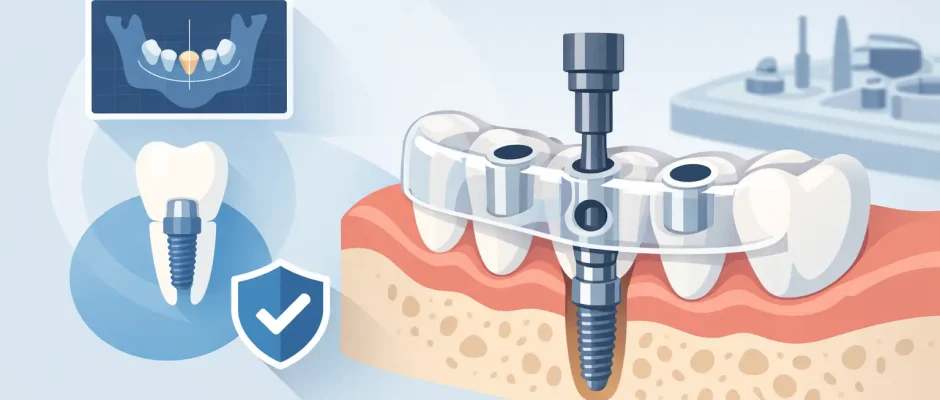
A surgical guide for dental implants is a custom-made template used during implant placement. It is designed from your digital scans so the implant can be placed at the planned angle, depth, and position.
In practical terms, the guide translates the virtual treatment plan into the mouth during surgery. Instead of relying only on visual judgment and hand positioning, the surgeon works through a planned pathway that reflects the anatomy seen on the scan.
This matters because implant placement is not just about putting a titanium fixture into bone. The implant must relate correctly to the future crown, the neighboring teeth, the bite, the available bone volume, and important anatomic structures such as the maxillary sinus or the inferior alveolar nerve. A well-made guide helps align all of these factors before surgery even starts.
How the planning process works
Guided implant surgery begins long before the appointment itself. First, the patient undergoes clinical examination and imaging, often including a CBCT scan. If needed, an intraoral scan or a digital model is added. These records allow the surgeon to assess bone dimensions, soft tissue conditions, prosthetic space, and the position of nearby structures.
Then the implant is planned virtually. This is one of the most important points patients often miss: the value is not only in the plastic guide. The real value is in the planning discipline behind it. The surgeon chooses implant diameter, length, angulation, and position based on both surgical and restorative goals.
Once the plan is approved, the guide is fabricated – usually by 3D printing – and sterilized for surgery. During the procedure, the guide is seated on the teeth, mucosa, or bone, depending on the case. The drilling sequence is performed through metal or reinforced sleeves, helping the surgeon follow the planned trajectory.
When the workflow is done correctly, it reduces guesswork. It does not replace surgical skill. It makes skilled surgery more controlled.
Why patients ask for guided surgery
Most patients are not interested in digital dentistry for its own sake. They want three things: safety, comfort, and a predictable result.
A surgical guide can support all three.
From a safety standpoint, guided planning helps the surgeon evaluate the available bone and avoid critical structures more precisely. This is especially relevant in the posterior mandible, where the nerve canal must be respected, and in the upper jaw, where sinus anatomy may limit implant position.
From a comfort standpoint, guided surgery can sometimes make the procedure less invasive. In selected cases, flapless or minimally invasive implant placement is possible, which may reduce swelling, operative time, and postoperative discomfort. That said, flapless is not automatically better. If visibility is compromised or bone augmentation is needed, opening the site may still be the safer option.
From a predictability standpoint, the guide helps place the implant where the final tooth should be, not simply where bone appears easiest to access. This is particularly important in the esthetic zone, where even small positional errors can affect gum symmetry, crown emergence, and the overall appearance of the smile.
When a surgical guide for dental implants is most useful
Not every implant case needs the same level of guidance, but there are scenarios where a surgical guide is especially valuable.
One is immediate implant placement after extraction. In these cases, the implant often needs to engage the remaining native bone beyond the socket while also being positioned correctly for the future restoration. The anatomy can be less forgiving than it looks clinically.
Another is limited bone volume. When bone is narrow, angled, or reduced by long-term tooth loss, there is less room for error. The guide helps maximize the available anatomy while respecting safety margins.
Full-arch treatment such as All-on-4 or similar concepts is another area where digital planning is highly useful. Implant angulation, multi-unit prosthetic design, and the relationship between implants all need to be coordinated carefully. In these cases, precision affects not only surgery but the entire restorative workflow.
The esthetic zone is also a classic indication. An implant that is only slightly too facial, too deep, or too angled can create visible problems later. A guide can improve control where esthetic demands are high.
Finally, guided surgery can be helpful in complex revision cases, where old implants, bone grafts, sinus anatomy, or prior extractions have changed the normal landmarks.
What a guide can and cannot do
This is where realistic expectations matter.
A surgical guide improves execution of a good plan. It does not rescue a poor plan, poor imaging, poor case selection, or poor surgical judgment. If the records are inaccurate or the guide does not seat properly, the entire chain is affected.
It also does not eliminate biological variables. Bone density can differ from what was expected. Extraction sockets may behave differently once the tooth is removed. Soft tissue quality, inflammation, and hidden defects can change the intraoperative picture.
For that reason, experienced surgeons do not treat guided surgery as autopilot. They use it as a tool within a broader surgical protocol. Sometimes the guide is followed exactly. Sometimes the plan must be adjusted during surgery because the real anatomy demands it.
That is not a failure of the method. It is responsible surgery.
Is freehand implant placement outdated?
No. Freehand implant placement is still appropriate in many cases when performed by an experienced implant surgeon. In straightforward situations with good visibility, sufficient bone, and clear landmarks, freehand placement can be accurate and efficient.
The better question is not guided versus freehand as if one is universally superior. The better question is which method offers the most control in your specific anatomy and treatment plan.
A skilled surgeon should be comfortable with both. Digital protocols are powerful, but experience remains essential, especially when the case becomes more complex than expected. If bone grafting, sinus work, soft tissue management, or immediate provisionalization are involved, the decision is never purely technical. It is clinical.
Are there downsides?
There can be.
Guided surgery adds planning time, imaging requirements, and laboratory or printing costs. In simple cases, that extra step may not always provide meaningful benefit.
There are also technical limitations. A guide needs stable seating. If support is poor, mouth opening is limited, or access is restricted in the posterior region, using the guide can become less practical. Metal sleeves and guided drills also require space, which is not always abundant.
Another trade-off is that some clinicians may over-rely on the template and pay less attention to tactile feedback. That is a mistake. Implant surgery still requires active assessment of bone resistance, primary stability, and real-time surgical conditions.
The right use of a guide is selective and purposeful, not automatic.
What patients should ask before treatment
If your surgeon recommends a surgical guide for dental implants, it is reasonable to ask how it changes your case specifically. Not in general terms, but in your anatomy, your bone condition, and your restorative plan.
Ask whether the guide is being used to improve implant positioning for esthetics, to protect important structures, to support immediate placement, or to coordinate a more complex full-arch or grafting case. The answer should be clear.
It is also worth asking what happens if the guide does not fit as expected or if the anatomy during surgery differs from the digital plan. A confident surgeon plans for both possibilities.
In a practice focused on digital planning and microsurgical precision, such as Implantolog.co.il, the point of guided surgery is not marketing language. It is to make treatment calmer, safer, and more predictable when the case truly benefits from it.
The real value is not the template
Patients often focus on the visible part – the guide itself. Clinically, the real advantage is deeper than that.
A surgical guide reflects a treatment philosophy: plan first, measure carefully, respect anatomy, and place the implant where the final restoration will function best over time. That approach tends to reduce surprises, which is exactly what most patients want before surgery.
If a guide is recommended for your case, the key question is not whether the technology sounds advanced. The key question is whether it helps your surgeon deliver a safer and more predictable result with less compromise. When the answer is yes, even a small piece of printed material can make a very meaningful difference.


Comments (0)