Choosing a clinic for implantation does not start with looking at photographs of smiles.
It’s worth starting with a more practical question: what is the safest and most predictable method of installing a titanium root into living bone, taking into account your anatomy, health history and the amount of bone you currently have.
Therefore, “dental implantation in Israel” is not just one service. In Israel, the difference between an average and an excellent result is most often determined by diagnosis, surgical planning and how the surgeon manages difficult cases: thin bone, past infections, old extractions, proximity of a sinus, gum recession or a bite that has compensated for missing teeth for years.
Why patients choose dental implantation in Israel
For many patients, Israel is attractive for two factors that are important for surgery: a strong medical culture and a high level of diagnostics. CBCT (3D imaging), digital planning and modern anesthesia protocols are widely used here. This in itself does not guarantee correct treatment, but it does reduce that “guessing” approach that people fear.
The second reason is access to complex protocols. When there is little bone or time is important, proven options are more often offered: immediate implantation after removal, directed bone regeneration, sinus lift, complete restoration of the jaw according to the All-on-4 type. The downside is that complex protocols require more experience and careful observation. A mistake in planning can cost you months later.
Implantation Basics – in Clinical Terms
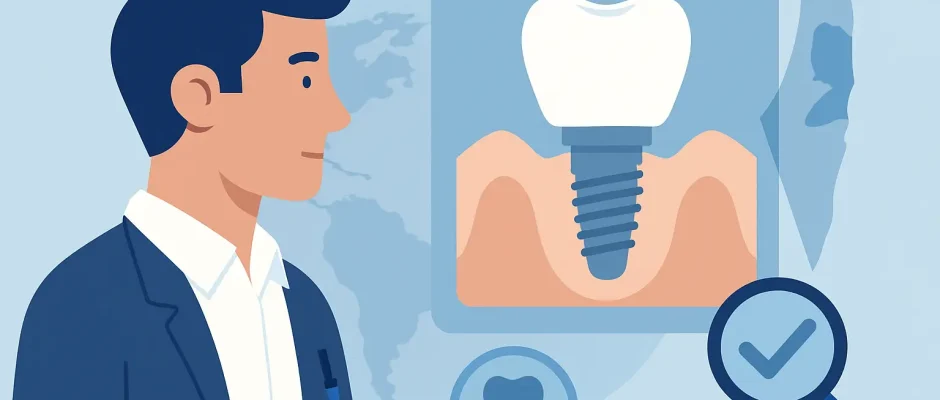
A dental implant is a titanium (or titanium alloy) rod that is installed in the jaw bone; it fuses with the bone during healing. After osseointegration, the abutment and crown restore function and esthetics.
Patients often underestimate: an implant is not “just a screw.” This is a surgical intervention in a biologically active area, near nerves, sinuses and adjacent roots. Position is measured in millimeters, and the condition of the soft tissue is as important as the bones. Therefore, the plan is the treatment, and the implant is just one of its elements.
Who is suitable for implants – and when is it ambiguous?
Most adults may be candidates for implantation, but “they can” and “they are indicated for it” are different things.
With good general health, controlled chronic diseases, stable oral hygiene and sufficient bone volume, treatment usually follows a standard scenario.
Everything changes when there are factors that influence healing and risks: smoking, uncontrolled diabetes, certain medications for osteoporosis, a history of aggressive periodontitis, bruxism (night grinding), untreated gum disease. None of these factors by itself precludes implantation, but requires a thoughtful plan – sometimes a staged operation, sometimes additional hygienic therapy, sometimes a different prosthetic design to reduce overload.
Age itself is rarely a limitation. What is more important is the quality of the bone, general health and the ability to come for control.
Diagnostic step that protects you
High-quality preparation for implantation should clearly answer four questions.
First: is the tooth (or root) really unsalvageable? Sometimes an implant is suggested, although a microsurgical option with preservation of the tooth is possible.
Second: where is the bone located and what quality is it? This is why CBCT is important. A conventional 2D image cannot reliably assess the thickness of the vestibular plate, the anatomy of the sinus, or the exact position of the nerve.
Third: what will the final crown look like and where should the implant be placed to support it? This is called a prosthetic-oriented installation. Implants placed without a restoration plan may take root but look incorrect, cause food retention, or force compromises in hygiene.
Fourth: what is the risk profile – history of infections, periodontal condition, occlusal loads, aesthetic expectations.
When these responses are recorded, anxiety usually decreases. The unknown turns into a plan with steps.
Surgical planning in Israel – digital, templated, predictable
Digital protocols are not marketing. When used correctly, they reduce variability.
CBCT and intraoral scanning are often combined. From this basis, the surgeon plans the implant position in 3D and can use a surgical template to transfer the plan into the oral cavity.
Guided surgery is not necessary in every case. In experienced hands, a free-flowing installation can be excellent. But in anatomically risky areas, narrow ridges, or immediate implantation plans, the template adds safety and precision—and often reduces surgical time, which patients experience as comfort.
Immediate and delayed implantation – what’s the difference?
Patients like the formulation “implant in one day.” In a clinical sense, immediate implant placement is the placement of an implant at the same appointment as the tooth extraction. This can be a very good protocol, but only if the indications are followed.
Immediate implantation can preserve tissue contour and reduce overall treatment time, as well as reduce the number of surgical visits.
The downside: removal must be atraumatic and infection control must be strict. If the walls of the socket are thin or destroyed, or there is active purulent inflammation, the surgeon may require bone grafting and a staged approach. Immediate placement of unsuitable anatomy increases the risk of recession, aesthetic problems, or rejection.
Delayed implantation (8 to 12 weeks or more after removal) may be safer when there is significant infection or when soft tissue healing is needed first. In some cases, a step-by-step plan will result in a more stable and aesthetically pleasing gum line.
What to do when bones are not enough
Bone deficiency is common, especially if a tooth has been missing for years. In the upper jaw, the sinus may expand (pneumatization). At the bottom, the ridge narrows, and the nerve limits the depth.
This does not automatically mean “implants are not possible.” This means you need a dice strategy.
A sinus lift (internal or lateral) is used to increase the height of the bone in the posterior part of the upper jaw. Guided bone regeneration (GBR) – membranes and osteoplastic materials to fill the defect. Ridge augmentation widens a narrow jaw. These techniques are technique sensitive: flap design, tension-free closure, membrane stabilization, infection prevention, and patient compliance are important.
Many surgeons in Israel also use biological supplements, such as PRF (platelet-rich fibrin). PRF may improve soft tissue healing and reduce postoperative discomfort. It’s not magic, but it can be a useful part of a thoughtful protocol.
Full restoration according to the All-on-4 type – who is suitable for it?
All-on-4 is a protocol in which the entire jaw is supported by four implants, often with an immediate fixed design. This can radically change your life if you have damaged teeth, severe periodontitis, or multiple missing teeth.
This is not a “cheap pass.” The success of All-on-4 depends on accurate implant placement, primary stability, bite control and a well-manufactured prosthesis. The temporary bridge must be designed to protect the implants during the healing period. Permanent prosthesis – taking into account access for hygiene and long-term maintenance.
For some patients, it is more advisable to install more than four implants or perform bone grafting at the first stage. The right plan is the one that suits your anatomy, expectations and ability to maintain hygiene.
Timing – what to expect in practice
One implant with a crown in a typical case – from surgery to a permanent crown it can take 3-4 months, sometimes more.
If an immediate implant and an immediate temporary crown are possible, you can quickly walk away with an aesthetically pleasing temporary tooth, but the permanent crown is still placed after biological integration and tissue maturation.
With bone grafting or sinus lifting, the time frame can extend to 6–9 months or more. This is not a disadvantage – it is often the price of predictability.
If you are coming to Israel for treatment, it is important to plan your visits. Implantation is compatible with travel, but only with a logical schedule and supervision. A good clinic will tell you in advance which appointments are required in person, and which checks can be arranged remotely.
Pain, swelling and comfort issues
Most implant procedures are well tolerated under local anesthesia; Depending on the clinic, sedation is possible.
Discomfort after surgery is often associated with manipulation of soft tissue and bone, rather than with the implant itself. Guided surgery and microsurgical techniques reduce the trauma, but in some patients the body still reacts with swelling.
A clear plan for pain relief, cooling, nutrition and hygiene is not a “bonus”, but part of the prevention of complications. The first 7–10 days are the time when patient instructions are most important.
The cost of dental implantation in Israel – what does the price depend on?
People often ask for the price “for one implant.” From a clinical point of view, you are not buying a screw. You pay for diagnosis, planning, surgery, materials and responsibility for the result.
The cost depends on the implant system, the need for bone grafting or sinus lift, the use of guided surgery, the complexity of removal and the type of crown (material, aesthetic area requirements). The low quoted price may rise if it does not include plastics, membranes, temporary structures or surveillance.
It makes sense to discuss the cost after diagnostics: CBCT, examination andwritten planwith options.
How to choose a surgeon or clinic
A safe choice is usually visible in the way the plan is presented.
Important: clear diagnosis, written sequence of stages and discussion of alternatives. It makes sense to hear about risks in ordinary language – without intimidation and without vague reassurances. Ask how complications are managed, what the follow-up schedule looks like, and who performs each step.
Experience is most important in the “boring” parts: atraumatic removal, soft tissue work, stabilization of bone material, coordination with prosthetics. These details determine whether the implant will simply settle in or be truly functional and aesthetically pleasing for years to come.
If you are lookingsurgeon in Tel Aviv, which specializes in dental surgery and complex implantology cases with digital planning, templates, PRF and structured treatment plan, you can start withImplantolog.co.iland sign up for a consultation to sort out the pictures and options.
In conclusion – to make it calmer
When patients say they are afraid of implantation, they are rarely talking about the operation itself. This is the fear of making the wrong decision and staying with it.
A good implant plan does something very practical: fewer surprises. If the diagnosis is accurate, the steps are logical, and the surgeon confidently handles both simple and complex cases, your task is simple – follow the recommendations, come to the control and allow the body to do what it knows how to do: heal predictably when it is treated with respect.


Comments (0)