If there are no chewing teeth on the upper jaw for a long time, the bone in the lateral sections often becomes too thin for reliable implantation. In such a situation, the patient naturally raises the question of how the sinus lifting of the upper jaw goes, how traumatic it is and whether the procedure can be combined with the implant placement. The short answer is: this is a planned and well-predicted operation, if it is carried out according to indications, after an accurate diagnosis and withunderstandable surgical protocol.
What is sinus lift and why is it needed
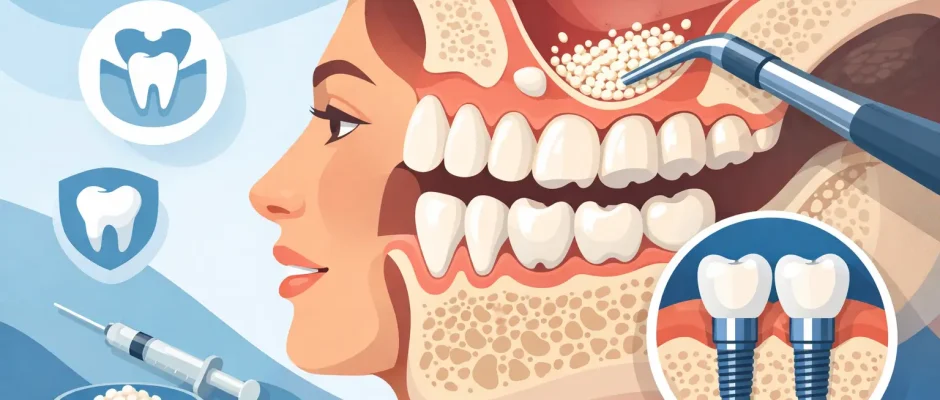
Sinus lifting is an operation to increase the volume of bone in the area of the upper chewing teeth. Above the roots of the premolars and molars is the maxillary sinus. When the tooth is removed a long time ago, the bone gradually decreases, and the bottom of the sinus drops lower. As a result, bone height may not be sufficient for stable implant placement.
The task of sinus lifting is to gently raise the mucous membrane of the sinus and create a space for bone-plastic material under it. Over time, this volume is rebuilt, and the support for the implant is formed. For the patient, this is not “sinus surgery” in the everyday sense, but dental bone grafting in a strictly limited anatomical area.
It is important to understand that sinus lifting is not necessary for everyone. If your own bone is sufficient, no additional intervention is required. Therefore, the decision is made not by eye image, but after computed tomography, evaluation of the height and width of the bone, the condition of the sinus and the general plan of implant treatment.
How does the sinus upper jaw lifting go in stages
For most patients, the most disturbing moment is not related to the operation itself, but to the unknown. When a person understands the sequence of steps, the level of stress is markedly reduced.
Diagnosis and planning
It all starts with a CT scan. According to the three-dimensional study, the doctor assesses the residual bone height, the anatomy of the maxillary sinus, the thickness of the lateral wall, the presence of partitions inside the sinus, the condition of the mucosa and the future position of the implant. At this stage, it becomes clear which protocol is better –closed or open sinus lift, and whether the implant can be inserted immediately.
If there are signs of inflammation in the sinus, pronounced thickening of the mucosa, acute ENT problems or an active periodontal process, these issues are first addressed. In upper jaw surgery, haste usually gives a worse result than competent preparation.
Anesthesia and access
The operation is performed under local anesthesia. The patient does not feel pain, but may feel pressure, vibration, and instrumentation. In case of increased anxiety, additional sedation options are discussed if they are available at the site of treatment and are suitable for the state of health.
After anesthesia, access to the bone in the area of future implantation is performed. Further actions depend on the selected equipment.
Closed sinus lift
This option is used when the bone deficiency is moderate and there is a chance to obtain good primary stability of the implant. The doctor forms a bed for the implant, delicately lifts the bottom of the sinus through it and inserts bone material. Often, an implant is placed at the same stage.
The advantage of closed equipment is less trauma. But it has limitations: if the bones are too small, it is not always wise to try to solve the problem minimally invasively.
Open sinus lift
If the bone is severely atrophied, open sinus lifting is more often chosen. A small bone window is created on the sidewall of the upper jaw, through which the doctor peels off the sinus membrane and lifts it up. A bone plastic material is placed under the membrane, forming a future volume.
In some cases, an implant is placed simultaneously. This is possible if the residual bone allows for sufficient stability. If the support is not enough, first a sinus lift is performed, waiting for tissue maturation, and only then proceed to implantation. There is no one-size-fits-all rule. The correct answer depends on the millimeters of bone, the quality of the tissue, and the load the implant will have to carry.
What the patient feels during and after surgery
There should be no pain during the procedure. Normal sensations are pressure sensations, bursting in the cheek area, tip operation and unusual sounds. This is often more frightening than the surgery itself, so the calm accompaniment of the doctor during the operation is no less important than the technique.
After the intervention, moderate swelling, a feeling of congestion in the sinus area, sometimes small bruises on the cheek usually appear. In the first days, there may be discomfort when the head is tilted forward. Some patients have a feeling similar to a mild cold, but without a pronounced deterioration in well-being. Pain is usually controlled by standard painkillers.
If the operation is performed carefully, and the patient complies with the recommendations, the recovery is calm. The most noticeable edema usually occurs on 2-3 days, then decreases.
How long does healing take
Soft tissues heal relatively quickly – within 1-2 weeks. But sinus lifting is assessed not by the seams, but by how the bone volume matures. It takes more time.
If the implant is installed at the same time and its stability was good, further timing depends on the clinical situation. If only bone grafting is done first, it is usually several months before implantation. The exact interval is determined from the control images and the initial deficit volume. The desire to reduce deadlines is understandable, but in this area, excessive haste can put the long-term result at risk.
What materials and technologies affect the forecast
For the patient, not only the fact of the operation is important, but also how it is performed. An accurate protocol reduces the risk of complications and makes the outcome more predictable.
High-quality CBCT diagnostics, careful handling of the sinus membrane, appropriate graft material, and control over the future implant position all matter. In modern surgical practice, a microsurgical approach, delicate soft tissue management, and, when indicated, PRF can also support healing. If implant placement is planned at the same time, digital planning and surgical guides help position the implant prosthetically, not merely wherever bone happens to be available.
These details are what make treatment feel calm and predictable for the patient.
Possible risks and why they are not the same for everyone
The best-known complication of sinus lift surgery is perforation of the sinus membrane. In professional terms this is not rare, but it is not a catastrophe when it is recognized immediately and managed correctly during the procedure. The risk is higher with a thin membrane, anatomical septa, scar tissue, and complex anatomy.
Bleeding, infection, graft displacement, temporary nasal congestion, and prolonged swelling are also possible. Smoking, poorly controlled diabetes, chronic ENT inflammation, and poor adherence to postoperative instructions worsen the prognosis. A good surgical result depends not only on the surgeon but also on patient discipline after the operation.
What not to do after a sinus lift
After surgery, the doctor gives specific instructions, and they should be followed literally. The main rule is to avoid creating excess pressure in the sinus. Patients are usually asked not to blow their nose, to sneeze with the mouth open, to avoid drinking through a straw, to avoid heavy physical activity early on, and not to fly without discussing timing if a flight is planned soon after surgery.
Gentle hygiene, taking prescribed medication, and attending follow-up visits are also important. If pain suddenly increases, fever appears, there is an unpleasant smell, heavy bleeding, or a sensation of air moving through the surgical area, the clinic should be contacted without waiting for the scheduled visit.
When sinus lift surgery is truly justified
Not every bone deficiency requires a sinus lift. Sometimes the problem can be solved with short implants, a different implant position, or another grafting strategy. In the posterior upper jaw, however, sinus lift surgery often remains the most reliable way to create enough volume for an implant in the correct position and for a stable long-term crown.
This is especially important for patients who do not simply want the fastest implant, but a predictable result for years. In complex cases, the cost of error is high: an implant placed without adequate bone may look like a successful shortcut at first and become a source of problems later.
If you are offered a sinus lift, the main question is not whether the operation sounds frightening, but whether the plan is justified in your specific case. A good consultation usually reduces more anxiety than dozens of online reviews. When the patient understands the anatomy, stages, and timing, surgery stops being an unknown and becomes a clear part of treatment. If you are planning implant diagnostics in Israel, a detailed clinical assessment is available at Implantolog.co.il.


