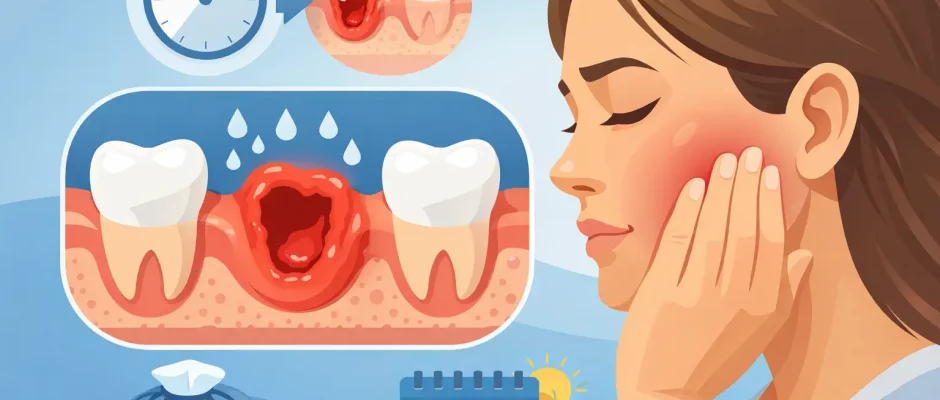
If the cheek becomes noticeably larger in the morning after tooth extraction, this does not mean that something went wrong. The question “how long does swelling last after tooth extraction” arises in almost every patient, especially after difficult extraction, wisdom tooth extraction or suture surgery. In most cases, swelling is an expected tissue response to surgical trauma rather than a sign of complication.
How long does the swelling last after tooth extraction is normal
Usually, the swelling does not increase immediately. Most often, it becomes more noticeable 6-12 hours after the procedure, reaches a maximum of 2-3 days, and then begins to gradually decrease. After simple removal of soft tissues, there may be quite a bit, and it goes away in 1-3 days. After the removal of a retinated or dystopian tooth, gingival incision, bone drilling, or tooth fragmentation, swelling may persist for 5-7 days, sometimes for up to 10 days.
Normal postoperative edema usually behaves predictably. It either stabilizes or slowly decreases with each passing day. The cheek may be tight to the touch, it may not be very convenient to open the mouth, sometimes it hurts to chew or swallow. This is unpleasant, but with a controlled course it does not go beyond the expected recovery.
It is important not to compare yourself with someone else’s experience. One patient has almost no changes after the removal of the figure eight, the other has a pronounced asymmetry of the face for 2 days. The difference depends not only on the pain threshold, but also on the volume of intervention, initial inflammation, tissue thickness, root anatomy, and even how traumatic it was to work in the bone.
Why does edema appear at all
After removal, a natural inflammatory reaction is triggered. This is a normal part of healing: the vessels dilate, the permeability of the tissues increases, fluid accumulates in the area of surgery, and the cells of the immune system begin to “clean up” and repair. The larger the surgical volume, the more noticeable the tissue response is usually.
Therefore, after simple removal of a movable tooth, swelling may be minimal, and after removal of the lower eight, especially lying in the bone, it is often more pronounced. If there was already acute inflammation, flux or suppuration before surgery, it is more difficult to predict the exact extent of swelling. In such cases, the tissues before the intervention are in a state of stress.
There are also technical factors. The presence of an incision, flap detachment, work with bone, the duration of the operation, suturing – all this can affect how long the swelling lasts after tooth extraction. At the same time, in itself, severe edema does not yet indicate poor-quality treatment. Sometimes the surgery was performed neatly, but the clinical situation was initially complex.
What is considered the norm by day
On the day of removal, numbness, moderate soreness and a feeling of bursting prevail more often. The swelling may still be small. It usually becomes more noticeable the next day. On 2-3 days, this is often a peak, especially after the removal of wisdom teeth.
From 3-4 days with normal healing, the picture should gradually improve. The swelling becomes softer or smaller in volume, the mouth opens slightly better, the pain no longer increases. By day 5-7, most patients feel clear relief, even if a slight swelling still persists. Residual tissue density sometimes lasts longer, but visually the face already looks almost normal.
If you had a tooth removed and at the same time underwent additional manipulations – for example, curettage, soft tissue plasty,PRF well supportor preparation for the further implantation stage, the timing may vary slightly. Therefore, it is better to focus not on one symptom, but on the general dynamics.
When swelling is abnormal
The key criterion is not the fact of edema itself, but its behavior. If on day 4-5 the cheek becomes larger rather than smaller, this is no longer a typical pattern. The same applies to the situation when the pain intensifies instead of gradually decreasing, bad breath, fever, weakness increases or it becomes difficult to swallow.
Several scenarios require special attention. The first is rapidly increasing swelling with tissue tension and worsening mouth opening. The second is severe throbbing pain, which is poorly relieved by prescribed drugs. The third is the absence of a clot in the well and increasing pain after 2-4 days, which may indicate alveolitis. The fourth is the temperature above 100.4°F, especially if it is holding or rising.
Immediate contact with a doctor is necessary if it becomes difficult to breathe, it is difficult to swallow saliva, swelling spreads to the neck or the area under the eye, a rash appears or signs of an allergic reaction to medications. These are rare but important situations that should not be observed at home “until tomorrow”.
What helps reduce swelling
On the first day, the cold works best. Not ice directly on the skin, but a cold compress through the fabric for 10-15 minutes with breaks. This does not completely remove the swelling, but it helps to limit its severity in the early period. Starting from the second day, aggressive cooling usually no longer provides such benefits.
It is important to sleep with your head slightly elevated and not to lie down horizontally immediately after the procedure for long hours. This reduces fluid congestion in tissues. Exercise, sports, sauna, hot bath, alcohol and smoking in the first days can increase swelling and impair healing.
Medications should be taken as prescribed by the surgeon. Not when it became completely painful, but according to the scheme, if it is given. This is especially important after complex deletions. Antibiotics, if prescribed, should not be stopped arbitrarily just because “it has become easier”. Conversely, you should not start them without testimony.
You do not need to rinse your mouth actively on the first day. Too energetic rinses can disrupt the clot in the well. It is usually recommended either to do nothing at all in the first hours, or to use very soft baths according to the doctor’s instructions from the next day. Too hot food, straws for drinks and constant “checking” of the well with the tongue also interfere with normal recovery.
What determines the recovery period
One of the main factors is the difficulty of removal. The deeper the tooth is located and the more surgical steps are required, the more likely the swelling is to be noticeable. The lower wisdom teeth almost always give a more pronounced reaction than the simple removal of the upper movable tooth.
The second factor is the initial state of the tissues. If removal was performed against the background of purulent inflammation, periostitis or a long-existing focus of infection, the postoperative period may be more difficult. In such patients, it is often more difficult to separate the “reaction to surgery” from the already existing inflammation, so control over the dynamics is important.
The third factor is individual characteristics. Age, smoking, diabetes, taking some drugs, quality of sleep, adherence to recommendations – all this affects the speed of edema withdrawal. Even with a perfectly performed operation, the body recovers in different ways for everyone.
Technique is of great importance in modern surgical dentistry. The more accurate the planning and the more carefully the surgeon works with soft tissues and bone, the calmer the postoperative period is usually. This is why patients often find it easier to tolerate treatment where predictable protocols are used,microsurgical approachand clear postoperative support. At https://implantolog.co.il, this approach is part of the general logic of treatment – not only to remove the tooth, but also to carry out the stage as controlled and comfortable as possible.
Whether you need to come for an examination if you still have edema
Yes, if the doctor has prescribed a follow-up visit, it is better not to miss it, even when it seems that everything is going fine. After removal, it is important to assess not only the external swelling, but also the condition of the well, sutures, mucous membrane, the degree of cleansing of the operation area and the overall healing dynamics.
If the seams are absorbable, this does not always obviate the need for inspection. And if the stitches need to be removed, the date of the visit is usually determined in advance. It is not very reliable to judge independently by the mirror whether everything is in order. A small swelling may look alarming, and a serious problem is to start outwardly rather modestly.
Frequently asked question after removing an eight
Afterwisdom tooth extractionpatients often ask how long swelling lasts after tooth extraction, because this is where the tissue reaction is most noticeable. For the lower eights, moderate swelling on day 2-3 is a common history. Sometimes it is joined by a restriction of the opening of the mouth and pain when swallowing.
Here it is especially important to look at the trend. If you feel a little better for 4-5 days, this is a good sign, even if your face is not yet completely symmetrical. If the cheek becomes harder, hotter, the pain is sharper, and the mouth opens worse, this is a reason not to wait.
After tooth extraction, the body needs time to go through the normal phase of inflammation and move on to healing. Edema should not be frightening in itself, but it requires careful attention to timing and dynamics. If the picture fits into the expected course, the best assistant is a calm implementation of recommendations and communication with the doctor in case of any doubts.


Comments (0)