If your treatment plan mentions PRF, the question usually is not academic. Patients ask about it right before tooth extraction, implant placement, sinus lift, or bone grafting, when they want one clear answer: what exactly is being added to the procedure, and does it truly improve healing? That is the right question.
What is PRF in dentistry?
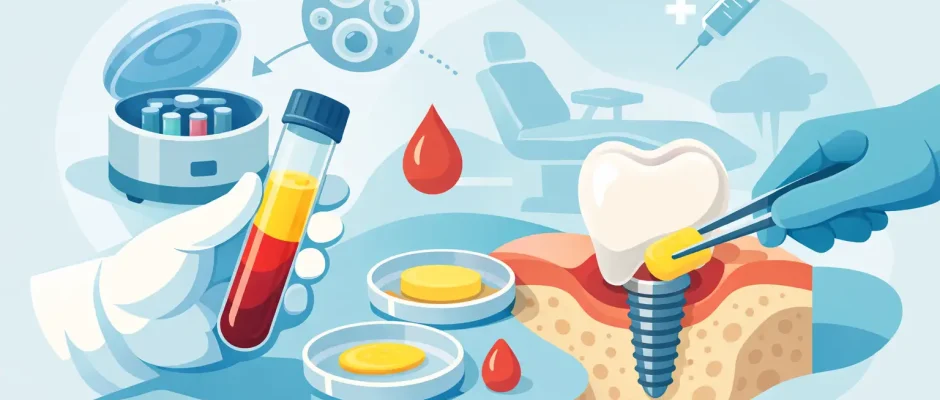
What is PRF in dentistry? PRF stands for platelet-rich fibrin. It is an autologous biomaterial, which means it is made from the patient’s own blood immediately before or during the procedure. After a small blood draw, the tubes are spun in a centrifuge under a specific protocol. The result is a fibrin clot or membrane rich in platelets, leukocytes, and growth factors that can support soft tissue and bone healing.
In plain terms, PRF is not a drug and not a synthetic filler. It is a concentrated healing matrix created from your own blood and used as an adjunct in oral surgery. That distinction matters because many patients imagine PRF as something implanted permanently. It is not. It acts more like a biologic support for the early healing phase.
Why PRF is used in oral surgery
Healing after surgery depends on blood supply, clot stability, tissue closure, and the body’s regenerative response. PRF is used because it may improve the local healing environment. The fibrin network works as a scaffold, while platelets and leukocytes release signaling molecules over time. In clinical practice, this can be helpful when the goal is to protect a graft, support soft tissue closure, reduce the depth of a post-extraction defect, or optimize healing around an implant site.
This does not mean PRF replaces sound surgical technique. It does not. Careful extraction, atraumatic tissue handling, tension-free closure, control of infection, and accurate implant positioning remain far more important than any adjunct. PRF works best when it is part of a disciplined protocol, not as a shortcut.
Where PRF is commonly used in dentistry
PRF after tooth extraction
After a difficult extraction, especially with wisdom teeth or teeth removed because of infection or fracture, PRF may be placed into the socket. The goal is to support clot organization and soft tissue healing. In some cases, patients report a more comfortable early recovery, although the experience varies.
This is particularly relevant when preserving the socket matters for future implant placement. PRF can be combined with grafting materials or used on its own depending on the defect, the thickness of surrounding bone, and the long-term treatment plan.
PRF during implant placement
In implant dentistry, PRF is often used around the surgical site rather than as a replacement for bone graft material. It may be applied to the osteotomy area, mixed with particulate graft, or used as a membrane-like layer to support soft tissue management.
In immediate implant placement, where the implant is placed at the time of extraction, PRF may help manage the gap between the implant and the socket wall as part of a broader biologic strategy. But whether it is indicated depends on the defect morphology and primary stability. It is useful in selected situations, not automatically in every case.
PRF in bone grafting and sinus lift
This is one of the most common scenarios. In guided bone regeneration or sinus augmentation, PRF can be mixed with graft particles to make them easier to handle and more cohesive. It can also be pressed into membranes that help cover or stabilize the site.
For the surgeon, this improves tissue behavior and handling. For the patient, the benefit is less about marketing language and more about increasing the predictability of healing conditions around the graft. Again, the key word is adjunct. PRF supports the plan, but it does not compensate for poor indication or poor execution.
PRF in soft tissue surgery
PRF is also used in periodontal and mucogingival surgery, including procedures aimed at improving gum thickness, covering recession defects, or enhancing wound healing after microsurgical interventions. In these cases, PRF may contribute to better tissue quality and gentler healing, especially when combined with precise suturing and minimally traumatic technique.
How PRF is prepared
The process is straightforward and done on the day of treatment. A small amount of blood is drawn from your arm, similar to a routine lab test. The blood is immediately placed in a centrifuge. Based on the chosen protocol, the clinician obtains a fibrin-rich layer that can then be used as a clot, plugs, fragments, or compressed membranes.
Timing matters. PRF has to be prepared and used correctly because its quality depends on how the blood is collected, how quickly it is processed, and which centrifugation parameters are selected. This is one reason PRF should not be seen as a simple add-on. The protocol affects the final material.
What patients usually want to know about PRF
The first concern is safety. Because PRF comes from your own blood, the risk of immune reaction is extremely low. There is no donor tissue involved. That makes it attractive for patients who prefer biologic materials with minimal foreign-body exposure.
The second question is whether it reduces pain or swelling. Sometimes it may help improve early healing comfort, but expectations should stay realistic. PRF is not anesthesia, not an antibiotic, and not a guarantee of an easier recovery. Surgical complexity, infection status, smoking, diabetes, oral hygiene, and how closely postoperative instructions are followed often have a bigger impact.
The third question is whether PRF is necessary. The honest answer is no, not always. Some procedures heal very well without it. In other cases, especially bone grafting, sinus lift, immediate implantation, or surgeries where tissue quality is limited, PRF may provide a meaningful biologic advantage.
What PRF does not do
This is where clarity matters. PRF does not regrow large volumes of bone by itself. It does not replace bone grafts when a major augmentation is needed. It does not guarantee implant success. It also does not fix uncontrolled periodontal disease, poor oral hygiene, or a bite overload problem.
Patients are often exposed to oversimplified claims online. A more accurate way to think about PRF is this: it can improve the local healing environment, but the outcome still depends on diagnosis, surgical planning, tissue management, and follow-up. In complex implant cases, biology and mechanics must both be respected.
Is PRF worth including in a treatment plan?
That depends on the procedure and the clinical goal. If the surgery is minor and tissues are healthy, the benefit may be modest. If the case involves extraction with ridge preservation, immediate implant placement, soft tissue deficiency, or bone regeneration, PRF may be more valuable.
The best reason to include PRF is not because it sounds advanced, but because it fits a specific protocol. In a surgical practice focused on predictable healing, it is often used as part of a broader approach that may also include digital planning, atraumatic technique, microsurgical handling, and careful postoperative monitoring.
For patients who are choosing a surgeon, this is the more useful question: not “Do you use PRF? ” but “In my case, why are you using it, and what problem is it solving? ” A good answer should be individualized and clinically concrete.
What is PRF in dentistry compared with PRP?
Patients sometimes hear both terms and assume they are interchangeable. They are related, but not identical. PRP refers to platelet-rich plasma, while PRF is platelet-rich fibrin. The preparation protocols and final consistency are different. PRF forms a fibrin matrix and is often easier to use as a membrane or biologic scaffold during oral surgery.
From a patient perspective, the practical difference is that PRF is widely used in surgical dentistry because it integrates naturally into extraction sites, grafted areas, and soft tissue closures. Which option is preferred depends on the clinical application and the clinician’s protocol.
When PRF may be especially relevant
PRF often makes the most sense when healing conditions are less than ideal. Examples include thin gum tissue, extraction sites with bone defects, staged augmentation before implants, sinus lift procedures, or immediate protocols where preserving tissue architecture matters. Smokers and medically compromised patients may also ask about it, although these cases require careful evaluation rather than blanket promises.
If you are planning implant treatment and want a clear explanation of the surgical steps, biomaterials, and healing strategy, that conversation should happen before the procedure, not on the day of surgery. A thoughtful treatment plan reduces anxiety because it replaces vague terms with real decisions. If you are reviewing options for surgical care in Israel, implantolog. co. il explains treatment protocols in that practical, patient-centered way.
PRF is best understood not as a miracle product, but as a smart biologic tool. In the right hands and in the right case, that can make a real difference where it matters most – calm healing, stable tissues, and a result that stays predictable long after the surgery is over.


