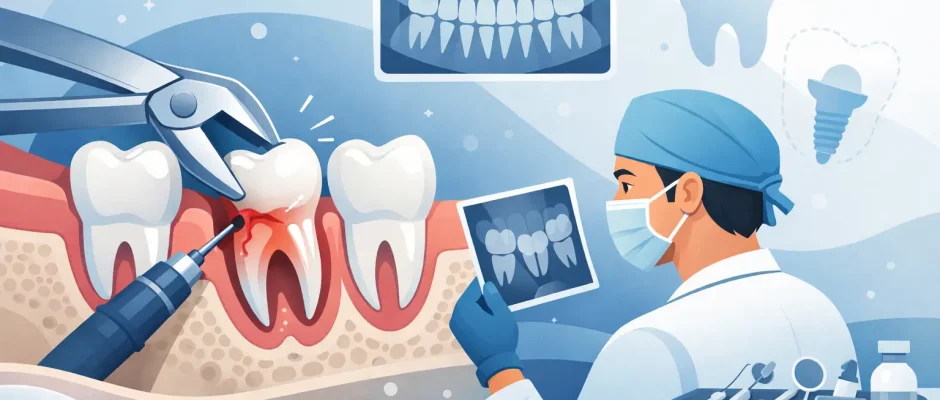
A tooth that “just needs to come out” is not always a simple extraction. Roots may be curved, the crown may be broken below the gumline, the tooth may sit close to the sinus or the mandibular nerve, or inflammation may have changed the surrounding bone. That is where a real guide to complex tooth extraction becomes useful – not to create more worry, but to replace uncertainty with a clear, medically sound plan.
For many patients, the hardest part is not the procedure itself. It is the lack of clarity beforehand. Will it hurt? Is a CT scan really necessary? Can an implant be placed right away? The answers depend on anatomy, infection status, bone volume, and the long-term restorative plan. In surgical dentistry, good outcomes come from correct sequencing, not from rushing.
What makes a tooth extraction complex
A complex extraction usually means the tooth cannot be removed safely and predictably with standard forceps alone. The reason may be mechanical, anatomical, or biological.
A common example is a severely decayed tooth that has fractured to the gum level. There is very little structure to grip, so the surgeon often needs to create access, separate roots, and remove the tooth in controlled sections. Impacted or partially erupted wisdom teeth also fall into this category, especially when they are angled toward the second molar or located close to the inferior alveolar nerve.
Complexity also increases when previous root canal treatment, chronic infection, cystic changes, or dense bone alter the normal surgical field. In some cases, the extraction itself is only one part of the treatment. Preserving bone for a future implant may be equally important, which changes the surgical approach.
Guide to complex tooth extraction: the planning stage
The most important part of a difficult extraction happens before surgery starts. Clinical examination shows mobility, soft tissue condition, swelling, mouth opening, and tenderness. Imaging shows the rest.
A standard X-ray may be enough for straightforward cases, but a cone beam CT is often valuable when roots are close to nerves, the maxillary sinus, or adjacent teeth. Three-dimensional imaging helps answer practical questions: whether the roots are fused or divergent, whether bone loss is present, and whether immediate implantation is realistic.
This planning stage also defines the safest sequence. Sometimes the best option is extraction with socket preservation, followed by implant placement after healing. In other cases, immediate implant placement can reduce treatment time and help maintain tissue architecture. The right choice is not the fastest one. It is the one that gives the most predictable result in that specific anatomy.
How the procedure is performed
In a complex extraction, precision matters more than speed. The procedure is typically performed under profound local anesthesia. For anxious patients, the overall experience can often be improved by careful pacing, clear communication, and an atraumatic surgical technique.
If the tooth is not accessible or has broken below the gumline, a small flap may be raised to expose the area. In some cases, a limited amount of bone is removed to create a safe path of removal. Multi-rooted teeth are often sectioned, which means each root is removed separately instead of forcing the entire tooth out at once. This reduces stress on the surrounding bone and lowers the risk of uncontrolled fracture.
After removal, the socket is assessed carefully. Any inflammatory tissue is cleaned out, the bone walls are checked, and the surgeon decides whether additional steps are needed. Depending on the plan, this may include PRF, grafting material, a collagen membrane, or preparation for immediate implant placement. Sutures are placed when they improve soft tissue adaptation and protect healing.
When immediate implant placement is possible
Many patients ask whether the tooth can be removed and replaced with an implant in the same visit. Sometimes yes, but only when the local conditions support stability and long-term success.
Immediate implantation depends on several factors: the amount of remaining bone, the ability to achieve primary stability, the absence of uncontrolled acute infection, and the position of the future crown. If the socket is damaged extensively or infection has compromised the bone, delaying implant placement may be safer.
This is where surgical judgment matters. A well-indicated immediate implant can shorten treatment and preserve tissues. A poorly indicated one can create avoidable complications. In complex cases, preserving the biology of the site is more important than following a one-visit concept.
Recovery after complex tooth extraction
Most patients expect pain to be the main issue. In reality, swelling, tightness, and limited chewing are often more noticeable during the first few days. With proper anesthesia, the procedure itself is usually manageable. The recovery pattern depends on the extent of surgery, the amount of bone manipulation, the presence of pre-existing infection, and the patient’s general health.
Mild bleeding or oozing on the first day is common. Swelling typically peaks around 48 to 72 hours. If a wisdom tooth was impacted or bone removal was required, jaw stiffness can also occur for several days. This does not automatically mean something is wrong.
What deserves attention is worsening pain after initial improvement, persistent bad taste, fever, increasing swelling, or numbness that does not follow the expected course discussed before surgery. Good postoperative follow-up reduces guesswork and allows early management if healing is off track.
Risks and how they are reduced
Every surgical extraction has risks, but they are not the same in every case. The relevant question is not whether risks exist. It is whether they have been identified and addressed before treatment.
For lower posterior teeth, nerve proximity may be the central issue. For upper molars, the concern may be the sinus. In fragile teeth or endodontically treated roots, fracture during removal is more likely. In infected sites, tissue quality and delayed healing may become the limiting factor.
Risk reduction comes from diagnostics, technique, and restraint. Three-dimensional planning, careful flap design, root sectioning, microsurgical handling of soft tissues, and a realistic implant timing strategy all contribute to a safer procedure. This is especially important for patients who are not only removing a tooth, but also planning the next step of rehabilitation.
Why bone preservation matters
A tooth extraction is never just subtraction. Once a tooth is removed, the surrounding bone begins to remodel. That process is natural, but in some areas it can be significant enough to complicate future implant placement or affect esthetics.
This is why difficult extractions should be approached with reconstruction in mind. If the bone walls are preserved, if trauma is minimized, and if grafting is used when indicated, the site is often easier to restore later. That matters most in the smile zone, but it also matters in posterior areas where implant positioning affects function.
For patients considering implants, extraction should be planned as the first stage of reconstruction, not as an isolated event. That shift in thinking often leads to better long-term decisions.
Guide to complex tooth extraction for anxious patients
Dental anxiety is common, and surgical treatment tends to amplify it. Patients are often less afraid of pain than of losing control or being surprised during the procedure.
A good surgical experience starts with clarity. You should know what makes the extraction difficult, what imaging is needed, whether the tooth will be sectioned, what the recovery timeline looks like, and what comes next if an implant is part of the plan. Specific explanations usually reduce fear more effectively than reassurance alone.
Technique also matters. Atraumatic handling of tissues, reliable anesthesia, and a structured protocol make surgery feel more controlled. For many patients, the most calming part is hearing that the plan was built around their anatomy rather than around a standard template.
Choosing the right surgeon for a difficult case
Not every difficult extraction requires a highly specialized approach, but many benefit from one. The difference is often seen in planning quality, tissue preservation, and what options remain after the tooth is removed.
If the case involves an impacted tooth, a retained root near vital structures, significant bone loss, or a combined extraction-and-implant decision, experience in surgical dentistry and implantology becomes especially relevant. It is reasonable to ask what imaging will be used, whether bone preservation is part of the plan, and how complications are handled if anatomy proves more challenging than expected.
In advanced cases, digital planning and microsurgical protocols are not marketing extras. They help make treatment more precise and recovery more predictable. On https://implantolog.co.il, that philosophy is central: diagnose carefully, operate conservatively, and keep the final restorative result in view from the first surgical step.
A complex extraction can still be a calm, well-controlled procedure when the plan is specific, the technique is disciplined, and the next phase of treatment is considered from the start. If you are facing one, the most useful question is not “How difficult will this be?” but “What is the safest and most predictable way to do it in my case?”


Comments (0)