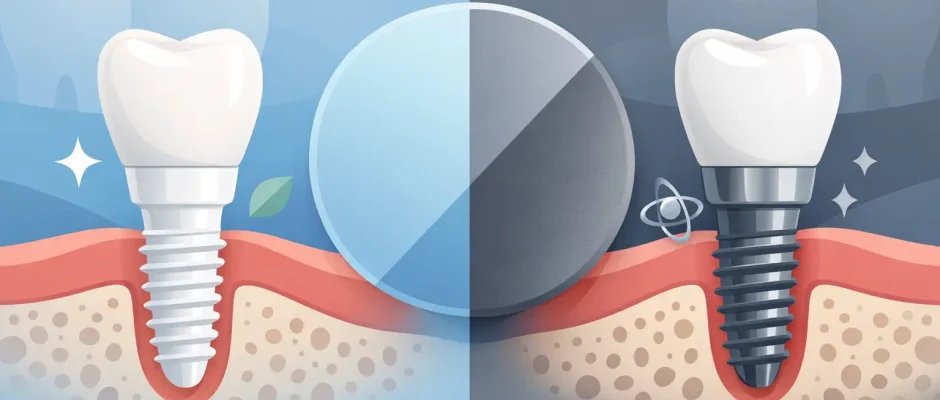
If you are comparing zirconia vs titanium implants, you are already asking the right question. The material matters, but not in isolation. In practice, the better choice depends on bone volume, bite forces, gum anatomy, smile line, medical history, and how much long-term predictability matters in your specific case.
Patients often come in assuming zirconia is the more modern and therefore better option, or that titanium is old but proven. Both ideas are only partly true. Titanium remains the standard in implant dentistry because it has the longest clinical track record and the widest range of components and protocols. Zirconia is attractive for select cases, especially when esthetics and metal-free treatment are priorities, but it is not automatically the superior choice.
Zirconia vs titanium implants: what is the real difference?
The main difference is not simply color or whether the implant contains metal. It is how each material behaves under functional load, how flexible the restorative planning can be, and how predictable treatment is over many years.
Titanium implants are made from medical-grade titanium or titanium alloys. They are biocompatible, integrate well with bone, and have decades of clinical evidence behind them. They are used in straightforward single-tooth cases, full-arch rehabilitation, immediate implant placement, and complex situations that involve bone grafting or guided surgery.
Zirconia implants are ceramic. Their white color makes them appealing in areas where gum recession or a very thin gum phenotype could potentially reveal the implant through the tissue. They also appeal to patients who want a metal-free solution. In the right indication, zirconia can perform well. The key phrase is in the right indication.
Why titanium is still the benchmark
Titanium is not popular by habit alone. It became the benchmark because it combines strength, biocompatibility, and restorative flexibility in a way that works across a wide range of clinical scenarios.
One major advantage is the depth of evidence. Titanium implants have been studied extensively for long-term survival and success rates. That matters because implant treatment is not just about whether an implant integrates in the first few months. It is about how it performs under years of chewing, clenching, tissue remodeling, and maintenance.
Another advantage is prosthetic versatility. Titanium systems offer more options for angulation correction, abutment selection, screw-retained and cement-retained restorations, and management of challenging implant positions. In real treatment planning, this is often decisive. A material may look appealing on paper, but if it limits the restorative phase, it can compromise the final result.
Titanium is also more forgiving in complex cases. When bone is limited, when immediate placement is planned after extraction, or when a patient has high bite forces, the predictability of titanium is difficult to ignore. In a surgical practice that handles bone deficiency, sinus elevation, and immediate protocols, this matters every day.
Where zirconia implants make sense
Zirconia implants are not a trend without substance. They offer real advantages in selected situations.
The most obvious benefit is esthetics. Because zirconia is white, it can reduce the risk of a gray shine-through in patients with very thin soft tissue, especially in the anterior maxilla. This does not mean titanium always creates an esthetic issue. In many cases, careful planning of implant position, tissue thickness, and prosthetic design makes titanium highly esthetic. But zirconia may offer an advantage when soft tissue is especially delicate and the smile line is high.
Some patients also strongly prefer a metal-free restoration. That preference should not be dismissed. If the clinical situation is favorable and the patient understands the limitations, zirconia may be a reasonable option.
There is also interest in zirconia because of plaque accumulation and soft tissue response. Some studies suggest favorable soft tissue behavior around zirconia. Still, these findings should be interpreted carefully. Good hygiene, correct implant positioning, prosthetic contour, and regular maintenance usually matter more than material alone.
The limitations patients should understand
This is where many online comparisons become too simplistic. The real discussion is not zirconia good, titanium bad, or the reverse. It is about risk management.
Zirconia is more brittle than titanium. That does not mean it is weak in every situation, but it does mean it behaves differently under stress. In patients with heavy occlusion, bruxism, unfavorable bite patterns, or posterior load, that difference can be clinically relevant.
Another limitation is restorative flexibility. Many zirconia implant systems have fewer prosthetic options than titanium systems. Historically, some zirconia implants were one-piece designs, which limited surgical and restorative control. Two-piece zirconia systems exist today, but the ecosystem is still generally less versatile than titanium.
This becomes especially important in advanced treatment. If you need immediate provisionalization, angulation correction, full-arch planning, or treatment in reduced bone volume, the system must allow the surgeon and restorative dentist to control details precisely. A narrower range of components can turn a theoretically good plan into a compromised one.
There is also a simple but important fact: titanium has more long-term data. For patients who want the most studied and most predictable material over time, titanium still leads.
Zirconia vs titanium implants in visible front teeth
The front of the mouth is where this decision often becomes more nuanced. Patients worry about esthetics, and rightly so. But esthetics around implants is not created by material alone. It depends on implant position in three dimensions, preservation of bone and papillae, soft tissue thickness, emergence profile, and the design of the final crown.
If the gum tissue is thin and the smile line is high, zirconia may offer an esthetic advantage. But a poorly positioned zirconia implant will still produce a poor result. On the other hand, a well-planned titanium implant combined with soft tissue management can look excellent and remain stable for years.
In other words, the material can support esthetics, but it does not replace surgical precision.
What about allergies and biocompatibility?
This question comes up often. True titanium allergy is considered rare. More commonly, patients describe a general preference to avoid metal rather than a documented medical reaction. That preference is understandable, but it should be separated from evidence-based diagnosis.
Both titanium and zirconia are biocompatible materials. Both can integrate with bone. The more practical question is not which one is biologically accepted in theory, but which one offers the safest and most predictable treatment in your anatomy and bite.
If a patient has a specific medical history, previous adverse reactions, or strong concerns about material selection, that should be reviewed during consultation rather than assumed from internet forums.
How surgeons actually choose between them
In daily practice, the choice starts with diagnostics, not with marketing. A CBCT scan, clinical exam, soft tissue evaluation, and prosthetic planning usually clarify more than any materials debate.
If the case is complex, titanium is often the more rational choice because it gives more control. That includes immediate implants after extraction, cases with bone grafting, posterior teeth under high load, full-arch restorations, or situations where precise prosthetic correction may be needed later.
If the case is straightforward, the esthetic demand is high, the tissue is thin, and the patient specifically wants a metal-free option, zirconia may be considered. But it should still be selected because it fits the case, not because it sounds more advanced.
This is also where digital planning matters. Guided surgery, prosthetically driven implant positioning, and careful soft tissue management can improve outcomes with either material. The better the planning, the less likely you are to rely on material choice as a substitute for technique.
Which implant material is better for most patients?
For most patients, titanium is still the better default choice. Not because zirconia lacks value, but because titanium offers the strongest combination of evidence, durability, component flexibility, and predictability across routine and complex indications.
Zirconia is best seen as a selective option rather than a universal upgrade. It can be a very good solution when esthetic demands are specific and the biomechanics are favorable. It is not always ideal when the case is surgically demanding, the bite is heavy, or long-term restorative adaptability is essential.
That distinction matters if you want treatment that remains stable, maintainable, and predictable years after the crown is placed.
A good implant plan is rarely built around a material alone. It is built around your anatomy, your bite, your smile, and the surgical strategy that gives the safest path to a lasting result. If you are deciding between zirconia and titanium, the most useful next step is not to ask which material is best in general. It is to ask which material makes the most sense in your case, with your risks and your goals clearly on the table.


Comments (0)