Dental Implant Technology Explained Clearly
A dental implant is not just a titanium screw placed into bone. The real treatment happens much earlier – during diagnosis, digital planning, and the choice of surgical protocol for your specific anatomy. That is why dental implant technology explained properly should start not in the operatory, but with the question every patient actually cares about: how does modern technology make the procedure safer, more accurate, and more predictable?
For many people, the fear is not the implant itself. It is the uncertainty. Will there be enough bone? Will the implant go near a nerve or sinus? Is this a routine case, or a difficult one being treated as if it were routine? Modern implantology helps answer those questions before surgery begins, and that changes the entire patient experience.
Dental implant technology explained from the planning stage
The most important technology in implant dentistry is often invisible to the patient. It begins with 3D imaging, usually a CBCT scan, which shows the jaw in volume rather than as a flat picture. A regular dental X-ray is useful, but it does not fully show bone width, spatial relationships, or the exact position of critical structures. A CBCT allows the surgeon to assess available bone, the proximity of the mandibular nerve, the shape of the maxillary sinus, and possible hidden anatomical limitations.
This matters because implant placement is not simply about finding a place where an implant fits. It is about placing it where it will function well, support the future crown correctly, and remain biologically stable over time. Good planning is prosthetically driven, meaning the surgeon thinks not only about the implant in bone, but also about the tooth that will eventually sit on top of it.
In practical terms, digital planning software allows the doctor to choose implant dimensions, angle, and depth in advance. That may sound technical, but the patient benefit is straightforward: fewer surprises during surgery and a lower risk of compromise. In straightforward cases, this improves efficiency. In complex cases, it can be the difference between a predictable result and one that requires correction later.
What surgical guides actually do
One of the most useful tools in modern implantology is the surgical guide. This is a custom-made template based on digital planning and the patient’s anatomy. It helps transfer the virtual plan into the mouth with a high degree of precision.
Patients sometimes hear the phrase “guided surgery” and imagine a robot doing the work. That is not what happens. The guide does not replace the surgeon. It supports the surgeon’s plan by controlling the entry point, angle, and sometimes depth of drilling. In the right case, that can reduce trauma, improve implant positioning, and make flapless or minimally invasive surgery more realistic.
But this is also where nuance matters. A guide is not automatically better in every situation. If the soft tissues are unstable, if access is limited, or if there are unexpected findings during surgery, the surgeon still has to think and adapt. Technology is valuable when it supports clinical judgment, not when it tries to replace it.
The implant surface, connection, and why design matters
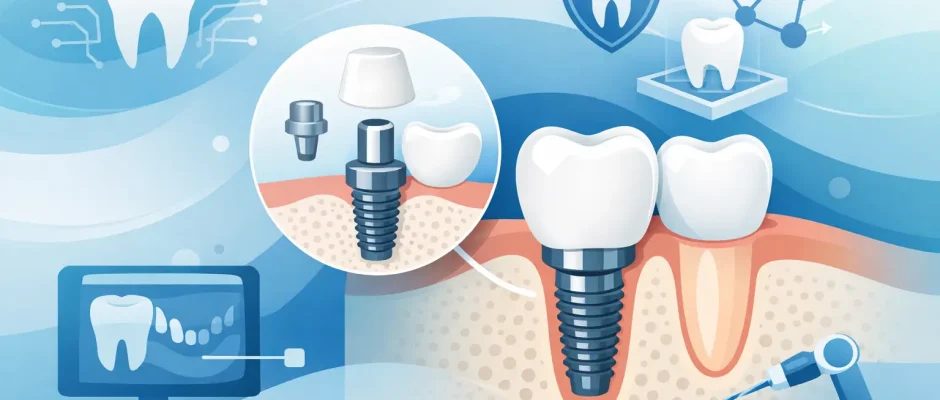
When patients ask about “implant technology,” they often mean the implant itself. That is only one part of the equation, but it is still important. Modern implants differ in surface treatment, thread design, macrogeometry, and the connection between the implant and abutment.
Surface treatment is designed to improve osseointegration, the biological process by which bone bonds to the implant. Roughened and specially treated surfaces generally allow more reliable bone attachment than older, smoother designs. Thread design affects how the implant engages with bone at placement, which is especially relevant when immediate stability is needed.
The implant-abutment connection also matters. A stable, well-engineered connection can reduce micromovement and help preserve surrounding bone and soft tissue. For the patient, this translates into something simple: the long-term success of an implant depends not only on whether it was placed, but on how its components work together over time.
There is no single implant system that is universally best for all cases. Bone quality, location in the jaw, bite forces, esthetic demands, and whether the implant is being placed immediately after extraction all influence the choice.
When there is not enough bone
A common reason patients are told they are “not candidates” for implants is a lack of bone volume. In reality, this often means they are not candidates for a simplified approach. Modern implantology includes bone augmentation techniques that make treatment possible in situations that used to be considered poor candidates.
Guided bone regeneration uses graft materials and membranes to rebuild deficient areas. In the upper jaw, a sinus lift may be needed when the sinus floor is low and bone height is limited. These are not add-ons for cosmetic refinement. In many cases, they are what make proper implant placement possible.
This is where planning technology becomes especially valuable. A 3D scan helps determine whether bone grafting is necessary, how much graft is needed, and whether the implant can be placed at the same time or should wait for healing. That decision depends on initial stability, defect size, infection history, and the quality of the remaining bone.
Patients usually want a simple yes or no. Can the implant be placed immediately, or not? Sometimes yes. Sometimes not yet. A careful answer is more trustworthy than an optimistic one.
Immediate implants and immediate loading
These terms are often confused. An immediate implant means the implant is placed at the same appointment as tooth extraction. Immediate loading means a temporary tooth is attached very soon after placement, sometimes the same day.
Both can be excellent options, but only under the right conditions. The extraction must be atraumatic, infection has to be controlled, the remaining bone must provide good primary stability, and bite forces must be managed carefully. If one of those factors is unfavorable, forcing an immediate protocol can increase risk.
This is why modern implant treatment is less about speed than about selecting the right protocol. Digital planning, careful extraction techniques, and precise implant selection can make immediate treatment more predictable, but they do not make it automatic.
PRF and microsurgical principles
Another part of dental implant technology explained well is understanding that technology is not only digital. It also includes biologic support and surgical technique. PRF, or platelet-rich fibrin, is created from the patient’s own blood and used to support healing. It can improve soft tissue quality, support grafted areas, and help make the postoperative phase more comfortable.
Microsurgical principles matter just as much. Gentle tissue handling, precise incision design, tension-free closure, and preservation of blood supply all influence healing. Patients rarely see these details, yet they strongly affect swelling, discomfort, and the quality of the final result.
In other words, advanced implantology is not just high-tech equipment. It is the combination of digital precision and disciplined surgery.
Full-arch cases and complex rehabilitation
For patients missing many teeth, or all teeth in one jaw, technologies used in full-arch rehabilitation can be life-changing. Concepts such as All-on-4 or similar full-arch protocols rely on careful 3D planning, implant angulation, and prosthetic coordination. These are not simply “four implants and done.” They require a clear understanding of bone availability, bite dynamics, smile line, and hygiene access.
In advanced cases, treatment may involve extractions, bone reduction, immediate implant placement, and a fixed provisional restoration. This can be efficient and very effective, but only when the diagnosis is accurate and the surgical and restorative teams are aligned.
That is also why complex treatment should not be reduced to marketing slogans. Fast protocols can be appropriate. They can also be overpromised. A responsible plan takes anatomy, biology, and long-term maintenance seriously.
What patients should really ask about technology
If you are evaluating implant treatment, the right question is not “What machine do you use?” It is “How does your technology change my plan, my safety, and my result?” A useful explanation should cover diagnostics, surgical accuracy, bone management, healing strategy, and the limits of each protocol.
In a practice focused on surgical implantology, technology should make treatment more understandable, not more mysterious. It should help the patient see why one case can be completed in a single stage while another requires grafting and healing. It should also make it easier to discuss risk honestly.
That is particularly relevant in complex cases, including severe bone loss, impacted teeth, failed previous treatment, or esthetically demanding areas. Here, precision matters because compromise tends to show up later – in function, tissue stability, or appearance.
For patients seeking treatment in a high-standard surgical setting, including in Tel Aviv where many expect access to advanced protocols and clear planning, this level of explanation is not a luxury. It is part of informed care.
The best implant technology does not promise a miracle. It gives your surgeon better information, better control, and more ways to tailor treatment to your anatomy. For a patient, that usually means something very concrete: less guesswork, more clarity, and a result that is built to last.


