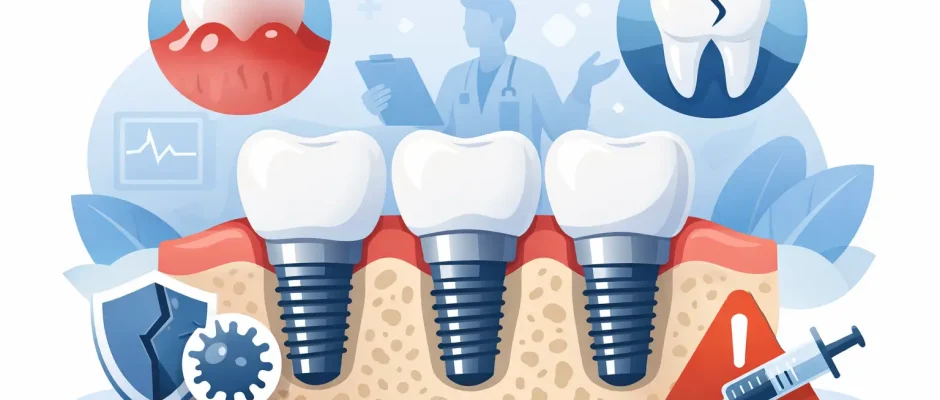
Risks of Dental Implant Surgery Explained
Most patients are not afraid of the implant itself. They are afraid of the unknown – pain, failure, infection, nerve injury, or finding out too late that their case is more complicated than it seemed. That is exactly why an honest discussion of the risks of dental implant surgery matters. Not to create fear, but to replace vague anxiety with specific, manageable facts.
Dental implants have a high long-term success rate when diagnosis, planning, and surgical execution are done properly. But implant surgery is still surgery. It involves bone, soft tissue, healing biology, and in some cases additional procedures such as extraction, bone grafting, sinus lift, or immediate implantation. The real question is not whether risk exists. It does. The question is which risks apply to your case, how likely they are, and what can be done to reduce them.
What are the real risks of dental implant surgery?
The most common risks are not always the most serious, and the most serious are not always the most common. Mild swelling, bruising, soreness, and temporary difficulty chewing are expected after surgery. These are normal postoperative effects, not complications. A complication is something outside the expected healing pattern – for example infection, prolonged numbness, implant instability, or delayed healing.
One of the first distinctions to make is between surgical risk and restorative risk. Surgical risk relates to placing the implant safely into bone without damaging nearby anatomy. Restorative risk relates to whether the implant will end up in the correct position for a functional, cleanable, long-lasting crown or bridge. An implant can be placed successfully from a purely surgical perspective and still create problems later if planning was incomplete.
That is why modern implantology depends on more than hand skills. It depends on imaging, prosthetic planning, and in many cases guided surgery. A good result starts before the day of surgery.
Infection, poor healing, and implant failure
Infection is one of the risks patients ask about most often, and for good reason. Any surgical site in the mouth is exposed to bacteria. The mouth is not a sterile environment, so success depends on controlling bacterial load, minimizing tissue trauma, and maintaining stable healing.
An early postoperative infection may present with increasing pain, swelling that worsens instead of improves, pus, bad taste, fever, or tenderness several days after surgery. Sometimes the issue is superficial and manageable. Sometimes infection disrupts the bond between the implant surface and the bone, leading to early implant failure.
Failure does not always mean a dramatic event. In some cases the implant simply does not integrate with the bone as expected. The implant may become mobile during the healing phase or show radiographic signs that integration is incomplete. Risk increases in smokers, patients with poorly controlled diabetes, those with active gum disease, or in sites where bone quality is limited.
This is also where technique matters. Excessive heat during drilling, poor primary stability, contamination of the implant surface, or unrecognized infection in the extraction site can all reduce the chance of successful osseointegration. In complex cases, a conservative staged approach is often safer than trying to do everything at once.
Nerve injury and sinus complications
The complications patients fear most are usually numbness and sinus problems. These are less common than swelling or temporary discomfort, but they deserve serious attention because they can affect quality of life.
In the lower jaw, the implant must be placed at a safe distance from the inferior alveolar nerve and, in some areas, the mental nerve. If an implant is too long, placed too deep, or angled incorrectly, the patient may experience numbness, tingling, altered sensation, or pain in the lip, chin, or teeth. Sometimes the change is temporary. Sometimes it can persist.
In the upper jaw, especially in the back, the maxillary sinus becomes a major anatomical factor. If bone height is limited, placing an implant without addressing the sinus properly can lead to sinus membrane perforation, poor implant stability, or communication with the sinus cavity. In selected cases, a sinus lift is predictable and safe, but it should be recommended for the right reason – not as a routine add-on, and not avoided when it is actually needed.
These problems are exactly why 3D imaging is so important. A standard 2D X-ray may not show enough detail about available bone width, angulation, concavities, or the precise course of anatomical structures. CBCT-based planning reduces guesswork.
Bone loss, soft tissue problems, and esthetic compromise
Not every complication is painful. Some are visible over time. Bone loss around an implant, gum recession, exposure of metal components, or an unnatural emergence profile can turn a technically successful surgery into an unsatisfying result.
This is especially relevant in the front teeth. The esthetic zone is unforgiving. If the implant is placed too far forward, too deep, too shallow, or in bone that is already deficient, the gum architecture may collapse. Even a stable implant can look gray, long, or asymmetrical compared with neighboring teeth.
Soft tissue thickness, bone volume, smile line, bite pattern, and the condition of adjacent teeth all matter. Immediate implant placement after extraction can be an excellent option in the right case, but it is not automatically the best option in every case. Sometimes waiting, grafting, or modifying the treatment sequence creates a more stable long-term outcome.
General health factors that change the risk profile
The risks of dental implant surgery are never identical for every patient. Medical history changes the picture. Smoking is a major factor because it reduces blood supply, affects soft tissue healing, and increases the risk of infection and marginal bone loss. Diabetes is another important variable. Well-controlled diabetes is not necessarily a contraindication, but poorly controlled blood sugar raises the chance of delayed healing and complications.
Patients taking bisphosphonates or other antiresorptive medications need careful evaluation, especially if treatment includes extractions or major grafting. A history of radiation therapy to the jaws, autoimmune disease, immunosuppression, active periodontitis, or clenching and grinding can also influence treatment decisions.
None of this means implants are off the table. It means the plan has to be individualized. In practice, safer treatment often comes from slowing down, staging procedures, and choosing the protocol that matches the biology rather than forcing an idealized timeline.
How experienced surgeons reduce risk
Patients often ask whether technology actually makes implant surgery safer or just sounds impressive. The answer is simple: technology helps when it supports sound clinical judgment. It does not replace it.
A thorough consultation should identify not only whether an implant can be placed, but what could go wrong in that specific site. CBCT imaging helps assess anatomy and bone volume. Digital planning makes it easier to align the surgical position with the final prosthetic result. Surgical guides can improve precision, particularly in limited bone or anatomically demanding areas. Microsurgical principles reduce unnecessary trauma to soft tissue. PRF may support healing in selected cases, especially where tissue quality is compromised or grafting is performed.
Just as important is case selection. An experienced surgeon knows when immediate implantation is appropriate and when it creates avoidable risk. The same applies to bone grafting, sinus lift procedures, and full-arch treatment concepts such as All-on-4. The goal is not to make the surgery look aggressive or impressive. The goal is to make the outcome predictable.
What patients should watch for after surgery
A well-informed patient is part of a safe treatment process. Mild bleeding in the first hours, swelling for several days, and soreness that gradually improves are typical. What deserves attention is a pattern that goes in the wrong direction – increasing swelling after day three, escalating pain, persistent bad taste, fever, prolonged numbness, implant mobility, or difficulty opening the mouth that gets worse instead of better.
Follow-up matters because some problems are easiest to treat early. A small issue at the incision line can often be managed simply. Left unattended, the same issue may progress into infection or loss of tissue around the implant.
For that reason, the quality of postoperative supervision is not a minor detail. It is part of the treatment. Patients should know whom to contact, what symptoms are expected, and when they should come back for evaluation.
Are dental implants still worth it?
For many patients, yes – very much so. An implant can restore chewing efficiency, preserve neighboring teeth from unnecessary preparation, and offer a stable long-term solution. But the best outcomes come when the decision is based on diagnosis rather than enthusiasm.
The safest approach is not the one that promises the fastest implant placement or the lowest price. It is the one that accounts for anatomy, bite, bone quality, gum condition, medical history, and the final restorative plan. If a surgeon takes time to explain risks clearly, that is not a red flag. It is usually a sign of good judgment.
A careful implant plan should leave you feeling informed, not pressured. Surgery is never risk-free, but when those risks are understood and managed properly, treatment becomes far more predictable – and much less frightening.


