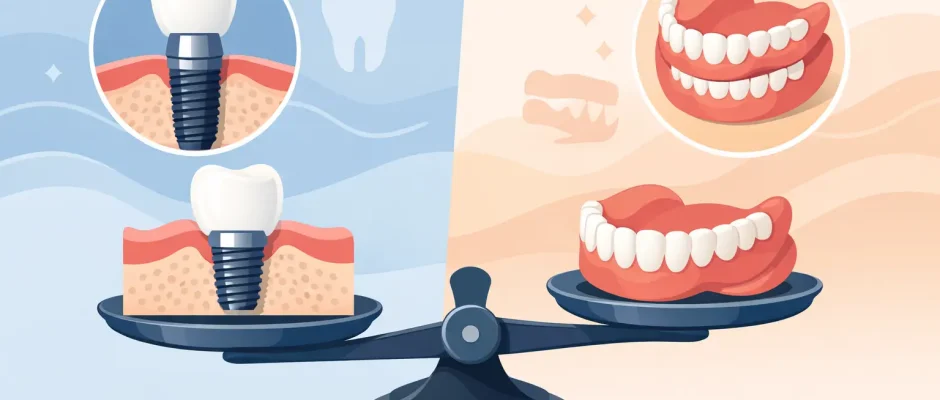
When patients ask about dental implant vs dentures, they are usually not asking for a textbook comparison. They want to know what life will actually feel like after treatment – how they will chew, speak, smile, clean their teeth, and whether the result will still make sense five or ten years from now.
That is the right way to frame the decision. Both implants and dentures can restore missing teeth, but they solve different problems in different ways. The better choice depends on bone volume, general health, the number of missing teeth, budget, and how much stability and long-term predictability matter in daily life.
Dental implant vs dentures: the core difference
A denture is a removable replacement for missing teeth. It sits on the gums and, in the case of a full denture, relies on the underlying ridge for support. A partial denture attaches around remaining teeth. Dentures can restore appearance and basic function, often with a lower upfront cost and a shorter treatment path.
A dental implant is a titanium fixture placed in the bone to replace the root of a missing tooth. Once integrated, it can support a crown, bridge, or a full-arch restoration. This changes the mechanics completely. Instead of resting on soft tissue, the restoration is anchored to bone.
That difference affects almost everything: chewing efficiency, fit, confidence while speaking, preservation of bone, and the amount of compromise a patient has to accept.
How each option feels in real life
For many patients, the biggest issue with dentures is not appearance. It is movement. Lower full dentures in particular can be unstable because the anatomy offers less natural retention. Even a well-made denture may shift during chewing or speaking, and over time the jawbone continues to remodel, which can make the fit worse.
Some patients adapt very well. Others never fully trust the prosthesis. They avoid certain foods, chew more slowly, or become self-conscious in social settings. Adhesives may help, but they do not turn a tissue-supported denture into a fixed solution.
Implants usually feel more secure because they reduce or eliminate movement. A single implant crown functions much more like a natural tooth than a removable appliance. In full-arch cases, implant-supported restorations can dramatically improve confidence, especially for patients who have struggled with loose dentures for years.
This does not mean implants feel identical to natural teeth in every situation. They do not have the same periodontal ligament, so the sensory feedback is different. But from a practical standpoint, fixed implant restorations are usually much closer to natural function than removable dentures.
Bone loss changes the conversation
One of the most overlooked parts of the dental implant vs dentures discussion is bone preservation.
When a tooth is lost, the bone that once supported its root begins to resorb. Dentures do not stop this process because they do not transmit functional load into the jaw the way a root or implant does. In fact, full dentures can become progressively less stable as the ridge shrinks.
Implants help preserve bone in the area where they are placed. That is one reason they are often the more biologically favorable option over the long term. In patients who already have bone loss, treatment may still be possible, but the plan becomes more individualized. Some cases require bone grafting, sinus lift procedures, angled implants, or full-arch concepts such as All-on-4.
This is where proper diagnostics matter. A decision made from a quick visual exam alone is often incomplete. CBCT imaging, digital planning, and a surgical protocol based on actual anatomy can show whether an implant solution is straightforward or whether it needs staged reconstruction.
Cost matters, but so does time horizon
Dentures usually cost less at the beginning. For a patient who needs a faster or more affordable replacement, that can be a reasonable and responsible choice. Not every clinical or financial situation supports immediate implant treatment.
But upfront price is only part of the picture. Dentures often need relines, repairs, adjustments, and eventual replacement as the mouth changes. If the prosthesis becomes unstable, function and comfort decline. What looked economical at first may carry repeating maintenance costs and daily compromises.
Implants usually require a higher initial investment, especially if extractions, grafting, or complex surgery are involved. Yet they often provide greater durability, better load distribution, and a more stable long-term result. In many cases, patients are not simply paying for a tooth replacement. They are paying for retention, bone support, and a lower level of compromise.
So the honest answer is not that one option is cheaper and the other is better. It is that the value calculation depends on how long you expect the restoration to serve you and what limitations you are willing to live with.
Who is a good candidate for dentures
Dentures remain a valid treatment option. They may be appropriate for patients with significant medical limitations, those who prefer to avoid surgery, or those who need a temporary or budget-conscious solution. They can also be useful as an interim restoration during healing before implant placement.
In some elderly patients, especially those already functioning reasonably well with an existing denture, making a new well-designed prosthesis may be the most practical next step. The right treatment is not always the most technologically advanced one. It is the one that matches the patient’s anatomy, health, expectations, and ability to maintain the result.
That said, if a patient is unhappy with a lower denture, struggles with retention, or has repeated sore spots and instability, implant support often changes quality of life more than they expect. Even two implants to retain a lower overdenture can make a major functional difference.
Who is a good candidate for implants
Implants are often the strongest option for patients who want fixed teeth, better chewing efficiency, and more predictable long-term support. They are especially useful when adjacent natural teeth should not be drilled for a bridge, or when a removable appliance would be poorly tolerated.
Good candidates generally need controlled oral health, adequate bone or a plan to rebuild it, and the ability to maintain hygiene. Smoking, uncontrolled diabetes, active periodontal disease, and certain systemic conditions do not always rule implants out, but they do change risk and protocol.
This is why implant treatment should not be sold as a simple product. It is a surgical and prosthetic process. The quality of planning, atraumatic technique, soft tissue management, and follow-up care all affect the final result.
In more complex cases, digital guides, microsurgical methods, PRF protocols, and staged bone augmentation can improve precision and healing. For patients who have previously been told they are “not candidates,” a second evaluation by an implant-focused surgeon may reveal options that a routine exam did not fully assess.
Full dentures, implant overdentures, or fixed full-arch teeth
For patients missing all teeth, the comparison is not only implants versus dentures. There are levels of implant support.
A conventional full denture is fully removable and rests on the gums. An implant overdenture is also removable, but it snaps onto implants for improved retention. A fixed full-arch prosthesis is secured to multiple implants and removed only by the dentist.
These options differ in hygiene needs, cost, stability, speech adaptation, and how much palate or acrylic bulk is required. Some patients prefer the simplicity and lower cost of an overdenture. Others strongly prefer a fixed solution because they do not want to remove teeth at night or worry about movement.
There is no universal winner. The best plan depends on anatomy, smile line, lip support, bite forces, dexterity for cleaning, and the patient’s expectations. A careful consultation should explain not only what is possible, but what each option demands in maintenance and what trade-offs come with it.
The question patients should ask first
Instead of asking only, “Which is better, a denture or an implant?” ask, “Which option gives me the most predictable function and comfort for my specific case?”
That shifts the discussion from marketing to medicine. A single missing tooth, multiple failing teeth, severe bone atrophy, or a loose lower denture are very different situations. The treatment should reflect that reality.
A thoughtful consultation should include diagnosis, imaging, review of medical history, and a clear explanation of what can be done now, what may require preparation, and where compromise begins. If a plan is presented clearly, most patients feel less fear because the unknown becomes structured.
For some, dentures are the right step. For others, implants are the solution that prevents years of frustration. The key is not choosing the more popular treatment. It is choosing the one that fits your anatomy, your goals, and the level of stability you want to live with every day.
If you are weighing these options, look for a plan that is specific, not generic. The right treatment should feel calm, explainable, and technically sound long before the procedure begins.


