You are missing one tooth, or you already know a failing tooth will need to be replaced. At that point, the real question is not simply how to fill the gap, but which solution will serve you better over time. In the dental implant vs bridge decision, the right answer depends on bone support, the condition of neighboring teeth, bite forces, timing, and how much long-term maintenance you are prepared to accept.
For many patients, both options can work. That is exactly why this choice deserves a careful, clinical discussion rather than a quick sales pitch. A bridge is not automatically outdated, and an implant is not automatically the best fit in every case. Good treatment planning starts with what is happening in your mouth now and what is likely to happen five or ten years from now.
Dental implant vs bridge: the core difference
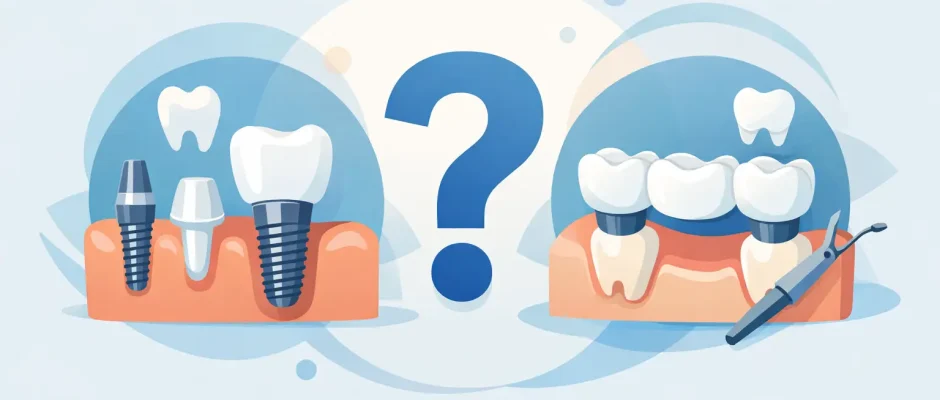
A dental bridge replaces a missing tooth by using the teeth next to the gap as support. Those neighboring teeth are prepared, meaning enamel is reduced so crowns can be placed on them, with an artificial tooth suspended in between.
A dental implant replaces the missing tooth by placing a titanium implant into the bone, where it functions as an artificial root. After healing, a crown is attached to the implant. The key distinction is simple: a bridge depends on adjacent teeth, while an implant depends on the bone.
That difference affects almost everything else – longevity, hygiene, bone preservation, cost structure, and treatment time.
When a bridge makes sense
A bridge can be an appropriate solution in very specific situations. If the teeth next to the missing tooth already have large fillings, fractures, root canal treatment, or old crowns that need replacement, preparing them for a bridge may be a reasonable part of an overall restorative plan.
A bridge may also be relevant when a patient wants a shorter treatment timeline. In many cases, once the supporting teeth are ready, the restoration can be completed faster than implant treatment, which usually requires a healing phase after surgery. For someone with strong supporting teeth and a clear preference to avoid implant placement, a bridge can provide good function and esthetics.
There are also cases where systemic health, medications, smoking, uncontrolled periodontal disease, or local bone limitations make implant treatment less predictable unless additional procedures are done first. In those situations, a bridge may become the more practical path.
Still, practicality should not be confused with superiority. A bridge solves the gap, but it does so by involving other teeth.
When an implant is often the better long-term option
If the neighboring teeth are healthy and untouched, an implant usually has a major advantage: it allows replacement of the missing tooth without grinding down adjacent teeth. That matters. Once a healthy tooth is prepared for a crown, it will never return to its original intact state.
An implant also helps preserve bone. After a tooth is lost, the jawbone in that area starts to shrink because it no longer receives normal functional load through a root. A bridge restores the visible tooth, but it does not stimulate the bone underneath the missing site. An implant, by contrast, transmits load to the bone and helps reduce ongoing atrophy.
For younger patients, or for anyone thinking beyond the next few years, this point is often decisive. Preserving bone and keeping neighboring teeth untouched usually supports a more stable long-term result.
Hygiene is another factor. A bridge can be maintained very successfully, but cleaning underneath the pontic requires technique and consistency. An implant crown can often be cleaned more like an individual tooth, although implant maintenance is still not casual and requires regular professional follow-up.
The real trade-offs in dental implant vs bridge treatment
Patients often expect a simple verdict, but treatment planning is rarely that clean. The better option depends on what you are optimizing for.
If your priority is avoiding surgery, a bridge may feel more comfortable psychologically. If your priority is preserving bone and not sacrificing healthy teeth, an implant often becomes the stronger option.
If cost is the first concern, the answer is not always obvious. The upfront fee for a bridge may be lower in some clinics, but long-term costs can shift if one of the supporting teeth later develops decay, endodontic problems, or fracture. An implant may cost more at the start, especially if bone grafting or guided surgery is needed, yet it can be more conservative biologically because it does not burden neighboring teeth.
Treatment time also varies. A bridge is often faster. An implant may require extraction, healing, bone grafting in some cases, implant placement, osseointegration, and then final restoration. However, immediate implant protocols are possible in selected cases with the right primary stability, favorable anatomy, and careful planning. This is where digital diagnostics and surgical protocols matter, because they improve precision and help determine what is realistic rather than simply desirable.
Bone, gum, and bite conditions matter more than marketing
The missing tooth itself is only part of the picture. Before choosing between an implant and a bridge, a clinician should evaluate bone volume, gum thickness, bite forces, smile line, parafunction such as clenching, and the condition of the adjacent teeth.
Take a missing molar as an example. Back teeth handle high chewing loads. If the neighboring teeth are already weakened, asking them to support a bridge may increase biomechanical stress. In contrast, if the bone is adequate and the patient can maintain good hygiene, an implant may distribute forces more favorably.
Now consider a front tooth. Esthetics become more demanding. The gum contour, thickness of the facial bone plate, and timing of extraction all affect the final appearance. In this area, both implants and bridges can produce excellent results, but only if tissue management is handled carefully. Sometimes a bridge can mask tissue loss more easily. In other cases, immediate implant placement with provisionalization and soft tissue support can create a highly natural outcome. There is no universal winner.
What patients often underestimate
The most common misunderstanding is thinking that replacing a tooth is just about the crown you see. Clinically, the supporting structures are just as important as the visible restoration.
Patients also tend to underestimate maintenance. A bridge is not maintenance-free because it is fixed. The margins around the supporting crowns must be kept clean, and the area under the pontic must be cleaned daily. An implant is also not maintenance-free. Peri-implant tissues can become inflamed, and implant complications are more likely when hygiene, bite control, and recall visits are neglected.
Another issue is timing after extraction. Waiting too long after losing a tooth can allow the bone and soft tissue to collapse, making future implant treatment more complex. In some cases, this means guided bone regeneration or sinus lift procedures are needed before implant placement. Early planning often expands your options and may simplify treatment.
Which option lasts longer?
This question is reasonable, but it should be asked carefully. Both bridges and implants can last many years when planned properly and maintained well. Failures rarely happen for a single reason. They are usually linked to a combination of biology, mechanics, and maintenance.
A bridge may fail because a supporting tooth develops decay at the margin, fractures, or requires root canal treatment. An implant may fail because of poor integration, overload, peri-implantitis, smoking-related complications, or untreated periodontal risk.
So the better question is not only which restoration can last longer, but which one gives your specific mouth the best chance of stable function over time. In many single-tooth cases, especially when adjacent teeth are healthy, the implant has a biologic advantage. But if the neighboring teeth already need crowns, a bridge can be entirely rational.
How the decision is usually made in practice
A proper recommendation starts with imaging, clinical examination, and a review of your goals. The plan should assess whether the tooth can be saved, whether extraction is necessary, the amount of available bone, and whether immediate implant placement is possible. It should also look at the neighboring teeth honestly. If they are healthy, that matters. If they are heavily restored, that matters too.
In a surgical practice focused on predictable outcomes, the discussion often goes beyond yes or no. It includes whether bone grafting is indicated, whether guided placement would improve accuracy, whether PRF can support healing, and whether temporary restoration is feasible during the treatment phase. These details do not just make treatment sound advanced. They change risk, comfort, and the precision of the final result.
So which is better?
If you want the shortest possible answer, here it is: when the adjacent teeth are healthy and bone conditions are acceptable, an implant is often the more conservative and long-term oriented choice. When adjacent teeth already need crowns, when implant surgery is not ideal, or when timeline and anatomy make surgery less predictable, a bridge may be the better option.
That is why the right decision is not made from a price list alone and not from before-and-after photos alone. It is made from diagnosis.
If you are deciding between these two options, ask for a plan that explains not only what can be done, but why that choice fits your anatomy, your bite, and your long-term goals. The best tooth replacement is the one that remains predictable after the excitement of treatment is over.


