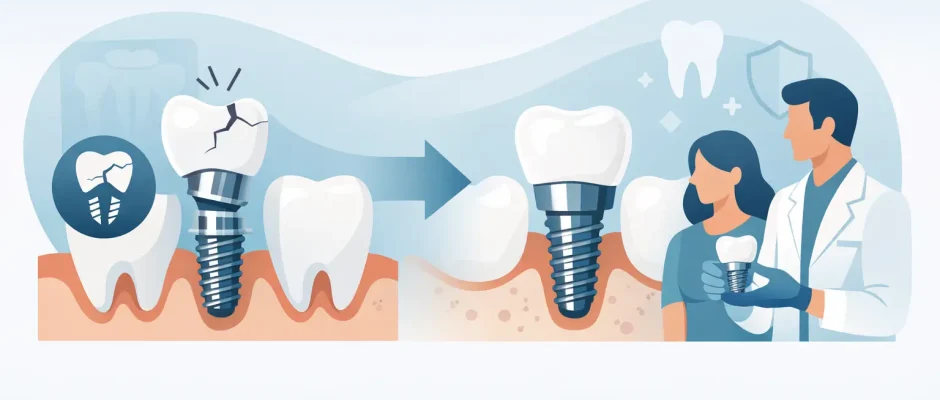
An implant that failed once should never be treated as a routine redo. Failed implant replacement begins with a more important question than when a new implant can be placed: why did the first one fail at all? Without a clear answer, replacing it too quickly can repeat the same problem with a different fixture.
For patients, this situation is frustrating because it often comes after time, cost, and a lot of emotional investment. For the surgeon, it is a case that requires more discipline, not less. The goal is not simply to place another implant. The goal is to rebuild a stable, healthy foundation and create conditions where the next treatment is more predictable than the first.
What counts as a failed implant replacement case
A failed implant does not always mean the same thing. In some cases, the implant never integrates with the bone after placement. In others, it integrates initially but later becomes mobile, painful, inflamed, or loses supporting bone. Sometimes the implant itself is stable, but the prosthetic result is compromised because the position, angle, or surrounding soft tissue is wrong.
That distinction matters. A true biological failure, a prosthetic planning error, and a peri-implant infection are not managed in the same way. If the reason for failure is misidentified, the replacement plan can look technically correct on paper while still carrying unnecessary risk.
Why implants fail in the first place
There is rarely a single universal cause. More often, failure happens because several smaller factors overlap.
One common scenario is inadequate primary stability at the time of placement. If bone quality is poor, the implant site is too wide, overheating occurs during drilling, or the loading protocol is too aggressive, osseointegration may not happen as expected. Another group of failures is related to infection. Existing periodontitis, residual infection from the extracted tooth, poor plaque control, or peri-implantitis can progressively destroy supporting tissues.
Planning errors are also more common than many patients realize. An implant may be placed in insufficient bone volume, in the wrong prosthetic position, or too close to adjacent teeth or implants. In complex cases, the absence of guided planning increases the chance of angulation and depth errors. Smoking, uncontrolled diabetes, bruxism, and untreated bite overload can further reduce the margin for error.
Sometimes the implant was not the wrong treatment, but the protocol was wrong for that specific anatomy. This is especially relevant in cases with bone deficiency, previous infection, sinus proximity, or thin soft tissue biotype.
The first step in failed implant replacement
Before discussing a new implant, the failed one must be assessed carefully. That means clinical examination, imaging, analysis of soft tissues, review of the original timeline, and evaluation of the bite and prosthetic design. A CBCT scan is often essential because it shows remaining bone volume, defect morphology, proximity to anatomical structures, and whether regeneration will be needed before re-implantation.
This stage should feel methodical. If a patient hears, “We’ll just remove it and place another one,” caution is reasonable. In many cases, the right approach is more staged and more precise.
The failed implant itself usually needs to be removed as atraumatically as possible to preserve the remaining bone. The less additional trauma created during removal, the more options remain for reconstruction. In experienced hands, this can often be done with minimal sacrifice of surrounding tissue, which becomes critical for the replacement phase.
Can a new implant be placed immediately?
Sometimes yes, but not always.
Immediate replacement can work when the implant is removed with limited damage, the infection is controlled, enough healthy bone remains for primary stability, and the site can be cleaned thoroughly. In selected cases, immediate placement shortens treatment time and helps preserve tissue architecture.
But immediate re-implantation is not automatically the best option. If there is active infection, significant bone loss, soft tissue deficiency, or uncertainty about the cause of failure, a delayed approach is often safer. Waiting allows the site to heal, inflammation to resolve, and bone or soft tissue grafting to be performed under better conditions.
This is one of the most important trade-offs in failed implant replacement. Faster is appealing, but predictability matters more than speed.
When bone grafting becomes part of the plan
A failed implant often leaves behind a defect. The shape and size of that defect determine what comes next.
If the remaining bone walls are largely preserved, guided bone regeneration may be enough to rebuild the site. If there is more advanced loss, the treatment may require staged augmentation, membrane stabilization, and a longer healing interval before a new implant can be considered. In the posterior maxilla, sinus-related anatomy can further influence the plan.
This is where surgical technique matters. Precise flap design, careful debridement, tension-free closure, and control of soft tissue quality all affect the outcome. Adjuncts such as PRF may support healing, but they do not replace sound surgical principles. Technology helps most when it is used to serve biology, not to bypass it.
Planning the second implant differently
A replacement implant should not simply copy the first treatment plan. It should correct what was missing.
That may mean choosing a different implant diameter or length, changing the three-dimensional position, modifying the loading protocol, improving soft tissue thickness, or redesigning the prosthetic restoration to reduce overload. In some cases, the most responsible decision is not to place another implant at all until systemic or local risk factors are better controlled.
Digital planning and surgical guides can be especially valuable in re-treatment cases because the available bone may already be reduced and the margin for positional error is smaller. If the first implant failed partly because placement was driven by available space rather than prosthetic logic, the second plan should start with the final restoration and work backward.
What patients should ask before replacing a failed implant
Patients do not need to master implantology, but they should expect clear answers. A surgeon should be able to explain what likely caused the failure, whether the site is infected, how much bone remains, whether grafting is required, and why immediate or delayed replacement is being recommended.
It is also reasonable to ask how the new plan differs from the original one. If there is no meaningful change in protocol, timing, biomechanics, or tissue management, the case may not have been fully re-evaluated.
This is where specialist experience becomes important. Failed implant replacement is not just another implant placement. It is a reconstructive problem layered onto a previous complication. Cases like this benefit from a surgeon who is comfortable with bone deficiency, soft tissue management, atraumatic explantation, and prosthetically driven positioning.
Healing time and what to expect
The timeline depends on what is found after implant removal. If the site is clean and stable enough for immediate replacement, treatment may move relatively quickly, though integration still takes time. If grafting is needed first, the process becomes longer but often safer.
Patients are often surprised that a staged approach can be the better investment. More time upfront may reduce the chance of another failure, additional surgeries, and more bone loss later. The objective is not to make the treatment shorter at any cost. It is to make the result more durable.
After replacement, follow-up is not optional. Early healing, soft tissue behavior, oral hygiene, and bite control all need attention. Even a well-placed implant can be put at risk by overload, untreated clenching, or poor maintenance.
Is success still likely after a failed implant?
In many cases, yes. A prior failure does not automatically mean the patient is a poor candidate for future implant treatment. It does mean the second attempt should be more selective, more diagnostic, and more carefully executed.
Success rates can still be favorable when the cause of failure is identified, the site is reconstructed properly, and risk factors are addressed. But honesty matters here: outcomes depend on anatomy, tissue condition, systemic health, smoking status, oral hygiene, and the quality of planning. There is no single answer that fits every patient.
For patients in Tel Aviv seeking a second opinion, the most useful consultation is one that reduces uncertainty. You should leave understanding not only whether a new implant is possible, but what conditions need to be created first for it to be worth doing.
A failed implant is disappointing, but it can also be the moment when treatment becomes more precise. The right replacement plan is built on diagnosis, disciplined technique, and the willingness to slow down when biology demands it.


