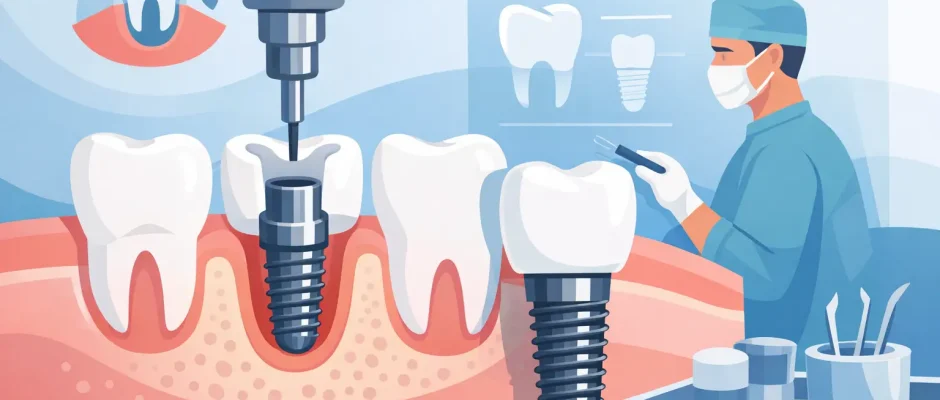
If you were told a tooth needs to be removed, your next question is usually not about the extraction itself. It is about what happens after. That is exactly why patients ask, how immediate implant placement after extraction works, and whether it is really possible to remove a tooth and place an implant in the same visit. In many cases, yes. But the key point is not speed alone. The real goal is a safe, stable, and predictable result.
This treatment protocol means the implant is placed into the fresh extraction site immediately after the tooth is removed. It does not mean every patient leaves with a final crown the same day, and it does not mean every tooth can be replaced this way. Immediate implant placement is a precise surgical decision based on anatomy, infection control, primary stability, and soft tissue management.
When immediate implant placement makes sense
The best candidates are patients whose tooth must be removed, but whose surrounding bone and gum architecture can still support an implant right away. A common scenario is a fractured tooth, a failed root canal, or a tooth with deep decay below the gumline, while the socket walls remain largely intact. In the front of the mouth, this approach can also help preserve the natural gum contour, which matters for esthetics.
That said, an extraction socket is not automatically ready for an implant. If the infection is extensive, if the buccal bone is missing, if the soft tissues are thin, or if the remaining bone cannot provide strong initial fixation, placing an implant immediately may create unnecessary risk. In those situations, a staged plan is often the more responsible option.
This is one of the most important trade-offs in implant dentistry. Immediate placement can reduce treatment time and help preserve tissues, but only if the biology and mechanics are favorable. Forcing the protocol in the wrong case usually leads to more bone loss, gum recession, or compromised implant positioning.
How they do immediate implantation after extraction
When patients ask how the procedure is actually done, the answer is more technical than many expect. The sequence matters.
Preoperative planning comes first
Before surgery, the case is evaluated clinically and with 3D imaging, usually a CBCT scan. This is how the surgeon assesses the socket anatomy, bone volume, root position, neighboring teeth, sinus or nerve proximity, and the likelihood of obtaining primary stability. In complex or esthetic cases, digital planning and a surgical guide may be used to improve implant position and angulation.
Immediate implantation is not simply “extract and place.” The implant must be planned according to the final prosthetic result. If the implant is placed in the wrong axis or too close to the outer bone plate, the case may look acceptable on the day of surgery and become problematic months later.
The tooth is removed as atraumatically as possible
The extraction itself is part of the implant surgery. The goal is not just to remove the tooth. The goal is to preserve the socket walls, especially the thin facial bone, and protect the gum architecture. That often means microsurgical instruments, sectioning the tooth when needed, and avoiding unnecessary force.
A traumatic extraction can destroy the very anatomy needed for immediate placement. This is why surgical technique matters so much.
The socket is cleaned and inspected
After the tooth is removed, the socket is carefully debrided. Granulation tissue, infected material, or cystic remnants are removed, and the walls of the socket are inspected. If there is active infection, the question is not whether infection existed before, but whether the site can be cleaned thoroughly and whether stable implant placement remains possible.
This is a point where clinical judgment matters more than marketing language. Some infected sites can still be treated immediately with proper debridement and protocol control. Others should not.
The implant is placed beyond the extraction socket
The implant is usually not anchored in the empty socket alone. Instead, it is positioned to engage native bone beyond the apex or along the palatal or lingual wall, depending on the tooth location and anatomy. That is how the surgeon achieves primary stability, which is the mechanical firmness of the implant at placement.
Without strong primary stability, immediate placement may still be possible, but immediate provisionalization usually is not. If stability is insufficient, the implant may need a healing period under the gums without load.
The gap is often grafted
In many cases, there is a space between the implant and the socket wall. This is often called the jumping gap. That space is commonly filled with bone graft material to support contour preservation and reduce collapse of the tissues during healing.
Depending on the defect, a membrane may also be used, and in selected cases PRF can support soft tissue healing. The exact combination depends on socket integrity, tissue thickness, and the esthetic demands of the case.
Soft tissue closure or provisional restoration
The site is then managed either with sutures and a healing abutment, or with a temporary tooth when conditions allow. A temporary tooth on the same day is possible only when implant stability is high enough and occlusion can be controlled. It is mainly a soft tissue and esthetic solution, not a sign that healing is already complete.
That distinction matters. A same-day temporary is not the same as a same-day final tooth.
How immediate implant placement after extraction works in the esthetic zone
The front teeth require the highest level of precision. Here, immediate implantation is often considered because preserving the gum line is as important as replacing the tooth. But this is also where mistakes are the most visible.
The thickness of the facial bone, the position of the implant shoulder, the depth of placement, and the design of the temporary restoration all affect the final appearance. Even a well-integrated implant can produce a poor cosmetic result if the tissues were not managed correctly.
For that reason, some patients are surprised to hear that delaying implantation can occasionally produce a better esthetic outcome than doing it immediately. If the socket is compromised, rebuilding the site first may be the more predictable choice.
When immediate implantation is not the best option
Not every extraction should be followed by an implant on the same day. Severe bone loss, uncontrolled periodontal disease, acute purulent infection with major tissue destruction, parafunctional overload, and certain systemic factors can all shift the balance toward a staged approach.
Smoking, poorly controlled diabetes, and a history of difficult healing do not always rule out immediate placement, but they do change the risk profile. In these cases, the safest treatment is the one that respects healing biology instead of chasing a faster timeline.
A good surgeon should be comfortable saying no to immediate implantation when the anatomy does not support it. Patients usually appreciate that honesty once they understand what is at stake.
Healing and what patients usually feel after surgery
Recovery after immediate implant placement is often similar to recovery after a careful extraction with grafting. Mild to moderate swelling, soreness, and limited chewing on that side are expected for several days. Pain is usually manageable with prescribed or recommended medication, especially when the surgery is performed atraumatically.
The implant still needs time to integrate with bone. In many cases, the healing period before the final crown is around three to four months, sometimes longer if additional regeneration was required. If a temporary crown is provided, it usually needs to stay out of heavy function during that period.
Patients often assume that if the implant was placed immediately, the entire treatment is finished immediately. It is better to think of it this way: the surgical phases are combined, but biologic healing still takes time.
Why technique and planning matter more than speed
The biggest advantage of immediate implantation is not convenience alone. It is the possibility of preserving hard and soft tissue architecture while reducing the number of surgical stages. But that benefit appears only when extraction is atraumatic, implant positioning is prosthetically driven, and tissue management is meticulous.
This is where digital planning, microsurgical technique, and protocol discipline make a real difference. In a practice focused on complex implant surgery, these tools are not cosmetic extras. They help reduce variability and improve predictability, especially in demanding cases.
If you are deciding whether this option is right for you, the most useful question is not, “Can this be done the same day?” It is, “Will same-day placement improve my long-term result in my specific case?”
That is the right standard for any implant treatment. Not faster at any cost, but safer, cleaner, and more predictable from the first scan to the final crown.


