A patient usually asks this question at the exact right moment – after deciding they want a fixed tooth again, but before they are ready to trust surgery. How long do dental implants last is not really a question about metal in bone. It is a question about predictability, maintenance, and whether this treatment will still make sense 10, 15, or 20 years from now.
The short answer is encouraging. In many cases, the implant itself can last decades. Not rarely, it lasts for life. But that answer needs context, because an implant is not one single part, and not every failure looks the same.
How long do dental implants last in real life?
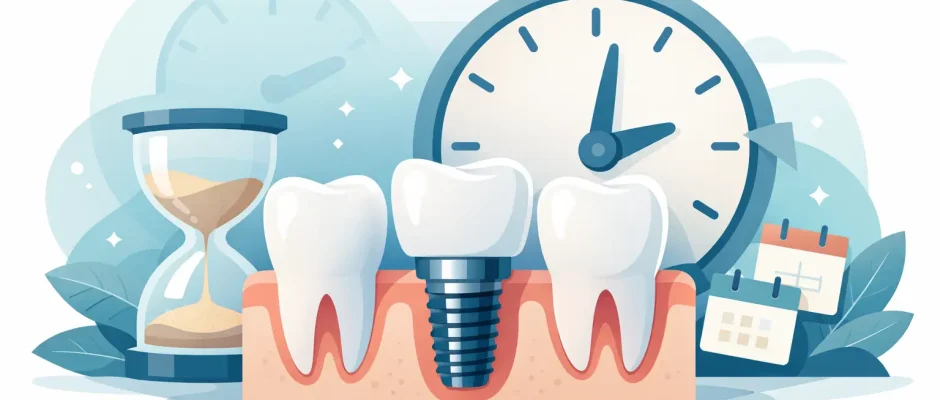
A dental implant has two main components. The implant fixture is the titanium or titanium-zirconia post placed in the bone. On top of it sits the restoration – usually a crown, sometimes a bridge or a full-arch prosthesis. These parts do not age in the same way.
The implant fixture is designed to be long-term. When placement is prosthetically planned, primary stability is achieved, healing is controlled, and the patient maintains healthy gums, long-term survival rates are very high. Many well-integrated implants continue functioning for 20 years or more.
The crown usually has a shorter service life than the implant. Ceramic can chip, bite forces can change, screws can loosen, and the restoration may need replacement or adjustment after 10 to 15 years, sometimes sooner, sometimes later. So when patients hear that implants “last forever,” what often really lasts is the implant in the bone – not necessarily every visible part attached to it.
What determines how long dental implants last?
Longevity starts long before surgery. The first determinant is diagnosis. Bone quality, bone volume, gum condition, bite pattern, smoking status, and general health all influence prognosis. An implant placed into an unfavorable position may survive, but survival is not the same as long-term comfort, hygiene access, and esthetic stability.
That is why digital planning matters. Three-dimensional imaging, evaluation of anatomical structures, and in many cases guided surgery help place the implant where the future restoration will function best. In complex cases, this becomes even more important. If there is bone deficiency, previous infection, or an extraction socket with compromised walls, the treatment plan has to address those limitations instead of pretending they do not exist.
Surgical technique also matters. Atraumatic extraction, careful handling of soft tissue, control of heat during osteotomy preparation, and good primary stability improve the chances of uneventful integration. In selected cases, adjuncts such as PRF or bone grafting are not marketing extras. They support healing biology and help create the conditions an implant needs to last.
Then comes the prosthetic phase. Even a perfectly integrated implant can be overloaded by a poorly designed crown or bridge. If occlusion is not balanced, if there is bruxism, or if full-arch cases are restored without enough attention to force distribution, mechanical complications become more likely.
The biggest reason implants fail is often not the implant
When people imagine implant failure, they usually picture the screw being rejected by the body. True biological failure can happen, but more often the long-term problem is inflammation around the implant, called peri-implantitis, or progressive bone loss caused by poor hygiene, excess cement, smoking, or uncontrolled risk factors.
This is one reason implants require maintenance, not just placement. An implant does not decay like a natural tooth, but the surrounding tissues can still become diseased. If plaque accumulates and inflammation is ignored, bone support can be lost over time.
Patients are sometimes surprised by this because they think an artificial tooth should be lower maintenance than a natural one. The reality is more nuanced. A well-made implant restoration should be easy to clean, but it still needs daily home care and periodic professional monitoring. In that sense, implants are durable, but they are not self-sustaining.
Who gets the longest lifespan from implants?
The best long-term outcomes are usually seen in patients whose treatment is carefully staged and whose risk profile is controlled. A nonsmoker with healthy gums, stable diabetes or no diabetes, good oral hygiene, and a bite that has been properly evaluated is in a very different category from someone who smokes heavily, clenches at night, skips cleanings, and wants to rush through treatment despite active infection.
That does not mean higher-risk patients cannot have successful implants. Many can. It means expectations should be honest. Sometimes the right decision is to treat periodontal inflammation first, graft bone before implant placement, use a surgical guide, protect the result with a night guard, or choose a staged approach instead of immediate loading.
For the right case, immediate implant placement after extraction can be an excellent solution. It shortens treatment time and helps preserve tissue architecture. But it is not a shortcut to be used indiscriminately. If infection is uncontrolled, soft tissue is deficient, or initial stability is not strong enough, immediate placement may compromise the long-term result rather than improve it.
How long do dental implants last if you grind your teeth or smoke?
These are two of the most common practical concerns, and both matter.
Bruxism increases mechanical stress. That does not automatically mean implants will fail, but it raises the chance of screw loosening, ceramic fracture, wear of opposing teeth, and overload of the supporting structures. In these cases, occlusal design and protective appliances are part of implant treatment, not optional extras.
Smoking affects healing and tissue stability. It impairs blood supply, increases the risk of infection, and is associated with more bone loss around implants over time. A smoker can still receive implants, but the conversation should be direct: the expected lifespan may be shorter, the maintenance burden higher, and the margin for error smaller.
Maintenance is where implant longevity is won or lost
Patients often focus on the surgery date. Clinically, the more decisive question is what happens in the years afterward. Regular follow-up allows the team to detect early inflammation, check bone levels radiographically when indicated, tighten or replace components if needed, and intervene before a manageable issue becomes a true failure.
Home care should also be realistic. If a restoration is difficult to clean because of shape or position, that is a design problem as much as a hygiene problem. Good implant dentistry aims for restorations that are not only esthetic and stable but maintainable.
For full-arch cases such as All-on-4, the same principle applies at a larger scale. These treatments can be life-changing and highly durable, but they are not maintenance-free. Professional hygiene, prosthetic checks, and patient compliance remain essential.
When should an implant be replaced?
Not every complication means the implant must be removed. Sometimes the restoration is the only part that needs attention. A crown may wear out, a screw-retained component may loosen, or esthetics may need refinement as adjacent teeth and gums change with time.
If the implant itself loses integration, develops advanced peri-implantitis, fractures, or sits in a position that prevents functional restoration, replacement may be necessary. Even then, treatment is often possible after site management, healing, and in some cases bone regeneration.
This is another reason to choose a surgeon who plans for the long term rather than only for insertion. In implant dentistry, technical success on the day of surgery is not the final standard. The real standard is stable tissue, comfortable function, and a restoration the patient can maintain over many years.
A realistic expectation patients can trust
If you are asking how long do dental implants last, the most honest answer is this: the implant can last decades, often much longer than the crown attached to it, but only if diagnosis, surgical execution, prosthetic planning, and maintenance all work together.
That is why experienced implantologists do not promise immortality. They promise something more useful – a treatment plan built around biology, function, and risk control. In a well-planned case, especially when advanced imaging, guided protocols, and microsurgical principles are used, implants can be one of the most predictable solutions in modern dentistry.
The goal is not simply to place an implant that survives. The goal is to create a result that remains healthy, cleanable, comfortable, and stable in everyday life. That is the difference patients feel years later, when the treatment no longer feels like a procedure and simply feels like their tooth again.


