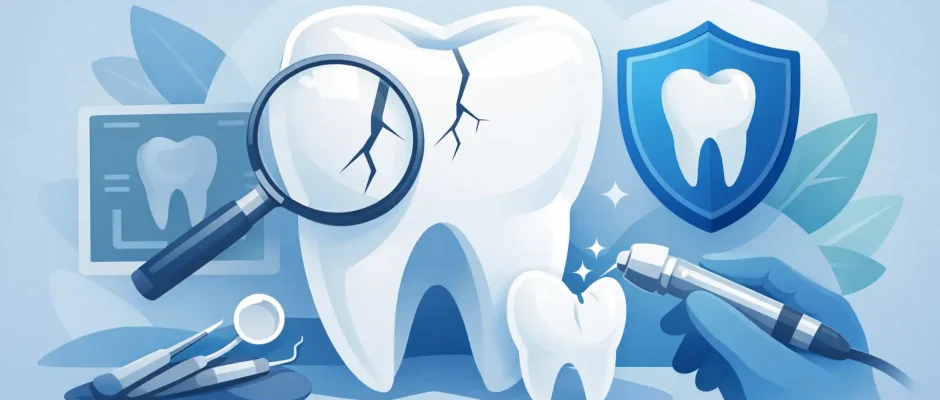
That sharp pain when you bite on one side, then release, is often the moment patients realize something is wrong. If you are searching for how to save cracked tooth problems at home or before an emergency visit, the most useful answer is this: some cracked teeth can be saved, but the outcome depends on how deep the crack goes, whether the pulp is involved, and how quickly the tooth is stabilized.
A cracked tooth is not one diagnosis. It can range from a superficial craze line in enamel to a vertical crack that extends into the root. These situations do not carry the same prognosis, and treating them as if they do is where people lose valuable time. The goal is not just pain relief. The goal is to preserve a tooth that still has enough healthy structure and periodontal support to function predictably.
How to save a cracked tooth starts with the right diagnosis
The first challenge is that cracks are often difficult to see. A tooth may look nearly normal on a standard exam, while the patient reports pain on chewing, sensitivity to cold, or discomfort that comes and goes. In other cases, a visible fracture line is present, but the true depth is not obvious without magnification, bite testing, transillumination, and radiographic assessment.
This matters because treatment is based on the level of damage, not only on symptoms. A small crack limited to enamel may need monitoring or protective restoration. A crack that reaches dentin usually requires coverage and stabilization. If the pulp is inflamed or infected, root canal treatment may be needed before the tooth can be protected with a crown or another definitive restoration. If the crack extends below the gum line or splits the root, the tooth may no longer be restorable.
In practical terms, there is no single home method that can “fix” a crack. What you can do is reduce additional stress until a dentist determines whether the tooth can be saved.
What you should do right away
If you suspect a cracked tooth, avoid chewing on that side. Even a small crack can propagate under repeated force, especially with hard foods such as nuts, crusty bread, ice, seeds, or candy. Many teeth that might have been restored predictably become much harder to save after a few more days of normal chewing.
Keep the area clean, but do not test the tooth repeatedly. Patients often bite again and again to check whether it still hurts. That repeated loading can worsen the fracture. Eat softer foods, use the opposite side, and if cold triggers pain, avoid very cold drinks.
If there is swelling, spontaneous throbbing, or pain that wakes you at night, the issue may already involve the pulp or surrounding tissues. In that setting, delaying care is more risky. Over-the-counter pain medication may help temporarily if you can safely take it, but pain control is not treatment.
Temporary dental repair kits sold in pharmacies can sometimes cover a sharp edge, but they do not stabilize a structurally compromised tooth in any reliable way. They are a short-term comfort measure, not a method of saving the tooth.
When a cracked tooth can be saved
A tooth is often salvageable when the crack is incomplete and the root remains intact. The earlier the tooth is protected, the better the chances. In many cases, the dentist first places a bonded restoration or a provisional protective restoration to reduce cuspal flexure. If symptoms settle and the crack appears limited, the tooth may then be restored definitively.
Teeth that hurt on biting but show no deep periodontal defect and no clear root fracture can often be maintained. Sometimes the final step is a crown, because a crown redistributes chewing forces and reduces the chance that the crack will continue through the tooth. In selected cases, an onlay may be appropriate, especially when enough healthy tooth structure remains and the crack pattern is favorable.
If the pulp has been damaged, saving the tooth may still be possible. Root canal treatment removes inflamed or infected pulp tissue, but it does not repair the crack itself. It helps only when the tooth still has enough structural integrity to be restored afterward. That distinction is important. A root canal can preserve a restorable tooth, but it cannot rescue a vertically fractured root.
When saving the tooth is unlikely
The prognosis changes significantly if the crack runs vertically into the root or extends far below the gum line. These cases often present with localized deep probing around one area of the tooth, persistent pain, swelling, or a narrow periodontal defect. Sometimes the fracture becomes more obvious only after symptoms recur despite treatment.
A split tooth is different from a minor crack. Once the tooth is divided into separate segments, predictable long-term retention is rarely possible. Likewise, if the fracture pattern compromises the biologic width or leaves insufficient sound tooth structure for restoration, heroic treatment may not be in the patient’s best interest.
This is where a careful, surgical-level assessment is valuable. The right question is not only, “Can this tooth be kept today?” It is, “Can it be restored in a way that is stable, functional, and worth the intervention?” Preserving a tooth at any cost is not always the most responsible plan.
Common treatments for a cracked tooth
The treatment plan depends on depth, location, symptoms, and restorability. Small enamel lines may require only observation if they are asymptomatic. More commonly, a structurally weakened cusp or incomplete crack needs a bonded restoration, onlay, or crown to brace the tooth.
If the crack has triggered irreversible pulpitis or infection, root canal treatment may be required before final restoration. When the fracture extends subgingivally in a localized and potentially manageable way, crown lengthening or other adjunctive procedures may sometimes be considered, although the benefit depends heavily on the exact anatomy and the remaining ferrule.
In some complex cases, especially where the crack pattern is uncertain, temporary stabilization and re-evaluation are sensible. Dentistry is not only about acting quickly. It is also about choosing a treatment sequence that gives the tooth a realistic chance.
What makes cracks worse
Cracked teeth often occur in heavily loaded posterior teeth, especially those with large fillings, a history of clenching or grinding, or repeated thermal and mechanical stress over time. Sudden trauma can cause a crack, but chronic overload is just as common.
Large old restorations weaken the remaining tooth walls. Bruxism adds cyclical force. Teeth that have undergone root canal treatment can also be more brittle if they are not adequately protected afterward. Sometimes the trigger is simple: biting on a hard olive pit, ice, or an unpopped popcorn kernel.
This is why prevention after treatment matters. If a patient has parafunctional habits, a night guard may be part of protecting the restored tooth and the neighboring dentition. If the bite is unbalanced, occlusal adjustment may also be relevant.
Can you save a cracked tooth without a crown?
Sometimes yes, but not always. A small crack with limited structural compromise may be managed with a bonded restoration or onlay. That said, many symptomatic posterior cracked teeth do better with cuspal coverage because the restoration must do more than fill a defect. It must reduce flexing under load.
Patients understandably want the most conservative option. That is often appropriate, but conservative does not mean minimal at all costs. If the remaining tooth structure is under constant stress, under-treating the case can lead to a worse fracture and eventual extraction.
Why timing changes the outcome
The window to save a cracked tooth is not infinite. A crack can deepen, bacteria can reach the pulp, and repeated biting can convert a restorable problem into a non-restorable one. This is one reason experienced clinicians do not dismiss intermittent chewing pain, even when the X-ray appears unremarkable.
Early diagnosis improves options. It may allow stabilization before pulpal involvement, and it may avoid more invasive treatment later. In surgical and restorative dentistry alike, predictability improves when intervention happens before the damage escalates.
For patients who are already anxious about dental treatment, this often helps to hear: the first visit is usually about clarity, not rushing into a major procedure. A structured examination, focused imaging, and a treatment plan based on restorability give you a more accurate answer than guessing from symptoms alone.
How to think about tooth-saving treatment realistically
If your goal is to keep your natural tooth, that is a reasonable priority. Natural teeth are valuable. But the right approach is not optimism alone. It is a disciplined evaluation of whether the tooth can be saved in a stable, comfortable, and long-lasting way.
In advanced practices, that evaluation may include magnification, high-quality imaging, and treatment planning that considers both restorative and surgical options. In more difficult cases, the question is not whether treatment can be attempted, but whether the expected result justifies the intervention.
A cracked tooth is one of those problems where small delays can have big consequences. If the pain appears when you bite and release, if cold lingers, or if one tooth suddenly feels unreliable, treat that as a reason to be examined promptly. The sooner the tooth is stabilized and diagnosed correctly, the better the chance that saving it remains a real option.
And if it turns out the tooth cannot be preserved predictably, a clear diagnosis is still valuable – because the best treatment is the one that protects your long-term function, comfort, and peace of mind.


