Losing several teeth in one area creates a very practical problem: you want to chew normally, speak clearly, and stop thinking about the gap every time you smile. When patients compare implant bridge vs partial denture, they are usually not asking for theory. They want to know which option will feel more natural, last longer, and create fewer compromises over time.
The honest answer is that both can be appropriate. But they solve the problem in very different ways, and the best choice depends on bone volume, the condition of the remaining teeth, bite forces, medical history, expectations, and budget.
Implant bridge vs partial denture: the core difference
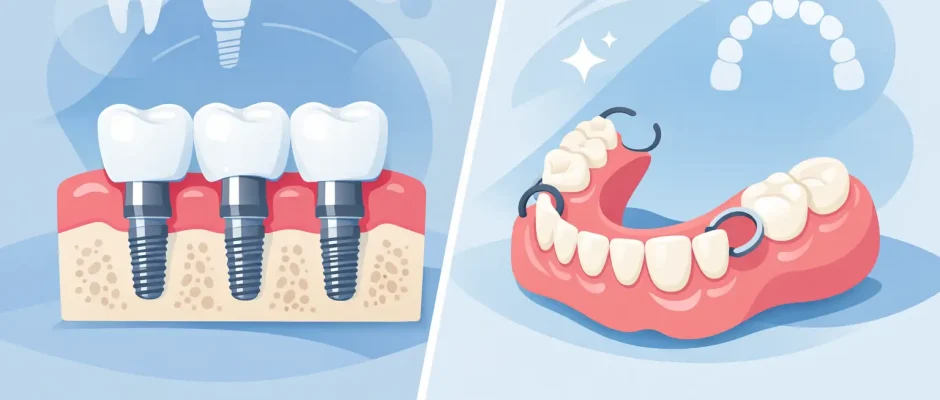
An implant bridge is a fixed restoration supported by dental implants placed in the jawbone. It replaces several missing teeth without relying on a removable appliance. Once completed, it functions much closer to natural teeth because it is anchored in bone and does not need to be taken out for cleaning.
A partial denture is a removable prosthesis that replaces missing teeth and usually gains support from the gums and the remaining natural teeth. Depending on design, it may use clasps or more discreet attachments. It is less invasive at the start because it does not require implant surgery, but it is also less stable and less similar to natural teeth in day-to-day use.
That difference – fixed in bone versus removable on top of the tissues – shapes almost every other trade-off.
How each option feels in daily life
For most patients, the biggest difference is stability. A well-planned implant bridge tends to feel secure during chewing and speaking. It does not shift, lift, or press unevenly on the gums in the same way a removable appliance can. Many patients adapt to it quickly because it becomes part of the mouth rather than something placed into it.
A partial denture can restore appearance and basic function very effectively, but adaptation is usually more noticeable. Some patients feel bulk along the palate or under the tongue. Others notice movement when eating certain foods, especially sticky or hard items. Even a high-quality partial denture has mechanical limits because it is removable and because soft tissue under it compresses under load.
This does not mean partial dentures are always uncomfortable. Many patients do well with them, especially when the design is precise and expectations are realistic. But if your priority is the most natural feel possible, the implant bridge usually has the advantage.
Bone preservation and long-term oral health
This is where the clinical difference becomes more important than the cosmetic one. Implants transmit chewing forces into the bone, which helps maintain bone volume in the area of missing teeth. That matters because after a tooth is lost, the jawbone in that region begins to resorb.
A partial denture does not stop that process in the same way. It replaces teeth above the gums, but it does not stimulate the underlying bone like an implant does. Over the years, this can lead to changes in fit, pressure points, and a need for adjustments or replacement.
There is another consideration. A partial denture often uses the remaining teeth for support. If those teeth already have reduced periodontal support, large fillings, mobility, or an unfavorable position, additional loading may not be ideal. In contrast, an implant bridge can restore the missing area without asking neighboring teeth to carry that burden.
Implant bridge vs partial denture: function and chewing power
Chewing efficiency is not just about comfort. It affects food choices, digestion, and confidence in social situations. Implant-supported restorations generally provide better bite stability and stronger chewing performance than removable partial dentures.
This matters more in the back of the mouth, where bite forces are high. Replacing multiple missing molars with a partial denture may be reasonable, but some patients continue to avoid nuts, crusty bread, meat, or fibrous foods because the appliance does not feel secure enough. With an implant bridge, function is usually closer to natural teeth, although the final result still depends on implant number, position, bone quality, and prosthetic design.
If a patient says, “I do not want to think about my teeth when I eat,” that usually points toward a fixed implant solution if anatomy and health allow it.
Cost matters, but so does the time horizon
A partial denture is typically less expensive at the beginning. For some patients, that alone makes it the right starting point. If surgery is not possible now, or if treatment needs to begin quickly, a partial denture can restore appearance and function without delay.
An implant bridge usually involves a higher initial investment because it includes surgery, imaging, planning, implants, and the final prosthesis. In some cases, additional procedures such as bone grafting or sinus elevation are needed before implants can be placed safely and predictably.
But the lower upfront cost of a partial denture does not always mean lower long-term cost. Removable prostheses may need relines, repairs, clasp adjustments, or replacement as the mouth changes. If supporting teeth deteriorate, the design may also need to change. An implant bridge has its own maintenance needs, but when planned well and maintained properly, it is often the more stable long-term solution.
The right financial question is not simply, “Which costs less today?” It is, “Which option makes the most sense over the next 5 to 10 years for my mouth?”
Who is a good candidate for an implant bridge?
A good candidate usually has enough bone for implant placement or is willing to undergo bone augmentation when indicated. Gum health matters. Smoking status matters. Diabetes control matters. Bite pattern matters too, especially in patients who clench or grind.
This is why diagnostics are so important. A CT scan, clinical exam, and prosthetic planning help determine not just whether implants can be placed, but whether they can be placed in the right position for a predictable bridge. In complex cases, digital planning and surgical guides help improve accuracy and reduce unnecessary trauma.
Some patients assume they are “not candidates” because they were told years ago that they lacked bone. That is not always the final answer. Modern implant surgery can often address bone deficiency, although the plan becomes more individualized and the treatment timeline may be longer.
When a partial denture may be the better choice
A partial denture is not a second-rate option by default. In some situations, it is the more sensible treatment.
If surgery is medically contraindicated, a removable solution may be the safest path. If several teeth have uncertain prognosis and the long-term plan is still evolving, a partial denture can serve as a transitional restoration while the case becomes clearer. It can also be useful when a patient wants to restore function quickly and postpone implant treatment.
Age alone is not the deciding factor. What matters more is whether the patient can tolerate surgery, maintain hygiene, and commit to the treatment process. For some patients, simplicity and lower initial cost outweigh the disadvantages of a removable appliance.
Aesthetic considerations are not identical
An implant bridge often offers a more natural emergence profile and avoids visible metal clasps. That can be especially important in the smile zone. It also avoids the slight movement that sometimes affects confidence when speaking or laughing.
A partial denture can still look good, but aesthetics depend heavily on design and on the position of the remaining teeth. In some cases, clasp visibility becomes a concern. In others, acrylic replacement of missing gum tissue can actually improve the appearance when there has been significant tissue loss.
So aesthetics are not always a simple win for one side. If the area has major bone and soft tissue loss, the best-looking result may require a carefully planned compromise, whether fixed or removable.
Hygiene and maintenance
Neither option is maintenance-free. An implant bridge requires careful cleaning around the implants and under the bridge. Patients need to use the right tools and attend follow-up visits. The fact that it is fixed does not make it self-cleaning.
A partial denture must be removed and cleaned daily, and the supporting teeth need close attention because plaque retention can increase around clasps and rests. Some patients do very well with this routine. Others struggle with consistency.
The best restoration is the one the patient can maintain for years, not just the one that looks best on the treatment plan.
How the decision is usually made in real practice
In real clinical decision-making, the choice is rarely based on a single factor. The conversation usually comes down to three priorities: how fixed you want the result to feel, how much surgery is acceptable, and what level of long-term investment makes sense for your situation.
If the remaining teeth are healthy, the bone is suitable, and the patient wants the most stable and natural-feeling replacement, an implant bridge is often the stronger option. If surgery is not appropriate, the timeline must be shorter, or cost needs to stay lower at the start, a partial denture may be the more practical solution.
In complex cases, the answer may even be staged treatment: a partial denture now, implants later. That approach can make sense when treatment needs to begin immediately but the final fixed plan requires extra diagnostics, healing, or bone reconstruction.
The best decisions in implant dentistry are not made from a price list or a photo online. They come from careful examination, imaging, bite analysis, and a plan built around your anatomy rather than a generic template. If you are choosing between these two options, look for a treatment plan that explains not only what can be done, but why it is the most predictable choice for your case. That clarity usually reduces anxiety as much as the treatment itself.


