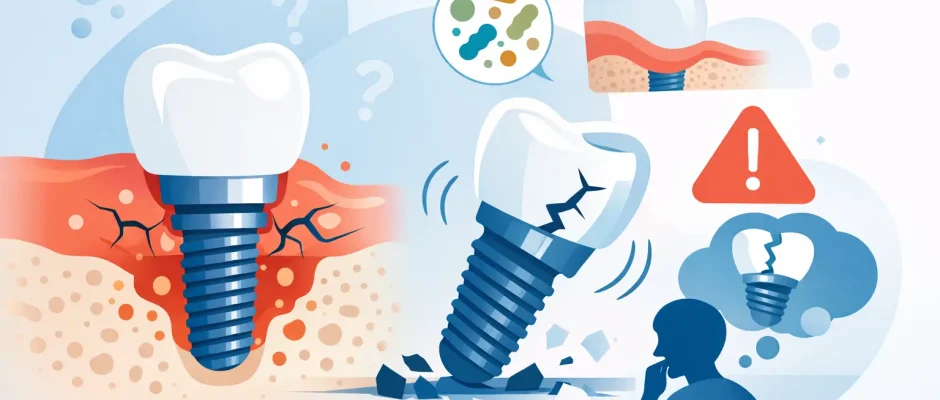
An implant that feels loose a few weeks after surgery is not a minor inconvenience. It is an early warning that osseointegration – the direct bond between bone and implant surface – may not be developing as expected. When patients ask why does implant fail early, they usually want a simple answer. In reality, early failure is almost never about one isolated mistake. It is usually the result of biology, mechanics, and treatment planning interacting at the wrong time.
Early implant failure generally means the implant does not integrate with bone before functional loading is established. This is different from late failure, which may happen years later because of peri-implantitis, overload, or progressive bone loss. In the early phase, the main question is not whether the crown fits well or looks natural. The key issue is whether the implant has become biologically stable inside the jaw.
Why does implant fail early after placement?
The shortest answer is this: the implant moved when it needed stability, or the surrounding tissues could not support normal healing. That can happen for several reasons, and good implantology is about reducing each one before surgery even begins.
Primary stability matters from the first day. If the implant is placed into bone with insufficient density, poor angulation, or an unfavorable drilling protocol, micromovement can exceed the threshold the healing bone can tolerate. Bone cells need controlled conditions to attach to the implant surface. If the implant shifts repeatedly, even on a microscopic level, fibrous tissue may form instead of bone. At that point, the implant may never truly integrate.
Bone quality is one part of the equation, but not the whole story. The upper posterior jaw, for example, often presents softer bone than the front of the mandible. That does not mean implants should not be placed there. It means the protocol may need to be adapted – implant design, drilling sequence, insertion torque, healing time, and in some cases bone augmentation. A technically correct plan in dense bone may be the wrong plan in fragile bone.
Infection is another major cause, although patients often misunderstand what that means. Early implant infection does not always present dramatically. Sometimes it appears as persistent swelling, unusual pain, suppuration, or early bone loss around the implant. Sometimes the source is local contamination during surgery. In other cases, the risk starts before the procedure, with untreated periodontitis, active dental infection, poor oral hygiene, or residual pathology in the extraction site. A clean-looking gumline does not always mean the site is biologically ready.
Surgical trauma also plays a role. Bone is a living tissue with limited tolerance for overheating, compression, and unnecessary manipulation. If osteotomy preparation generates too much heat, if irrigation is inadequate, or if the implant bed is over-compressed, the bone may undergo necrosis instead of healthy remodeling. This is one reason implant placement should never be treated as a routine screwing-in procedure. Precision matters at every step.
Patient-related reasons why an implant fails early
Not every early failure is caused by the surgery itself. Some risk factors are systemic, and some are behavioral.
Smoking remains one of the most consistent negative predictors. Nicotine causes vasoconstriction, reduces blood supply, and interferes with soft tissue and bone healing. Heavy smokers can still receive implants in many cases, but the risk profile changes. The conversation should be honest, not optimistic for the sake of reassurance.
Poorly controlled diabetes can also impair healing and increase susceptibility to infection. This does not mean every diabetic patient is a poor implant candidate. It means glycemic control should be part of treatment planning, not an afterthought. The same principle applies to immune compromise, radiation history, antiresorptive medications, and certain autoimmune conditions. Implant dentistry is local treatment, but the patient heals systemically.
Bruxism complicates matters as well. A patient may say, “I do not chew on that side,” and still place heavy parafunctional forces on a newly placed implant at night. Early loading is not automatically wrong, but uncontrolled loading is dangerous. In selected cases, immediate provisionalization works very well. In others, it is exactly what pushes a borderline case into failure. It depends on bone quality, implant stability, occlusal design, and the discipline of the provisional protocol.
Then there is compliance. Skipping follow-up visits, ignoring hygiene instructions, eating hard food too early, or continuing to wear a poorly adjusted temporary prosthesis can turn a stable situation into a compromised one. Patients rarely do this out of carelessness. Usually, they simply were not given clear enough instructions or did not understand how critical the first healing weeks are.
Why does implant fail early even when surgery seemed successful?
Because surgery can look smooth and still be biologically borderline.
An implant may achieve acceptable insertion torque at placement and yet fail to integrate later. This is one of the reasons experienced clinicians do not rely on one number alone. Torque is useful, but it does not replace full diagnosis. The shape of the socket, bone anatomy, infection history, soft tissue biotype, and prosthetic plan all influence the outcome.
Immediate implant placement after extraction is a good example. In the right case, it can shorten treatment time and preserve anatomy. In the wrong case, it can increase risk. If the extraction site has acute infection, missing bone walls, or limited apical bone for primary stability, immediate placement may become less predictable than staged treatment. Patients often prefer the faster option. The clinician’s responsibility is to distinguish between faster and wiser.
The same is true in cases of bone deficiency. Modern implantology offers effective solutions – guided bone regeneration, sinus augmentation, narrower implants in selected indications, and digitally planned implant positioning. But these tools do not eliminate risk by themselves. They work when they are selected appropriately and executed with discipline.
This is where digital planning and surgical guides add real value. They do not make surgery “automatic,” but they help translate a prosthetic plan into a controlled surgical position, especially in anatomically demanding cases. When combined with careful flap design, atraumatic technique, and protocols that support tissue healing, they improve predictability. That matters not only for esthetics, but for early survival.
Signs of early implant failure patients should not ignore
Pain alone is not a reliable indicator, because some postoperative discomfort is normal. What deserves attention is pain that intensifies instead of improving, mobility, recurrent swelling, persistent bleeding, pus, a bad taste, or the sense that the implant area feels unstable during chewing.
Sometimes the first sign is subtle. The gum may look inflamed for longer than expected. A temporary crown may feel “different” under pressure. The patient may notice a small clicking sensation. None of these findings automatically means the implant is lost, but they justify prompt examination. The earlier a problem is identified, the more options there usually are.
Radiographic follow-up can reveal changes before symptoms become obvious. That is why postoperative reviews are part of treatment, not an optional extra. A properly timed clinical and radiographic assessment can show whether the implant is integrating, whether marginal bone levels are stable, and whether the soft tissues are healing as planned.
How early implant failure is prevented
Prevention starts with diagnosis, not with the implant kit. A three-dimensional assessment of bone volume, bone density, neighboring anatomy, periodontal status, and prosthetic requirements is the foundation. Then comes case selection. Not every extraction site should receive an immediate implant. Not every patient is a candidate for immediate loading. Not every bone defect should be treated with the same grafting strategy.
Good prevention also means respecting the biology of soft tissue. Keratinized tissue width, flap management, tension-free closure when needed, and protection of the blood supply all affect healing. PRF and microsurgical principles can support tissue response, but they are not substitutes for sound fundamentals.
Equally important is communication. Patients do better when they know what normal healing looks like, what to avoid, and when to contact the surgeon. Predictability is not only a surgical achievement. It is also the result of a clear plan, realistic expectations, and follow-through.
If an implant does fail early, that does not automatically mean future implant treatment is impossible. In many cases, the site can be managed, allowed to heal, and treated again under better conditions. The key is to understand why the first implant failed rather than rushing to replace it.
For patients, the most useful question is not simply why does implant fail early. It is this: what is being done before, during, and after surgery to make early failure less likely in my specific case? That question usually leads to better decisions, calmer treatment, and a more predictable result.


