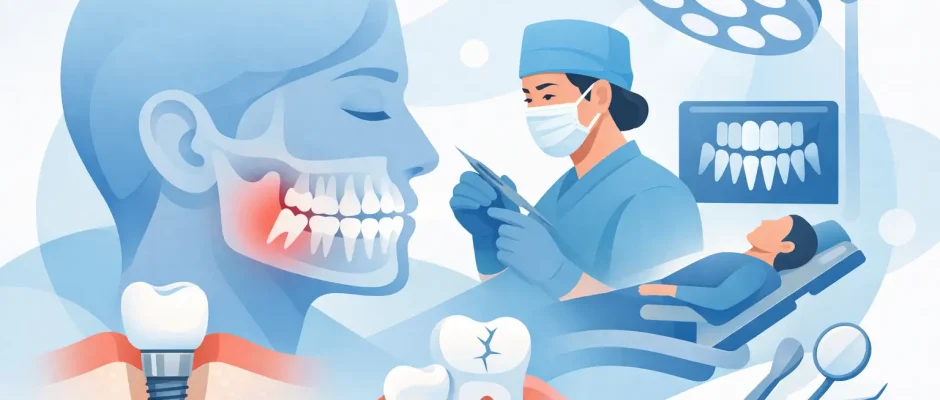
A tooth that hurts when you bite, a wisdom tooth that never fully came in, a failing implant site with too little bone – these are the moments when patients start asking, when do you need oral surgery? The short answer is not simply when something is painful. Oral surgery is usually recommended when a problem cannot be solved predictably with a filling, root canal, crown, or routine dental treatment alone.
For many people, the word surgery sounds bigger than the actual procedure. In practice, oral surgery covers a range of treatments, from a straightforward extraction to bone grafting, sinus lift surgery, microsurgical root-end treatment, and implant placement guided by digital planning. The right question is not whether surgery sounds serious. It is whether surgery is the safest and most predictable way to solve the problem and protect long-term function.
When do you need oral surgery instead of regular dental treatment?
The decision depends on diagnosis, anatomy, and prognosis. A general dentist may identify the problem, but a surgical consultation clarifies whether the tooth can be saved, whether bone and gum conditions are adequate, and what sequence of treatment gives the most stable result.
You may need oral surgery when the tooth is not restorable, when infection extends beyond what conventional treatment can control, when the tooth is trapped under the gum or bone, or when there is not enough bone to place an implant securely. Sometimes the issue is not disease alone but position. A tooth may be healthy in part, yet still damage neighboring teeth, create chronic inflammation, or make orthodontic treatment impossible.
This is why good surgical planning is individualized. Two patients may both have a broken molar, but one can keep it with restorative treatment while the other needs extraction and implant placement because the fracture extends below the gumline. The images may look similar to a patient, but the prognosis is very different.
Common situations where oral surgery is recommended
Teeth that cannot be predictably saved
Not every damaged tooth should be extracted. Modern dentistry can save many teeth that once would have been removed. But there are limits. Vertical root fractures, deep decay below the bone level, severe mobility from advanced periodontal destruction, and repeated failure after prior treatment often shift the balance toward surgery.
In these cases, extraction is not the whole treatment plan. The real question is what comes next. If replacement is needed, the surgeon evaluates bone volume, soft tissue quality, bite forces, and whether immediate implant placement is possible. When done with careful planning, extraction can become the first step toward a controlled reconstruction rather than a last-minute emergency.
Impacted or problematic wisdom teeth
Wisdom teeth are one of the most common reasons patients are referred for oral surgery. You may need them removed if they are impacted, partly erupted, repeatedly infected, damaging the adjacent second molar, or associated with cystic changes.
Pain is a common trigger, but it is not the only one. Some wisdom teeth cause silent damage. Food trapping, gum inflammation behind the second molar, root resorption of the neighboring tooth, and difficult-to-clean pockets can progress without dramatic symptoms. Timing matters here. Removing a problematic wisdom tooth earlier is often simpler and more predictable than waiting until recurrent infection or structural damage develops.
Dental implants and the surgery around them
Implant placement is oral surgery, even when it is minimally invasive. Patients often think of implants as a prosthetic treatment because the visible result is a new tooth. In reality, the surgical phase is what determines whether that tooth replacement will be stable, functional, and esthetic.
You may need oral surgery if you are missing a tooth, need a non-removable replacement, or want to restore chewing efficiency after multiple losses. The complexity varies. In some cases, an implant can be placed immediately after extraction. In others, there is bone loss, sinus expansion in the upper jaw, or soft tissue deficiency, and the site must be prepared first.
This is where digital planning and surgical guides can add real value. They help position implants according to anatomy and future prosthetics, not simply where bone seems available during surgery. That matters especially in the esthetic zone and in full-arch cases.
Bone grafting and sinus lift procedures
A patient may be a candidate for implants but still need preliminary surgery. Bone resorption after tooth loss is common, and it can be significant if a tooth has been missing for years or was lost because of infection.
If there is not enough width or height of bone, grafting may be recommended. In the posterior upper jaw, a sinus lift may be needed because the sinus sits close to the planned implant site. These are not “extra” procedures for their own sake. They are used when existing anatomy would make implant placement unstable, poorly positioned, or short-lived.
The trade-off is straightforward. Grafting usually means more treatment time and a more staged approach, but it can improve implant positioning and long-term prognosis. In selected cases, short implants or alternative strategies may reduce the need for grafting. That is why treatment planning should not be one-size-fits-all.
Persistent infection at the root tip
When a root canal has already been done but symptoms or infection remain, oral surgery may still save the tooth. Apicoectomy, also called root-end surgery, is a microsurgical procedure used when conventional retreatment is not possible or is unlikely to solve the problem.
This can be the right option when a crown or post makes retreatment difficult, when there is persistent inflammation around the apex, or when anatomy at the root end requires direct surgical management. The goal is conservative: remove the diseased tissue, seal the root end, and preserve the tooth if the overall prognosis justifies it.
Gum and soft tissue surgery
Not all oral surgery is about teeth and bone. Some procedures are done to improve the health and stability of the gums. This may include crown lengthening, treatment of gum recession, connective tissue grafting, or periodontal plastic surgery around teeth and implants.
These procedures may be recommended when there is not enough keratinized tissue, when recession causes sensitivity or esthetic concerns, or when tissue architecture needs to be improved before or after implant treatment. In experienced hands, soft tissue surgery is not cosmetic in a superficial sense. It is often central to protecting the result.
Signs you should not ignore
Severe pain, swelling, facial asymmetry, bad taste or drainage, difficulty opening the mouth, repeated gum infections around a partially erupted tooth, and a tooth that feels cracked or loose all deserve prompt evaluation. So does a missing tooth you have been postponing replacing for years, especially if the bite is changing or adjacent teeth are drifting.
The absence of pain does not always mean the absence of a surgical problem. Bone loss, cystic lesions, chronic infection, and root fractures can progress quietly. A CBCT scan or targeted imaging often reveals why a tooth has poor prognosis or why an implant site needs augmentation before treatment begins.
How a surgeon decides what you actually need
A proper consultation is not a sales conversation. It is a diagnostic process. The surgeon reviews symptoms, clinical findings, imaging, medical history, medications, smoking status, bite dynamics, and the strategic value of the tooth.
The key question is always prognosis. Can the tooth be kept predictably? If removal is necessary, is immediate implant placement appropriate or would delayed reconstruction be safer? Is enough bone present, or should regeneration be done first? Can a minimally invasive approach reduce swelling and recovery time? These decisions are based on anatomy and evidence, not preference alone.
For anxious patients, clarity matters as much as technique. When the plan includes anesthesia, the surgical steps, healing phases, and follow-up, treatment becomes easier to understand and much less intimidating.
What oral surgery should feel like from the patient side
Patients usually expect the worst and are often surprised by how controlled modern oral surgery can be. Precise imaging, microsurgical protocols, atraumatic extraction techniques, PRF, and guided implant placement are not just technical details. They support less tissue trauma, better healing, and a more predictable result.
That does not mean every case is simple. Some surgeries are complex because the anatomy is complex. But complexity for the clinician should still translate into a calm, organized experience for the patient. That includes an accurate diagnosis, a realistic explanation of options, and a treatment plan that balances biology, comfort, time, and budget.
If you are wondering whether your situation “really requires surgery,” the answer usually becomes clear after a focused exam and imaging review. The best surgical recommendation is not the most aggressive one. It is the one that solves the problem safely, preserves what can be preserved, and gives you the most reliable path forward.


