Dental Implant Systems Review: What Matters
An implant may be smaller than a natural tooth root, but choosing how it is placed affects every stage of treatment: surgery, healing, the final crown, and future maintenance. A useful dental implant systems review is therefore not a ranking of brands. It is an assessment of whether a system, a clinical protocol, and a patient’s anatomy can work together predictably.
For a patient, the name printed on an implant passport can feel like the main decision. In clinical practice, it is only one part of the decision. Bone volume, gum thickness, bite forces, the position of neighboring teeth, oral hygiene, and the experience of the surgical and restorative team are often more influential than a marketing label.
What an Implant System Actually Includes
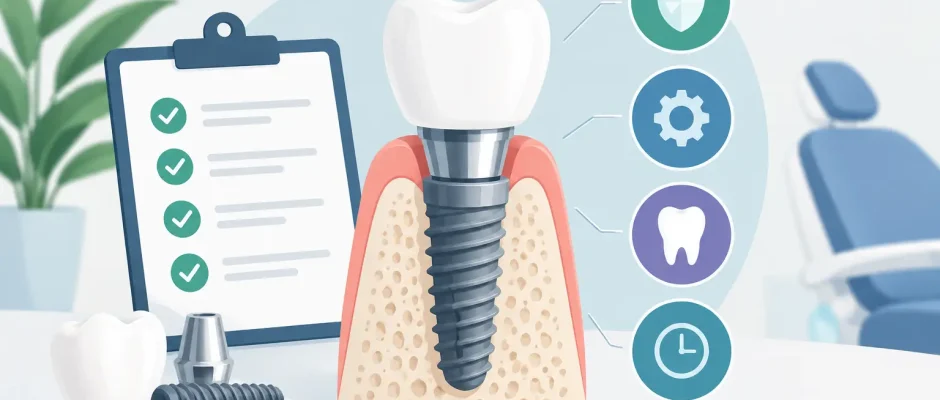
An implant system is more than the titanium implant placed in the bone. It includes the implant body, its surface treatment, internal connection, healing components, abutments, screws, impression or scanning components, and prosthetic options for crowns, bridges, and full-arch restorations.
This matters because the implant must remain serviceable for many years. If a crown screw loosens, if gum tissue changes, or if a restoration needs replacement after wear, the treating team needs accurate components and a stable prosthetic workflow. A system with well-documented parts and reliable availability can make maintenance simpler and more predictable.
Most modern implants are made from medical-grade titanium. Titanium has a long clinical history and is valued for biocompatibility and its ability to integrate with bone. Zirconia implants may be considered in selected cases, particularly when a metal-free option is requested, but they have different prosthetic limitations and should not be presented as a universal substitute for titanium.
Dental Implant Systems Review: The Criteria That Matter
A responsible review begins with evidence, not advertising. High-quality systems are supported by long-term clinical research, clear manufacturing standards, and a broad range of components. That does not mean only one manufacturer can provide a good result. Several established systems are appropriate when selected for the right indication and used according to protocol.
Implant design and primary stability
Implants differ in diameter, length, thread design, taper, and neck configuration. These features influence how an implant engages bone at the time of surgery. Primary stability is especially relevant when immediate implantation after extraction or immediate loading is being considered.
However, more torque is not automatically better. In dense bone, excessive compression may be undesirable. In softer posterior maxillary bone, stability may require a different implant design, a longer healing period, or additional bone augmentation. The goal is controlled stability without compromising biology.
Surface characteristics and bone healing
Modern implant surfaces are designed to support osseointegration, the direct structural connection between bone and implant. Surface texture and treatment can influence early healing, but they do not compensate for poor planning, uncontrolled inflammation, smoking, or inadequate oral hygiene.
A clinician should discuss healing in realistic terms. Some implants can receive a temporary restoration quickly in suitable cases, while others should remain unloaded during bone integration. The safest protocol depends on stability, bone quality, bite conditions, and the planned restoration.
The implant-abutment connection
The junction between implant and abutment is a technical detail with major practical importance. A precise internal connection helps stabilize the restoration and can reduce micromovement at the interface. It also affects how easily the final crown or bridge can be produced and serviced.
For a single tooth in the esthetic zone, this connection must support accurate positioning of the crown and healthy soft-tissue contours. For a full-arch prosthesis such as All-on-4, the prosthetic platform needs to accommodate angulated components and allow access for hygiene and maintenance. The best connection is the one that fits the restorative plan, not simply the one with the most impressive brochure.
Prosthetic flexibility and future maintenance
An implant is not the final tooth. The final result depends heavily on the crown, bridge, or fixed full-arch prosthesis built on it. A strong implant system provides restorative options that match the case: cement-retained or screw-retained crowns, customized abutments, temporary components, angled solutions, and digital scanning workflows.
Whenever possible, screw-retained restorations offer an advantage in retrievability. They can often be removed for repair, cleaning, or screw replacement without damaging the crown. That is particularly useful in posterior teeth and full-arch restorations. Yet there are cases where screw-channel position compromises esthetics or function, and another approach may be appropriate.
Documentation, traceability, and local support
Every implant should be recorded in the patient’s file, including its manufacturer, dimensions, lot information when available, and components used. This is not administrative excess. It protects the patient if care is needed years later, whether in the same clinic or elsewhere.
Availability also deserves attention for patients living in Israel or traveling for treatment. A widely supported system with accessible restorative components reduces uncertainty if future maintenance is required. At Implantolog.co.il, treatment planning is based on a documented surgical and prosthetic plan rather than an isolated choice of implant brand.
Why the Same System Can Perform Differently in Different Patients
Even a well-researched implant system can fail if it is placed in an unfavorable position or restored with excessive force. Implant dentistry is a discipline of three-dimensional planning. The surgeon must account for bone width, nerve pathways, sinus anatomy, the intended crown position, and the thickness of the surrounding gums.
A dental CBCT scan and digital planning help assess these variables before surgery. In selected cases, a surgical guide transfers the virtual plan to the clinical setting. Guided surgery is not mandatory for every implant, and it does not replace surgical judgment. It is valuable when precise angulation, multiple implants, limited bone, or immediate restoration makes accuracy especially important.
Patients with bone loss require further nuance. Placing a shorter or narrower implant may be reasonable in some cases. In others, guided bone regeneration, sinus lift surgery, or staged treatment provides a safer foundation. The choice should reflect anatomy and risk, not pressure to complete treatment in the fewest possible visits.
Immediate Implants and Full-Arch Treatment Are Not Brand Shortcuts
Immediate implant placement after tooth extraction can preserve treatment time and, in selected situations, support soft-tissue contours. But immediate placement is not automatically less traumatic or more successful. Active infection, loss of facial bone, insufficient primary stability, and an unfavorable bite may make a delayed approach more predictable.
The same principle applies to fixed full-arch solutions. All-on-4 can be an effective concept for patients missing most or all teeth, especially when bone anatomy limits conventional implant placement. It requires careful diagnostics, stable implant anchorage, a carefully designed provisional restoration, and disciplined hygiene follow-up. The system used matters, but the surgical plan and prosthetic execution matter just as much.
PRF may also be incorporated into selected surgical protocols to support soft-tissue healing and patient comfort. It should be viewed as an adjunct, not a replacement for atraumatic technique, sound grafting principles, or appropriate healing time.
Questions Worth Asking at Your Consultation
A productive consultation should give you more than a brand name. Ask whether the implant system has long-term clinical documentation, how the implant will be positioned relative to the final crown, and whether bone grafting or sinus augmentation is recommended. You should also understand whether a temporary tooth is safe in your specific case, what maintenance the final restoration will require, and how implant details will be documented.
It is reasonable to ask about the surgeon’s experience with complex extractions, immediate placement, bone augmentation, and management of complications. A clinician should be comfortable explaining alternatives, including why an implant may not be the first recommendation for a particular tooth or patient.
A Better Way to Judge Value
The lowest implant quote can omit diagnostics, grafting materials, provisional restorations, abutments, follow-up visits, or the final prosthetic work. Conversely, a higher price does not automatically prove better care. The useful comparison is a written treatment plan that specifies what is included, what may change after surgery, and which stages are necessary for a durable result.
A successful implant should feel unremarkable in daily life: stable when chewing, comfortable around the gums, and easy to maintain. The right system is the one selected deliberately for your anatomy and restoration, then placed with precision and monitored over time. That is the standard worth looking for before treatment begins.


