Dental Implant vs Tooth Extraction: What Comes Next?
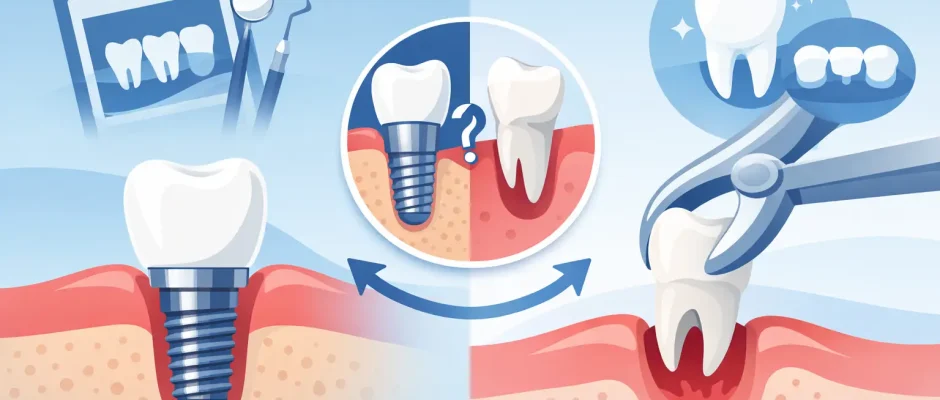
A painful tooth can make the decision feel urgent: remove it now, or try to keep it. But dental implant vs tooth extraction is not quite a direct comparison. Extraction removes a tooth that cannot be predictably maintained. An implant is one possible way to replace that tooth after removal. The clinical question is more precise: can your natural tooth be saved with a reliable long-term prognosis, and if not, what replacement plan protects your bite, bone, and comfort?
A clear answer requires more than an X-ray and a quick recommendation. It depends on the tooth itself, the condition of the surrounding bone and gums, your bite, medical history, and the quality of treatment that is realistically available.
Dental Implant vs Tooth Extraction: Start With the Prognosis
Whenever possible, a healthy natural tooth is worth preserving. It has a periodontal ligament, provides natural sensory feedback during chewing, and does not require surgery to replace. Root canal treatment, retreatment, a crown, periodontal therapy, or microsurgical treatment of the root tip may allow a compromised tooth to function for many years.
However, saving a tooth is not automatically the best choice simply because it remains in the mouth. A treatment plan should be judged by prognosis, not by optimism. If a tooth has repeated infection, a deep fracture, severe loss of bone support, or decay extending too far below the gum line, multiple attempts to preserve it can lead to prolonged discomfort, additional cost, and further bone loss.
The goal is not to remove teeth quickly, and it is not to perform heroic treatment on every tooth. The goal is a stable, comfortable result that can be maintained over time.
Situations where saving the tooth may be reasonable
A tooth may be a good candidate for preservation when the root is intact, infection can be controlled, enough healthy tooth structure remains for a durable restoration, and periodontal support is adequate. Even an apical infection does not always mean extraction. In selected cases, root canal retreatment or an apicoectomy, a microsurgical removal of infected tissue around the root tip, can preserve the tooth.
A cracked tooth also requires careful assessment. Some cracks are limited to the crown and can be stabilized with a properly designed restoration. A vertical root fracture, by contrast, usually has a poor prognosis and often makes extraction the safer choice.
When extraction is the more predictable option
Extraction is commonly recommended when a tooth cannot be restored predictably or creates an ongoing risk to surrounding tissues. Examples include a non-restorable crown or root, a vertical root fracture, advanced mobility from periodontal disease, severe recurrent infection, extensive root resorption, or an impacted tooth causing damage to a neighboring tooth.
Wisdom teeth are a separate category. A fully impacted or poorly positioned third molar may need removal even if it is not painful at the moment, particularly when it contributes to repeated inflammation, cystic changes, decay in the adjacent molar, or progressive bone loss behind that tooth.
In complex situations, three-dimensional CBCT imaging may be necessary. It helps evaluate root anatomy, bone volume, the maxillary sinus in the upper jaw, and the location of important nerves in the lower jaw. This information changes both the safety of extraction and the plan for future implant placement.
What Happens After Tooth Extraction?
After an extraction, the jawbone begins to remodel. This is a natural biologic response: once a root is gone, the bone that supported it is no longer needed in the same way. The greatest changes often occur during the first months, and both the width and height of the ridge can decrease.
That does not mean every extraction site requires an implant. A missing wisdom tooth, for example, is usually not replaced. But losing a visible tooth or a molar that participates in chewing can affect function, appearance, tooth position, and bite stability. Neighboring teeth may drift or tip into the space, while the opposing tooth can gradually over-erupt.
For a tooth that is likely to be replaced, preserving the extraction socket can be valuable. Atraumatic extraction techniques, bone grafting material, and a resorbable membrane may help maintain ridge volume. PRF, made from a small sample of the patient’s own blood, may also be used in appropriate cases to support soft-tissue and wound healing.
Socket preservation does not guarantee that no additional grafting will ever be required. It does, however, often make later implant treatment more predictable, especially in the front of the mouth where tissue contours matter.
When Can an Implant Be Placed?
Implant timing is individualized. There are three common pathways, and each has advantages and limitations.
Immediate implant placement means placing the implant at the same appointment as extraction. This may shorten the total treatment timeline and reduce the number of surgical procedures. It is most appropriate when the socket is favorable, infection is controlled, enough bone is available to achieve primary stability, and the gum tissue can be managed predictably. It is not a shortcut to be used in every case.
Early implant placement is performed after several weeks or months of soft-tissue healing. This approach may be useful when inflammation needs to resolve or when the surgeon wants better conditions for grafting and tissue management.
Delayed implant placement is performed after more complete bone healing, sometimes with ridge augmentation first. This can be the most controlled route when there is significant infection, bone loss, or a difficult extraction site. It adds time, but it may improve the foundation for the final restoration.
A well-planned delay is not a failure. Conversely, an immediate implant is not inherently superior. The right timing is the one that creates the safest conditions for long-term stability.
The Implant Is Only One Part of the Treatment
A dental implant is a titanium or ceramic fixture placed in the jawbone to support a crown, bridge, or full-arch prosthesis. It does not decay like a natural tooth, but it still requires healthy gums, good plaque control, and regular professional follow-up. Implants can develop inflammation around the tissues that support them, known as peri-implant mucositis or peri-implantitis.
Successful implant treatment therefore begins before surgery. The surgeon evaluates periodontal health, smoking or vaping, diabetes control, clenching or grinding, bone quality, bite forces, and the patient’s ability to maintain hygiene. Untreated gum disease or uncontrolled risk factors can compromise both natural teeth and implants.
Digital planning adds another level of control. A CBCT scan can be combined with an intraoral scan to assess the ideal restorative position before surgery. When indicated, a surgical guide helps transfer that plan to the mouth with greater precision. The implant should be placed not merely where bone happens to be available, but where it can support a functional, cleansable, and esthetic final tooth.
For patients with limited bone in the posterior upper jaw, a sinus lift may create sufficient height for implant placement. In other areas, guided bone regeneration can rebuild part of a deficient ridge. These procedures are often what make implant treatment possible in cases previously considered unsuitable.
Questions That Lead to a Better Decision
Before agreeing to extraction or implant treatment, ask for a diagnosis that explains the prognosis of the natural tooth and the replacement plan if removal is necessary. It is reasonable to ask whether the tooth can be restored, what its expected lifespan may be, and what factors could cause treatment to fail.
You should also understand whether extraction will be simple or surgical, whether grafting is recommended, when an implant could be placed, and what temporary option will be used while the site heals. A front tooth may require a temporary restoration for appearance; a back tooth may require a different strategy based on chewing demands and bite stability.
For anxious patients, the details matter. Local anesthesia, careful tissue handling, postoperative instructions, and planned follow-up are not minor additions to surgery. They are part of a safe and comfortable treatment protocol. Complex extractions, bone grafting, and implant placement should be planned as connected stages rather than isolated procedures.
A Decision Built Around the Whole Mouth
The choice is rarely about one X-ray finding alone. A tooth with a guarded prognosis may still be worth treating if it can function comfortably for years and fits into a broader restorative plan. In another patient, earlier extraction and implant replacement may prevent repeated infection and preserve a more manageable foundation for the future.
The best next step is a consultation that gives you a diagnosis, imaging when needed, and a written sequence of treatment. Whether the final plan is tooth preservation, careful extraction, immediate implantation, or bone reconstruction before an implant, confidence comes from knowing why that option fits your anatomy and your long-term goals.


