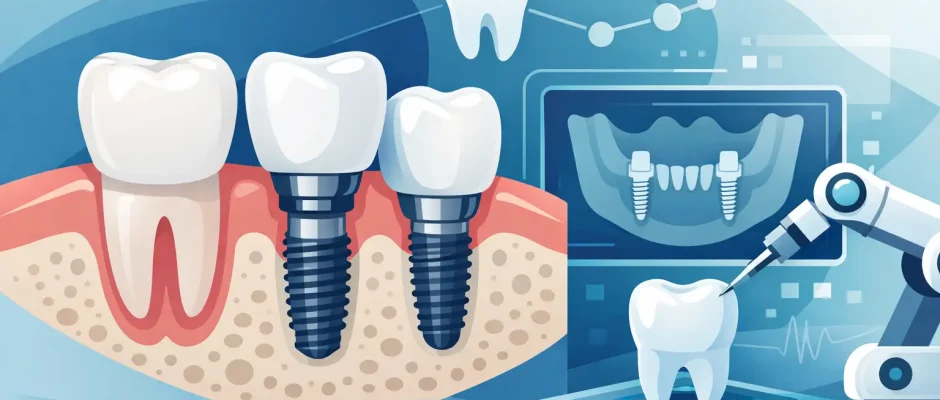
Modern Innovations in Dental Implantology
A dental implant is not simply a titanium post placed where a tooth used to be. It is a surgical and restorative plan that must account for bone volume, gum tissue, bite forces, neighboring teeth, and the patient’s general health. Modern innovations in dental implantology make this planning more precise, but technology is valuable only when it is used within a sound clinical protocol.
For patients, the practical benefit is not a more complicated treatment. It is a clearer diagnosis, fewer surprises during surgery, and a treatment plan that respects both long-term function and appearance. This is especially relevant after complex extractions, when bone has been lost, or when several teeth must be restored.
Digital Diagnosis Before Implant Surgery
The most meaningful advances often happen before the surgical appointment. Three-dimensional CBCT imaging allows the surgeon to assess the jaw in volumes rather than relying only on a two-dimensional X-ray. It shows the available bone width and height, the location of the maxillary sinus in the upper jaw, and critical structures such as the inferior alveolar nerve in the lower jaw.
This information changes decisions. A site that appears suitable on a standard image may have a thin bone wall, an unfavorable root position, or limited space from an important anatomical structure. Conversely, accurate imaging can show that a smaller, less invasive procedure is possible.
Digital intraoral scans add another layer of planning. They record the shape of the teeth, gums, and bite without conventional impression material. When a scan is combined with CBCT data, the planned implant position can be evaluated not only in relation to bone, but also in relation to the future crown. This is called prosthetically driven implant planning.
The distinction matters. An implant may be stable in bone yet positioned poorly for the final restoration. That can complicate hygiene, compromise esthetics, or create unfavorable forces on the implant. Planning from the final tooth backward helps avoid those compromises where anatomy allows.
Surgical Guides: Precision With Clinical Judgment
A digital plan can be transferred to the mouth using a surgical guide, also called a surgical template. The guide is designed from the scan and imaging data and helps control the position, angle, and depth of implant placement.
For a single implant in an uncomplicated area, a guide can improve accuracy and make the procedure more predictable. In full-arch rehabilitation, including selected All-on-4 cases, guided planning is particularly helpful because several implants must work together with a planned temporary or final prosthesis.
A guide is not an autopilot. It has to fit correctly, be stable during the procedure, and be based on accurate scans. The surgeon must still evaluate the tissue, bone quality, and surgical field in real time. If the clinical situation differs from the digital plan, professional judgment matters more than following a template mechanically.
Guided surgery may also allow for more tissue-conscious approaches in appropriate cases. However, a flapless procedure is not automatically better. When bone grafting, removal of infected tissue, or direct visualization of the ridge is needed, opening the gum tissue may be the safer choice.
Static and Dynamic Navigation
Static guidance uses a premanufactured template. Dynamic navigation is another modern option in which a tracking system displays the drill position on a screen during surgery, similar in principle to GPS. It can offer flexibility when the plan needs adjustment during the procedure.
Neither method replaces expertise. Static guides are highly useful for repeatable, preplanned positions; dynamic navigation can be advantageous in selected complex cases. The right choice depends on the anatomy, the number of implants, the restorative plan, and the need for bone augmentation.
Immediate Implant Placement Is Not a Shortcut
One of the most discussed developments in implant treatment is immediate placement: inserting an implant at the time a tooth is removed. In selected patients, this can reduce the number of surgical stages and preserve the architecture of the surrounding tissues.
But immediate placement is not appropriate simply because a patient wants treatment completed faster. The extraction must be atraumatic, infection must be controlled, the remaining bone walls must be assessed, and the implant must achieve sufficient primary stability. The gum biotype, bite, smoking status, and ability to maintain hygiene also influence the decision.
Immediate loading is a separate concept. It means attaching a temporary tooth or temporary bridge soon after implant placement. A fixed temporary restoration can be very beneficial for appearance and comfort, especially in the smile zone or in full-arch treatment. Yet it must be designed to protect the healing implants from excessive biting forces. In some cases, allowing the implant to heal without an immediate tooth is the more predictable plan.
The best protocol is not always the fastest one. It is the one that provides stable conditions for integration and a restoration that can be cleaned and maintained for years.
Modern Innovations in Dental Implantology for Bone Loss
Bone loss no longer automatically prevents implant treatment, but it does require careful diagnosis and a realistic plan. Modern innovations in dental implantology include techniques that rebuild or preserve the foundation needed for an implant rather than forcing an implant into an unfavorable site.
Guided bone regeneration uses bone graft material and barrier membranes to create space where new bone can form. It may be performed before implant placement or at the same time as implant surgery, depending on the size and shape of the defect. In the upper posterior jaw, a sinus lift can create bone volume below the maxillary sinus when the available height is limited.
These procedures are technique-sensitive. The stability of the graft, soft-tissue closure, blood supply, and infection control all affect healing. They also add treatment time, cost, and recovery considerations. For some patients, shorter or angled implants, a modified restorative design, or staged treatment may be more appropriate than extensive augmentation.
PRF and Tissue Healing
Platelet-rich fibrin, commonly called PRF, is prepared from a small sample of the patient’s own blood. It creates a fibrin matrix containing platelets and growth factors and can be used to support soft-tissue healing, fill extraction sockets, or complement grafting procedures.
PRF is not a substitute for proper surgical technique or adequate bone. Its role is supportive, not miraculous. Used thoughtfully, it can be a useful part of a treatment protocol focused on wound healing and patient comfort.
Microsurgical Principles Improve the Details That Matter
Implant success is often discussed in terms of whether the implant integrates with bone. That is essential, but it is not the whole result. Healthy, stable gum tissue around an implant affects esthetics, hygiene, and long-term comfort.
Microsurgical instruments, magnification, fine sutures, and careful tissue handling allow for more controlled procedures. These principles are important when preserving tissue around an immediate implant, performing connective-tissue grafting, or managing recession and thin gum tissue.
The goal is not merely a healed surgical site. It is a stable environment around the future crown where the patient can brush effectively and where the restoration looks proportionate to adjacent teeth. In the front of the mouth, small differences in gum contour can be highly visible.
Implant Materials and Surface Technology
Current implant systems use carefully engineered surfaces intended to support bone attachment. Improvements in surface design, implant connections, and restorative components have contributed to more reliable treatment across a wide range of indications.
Still, no implant brand or surface can compensate for poor planning, uncontrolled gum disease, smoking, untreated diabetes, or excessive bite forces. A quality implant system is one part of treatment. Accurate placement, a well-designed crown or bridge, and regular professional maintenance are equally important.
For patients, the more useful question is not, “Which implant is best?” It is, “Why is this implant position, treatment sequence, and restorative design appropriate for my case?” A clinician should be able to explain that answer in clear terms.
A Better Patient Experience Is Also an Innovation
Technology has value when it reduces uncertainty. Digital planning can help show patients where implants will be placed and why grafting or a staged approach may be necessary. Clear photography, scans, and written treatment sequencing turn an intimidating procedure into a set of understandable decisions.
Comfort also depends on fundamentals: effective local anesthesia, a calm surgical environment, minimally traumatic extraction techniques, postoperative instructions, and access to follow-up care. In complex cases, the ability to coordinate surgery with the restorative dentist is part of safe treatment, not an administrative detail.
At Implantolog.co.il in Tel Aviv, advanced imaging, surgical guides, PRF, and microsurgical methods are used as components of an individualized surgical plan. The technology is selected to serve the clinical objective, whether that means immediate placement after extraction, bone regeneration, or a carefully staged reconstruction.
The most reassuring sign of modern implant care is not an impressive list of devices. It is a consultation in which the surgeon explains the anatomy, the alternatives, the expected timeline, and the limits of each option. That conversation is where a precise and comfortable treatment plan begins.


