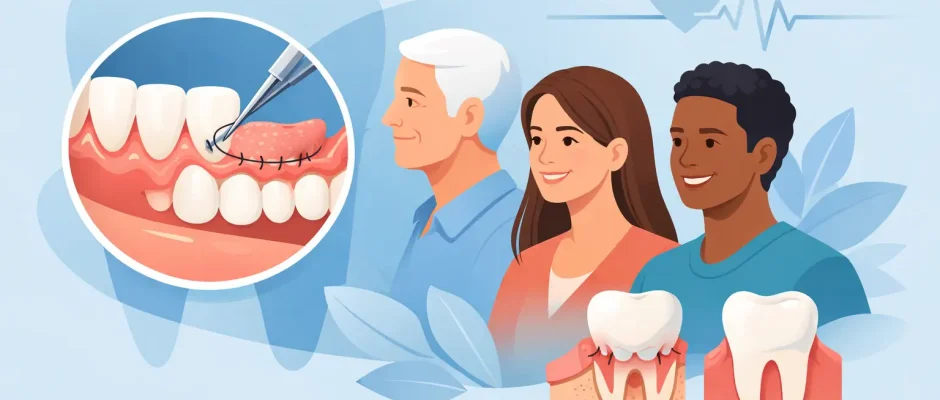
Best Candidates for Gum Grafting and Why
A tooth can be healthy and firmly supported yet still develop gum recession. The root becomes visible, sensitivity appears during brushing or with cold drinks, and the gumline may look uneven in photographs. The best candidates for gum grafting are not defined by appearance alone. They are patients in whom recession creates a real risk to the tooth, discomfort, or an esthetic concern that can be addressed predictably with periodontal microsurgery.
Gum grafting is a procedure that adds or repositions soft tissue around a tooth. Its purpose may be to cover an exposed root, thicken thin gum tissue, increase the zone of stable attached gum, or improve the contour of the gumline before restorative or implant treatment. The correct indication depends on a detailed examination, not on the amount of root that appears visible in a mirror.
Best Candidates for Gum Grafting: Clinical Signs
The most common candidate is a patient with localized gum recession around one or several teeth, especially canines and premolars. These teeth often sit in areas where the outer bone plate is naturally thin. Aggressive brushing, a thin periodontal phenotype, crowding, tooth position, gum inflammation, orthodontic movement, or clenching can gradually move the gum margin downward.
A graft may be recommended when recession is progressing. A stable 1-millimeter defect that has not changed for years does not always require surgery. In contrast, a gumline that continues to move, despite proper home care, deserves evaluation before root exposure becomes more extensive and coverage becomes less predictable.
Root sensitivity is another meaningful indication. Exposed root surfaces do not have enamel protection. They may react sharply to cold, sweets, and brushing, and they can be more susceptible to cervical caries and non-carious wear. Desensitizing products can help many patients, but they do not restore lost tissue. When sensitivity is persistent and recession is significant, grafting may be part of a durable solution.
Esthetics also matters, particularly in the smile zone. Recession around an upper canine or front tooth can create asymmetry that becomes more noticeable after whitening, veneers, or crown replacement. In these situations, treatment planning should begin with the soft tissue rather than placing a restoration first and trying to correct the gumline later.
Thin Tissue and a High-Risk Gumline
Some patients have naturally thin, delicate gum tissue with a narrow band of attached gingiva. This phenotype is more vulnerable to mechanical trauma and may recede more easily around prominent roots. A patient may not have severe recession yet, but the tissue can be unstable – particularly before orthodontic treatment, after tooth movement, or near a planned restoration.
For these patients, the goal is often tissue thickening rather than complete root coverage. A connective tissue graft can make the gum more resistant to future recession and improve the long-term appearance of the site. This preventive approach is considered selectively, after assessing bone anatomy and the cause of the tissue deficiency.
Recession Near Implants, Crowns, and Bridges
Soft-tissue management is especially relevant in complex restorative treatment. Around natural teeth, grafting may improve root coverage and gum thickness. Around implants, the objective is different: to improve the thickness, contour, cleansability, and esthetic integration of the tissue surrounding the implant restoration.
An implant does not have the same attachment apparatus as a natural tooth, so protocols must be individualized. A patient with thin tissue at a planned implant site, a high smile line, or an existing contour deficiency may benefit from soft-tissue augmentation before, during, or after implant treatment. Digital diagnostics and precise surgical planning help determine the sequence. In some cases, bone augmentation is also required; in others, adding soft tissue is the more relevant step.
What Makes a Result More Predictable?
A successful graft is not simply a matter of placing tissue over an exposed root. The surgeon evaluates the recession type, the level of bone between neighboring teeth, root position, the amount of existing keratinized tissue, bite forces, and the patient’s ability to maintain gentle plaque control during healing.
Complete root coverage is often achievable in favorable defects, especially when the recession is localized and the bone and gum tissue between teeth are preserved. However, no responsible clinician should promise identical coverage in every case. Deep, wide defects, recession extending between teeth, a severely prominent root, or a history of repeated trauma can limit the result. Even when full coverage is not realistic, grafting may still reduce sensitivity, increase tissue thickness, and slow further recession.
The cause must also be addressed. If recession developed because of a hard horizontal brushing technique, continued trauma can compromise a carefully performed graft. If inflammation is present, professional hygiene and home-care instruction come first. If tooth position or a traumatic bite contributes to the problem, those factors should be included in the treatment plan.
When Gum Grafting Should Be Delayed
Not every patient with recession should undergo surgery immediately. Active gingivitis or periodontitis must be controlled first. Surgery performed in an inflamed environment is less predictable and does not replace periodontal treatment.
Heavy smoking and nicotine use can impair wound healing and increase the risk of complications. Smoking is not always an absolute contraindication, but it is an important factor in deciding whether surgery should proceed and what result can reasonably be expected. Uncontrolled diabetes, immune disorders, medications that affect healing, and poor oral hygiene also require careful coordination with the patient’s physician and dental team.
Patients who cannot avoid brushing directly on the surgical site during early healing, or who cannot attend follow-up visits, may need to postpone treatment. Gum grafting is a precise procedure, but its outcome also depends on the healing period. Protection of the site, prescribed rinses, soft nutrition when indicated, and timely examinations are part of the protocol.
Which Gum Grafting Technique Is Used?
The technique is selected according to anatomy and the treatment goal. In many esthetic recession cases, a connective tissue graft is placed beneath the gum through a coronally advanced flap or a tunnel approach. This can thicken the tissue while allowing the gumline to be repositioned over the root.
A free gingival graft may be preferable when the principal goal is to create a wider, more stable zone of attached gum, often in the lower jaw or in areas exposed to brushing trauma. In selected cases, substitutes may be considered, although the patient’s own connective tissue remains a valuable option when maximum thickness and color integration are needed.
Microsurgical instruments, magnification, fine sutures, and careful tissue handling matter. They reduce unnecessary trauma and support precise wound adaptation. PRF may be used as an adjunct in selected protocols to support soft-tissue healing, but it is not a replacement for proper diagnosis, stable flap design, or a well-executed graft.
What to Expect From Consultation and Recovery
A consultation should include periodontal measurements, photographs, evaluation of brushing technique, and assessment of the teeth and bone around the recession site. When implant treatment or a complex restoration is planned, three-dimensional imaging and digital planning may be added to determine whether the primary limitation is bone, soft tissue, or both.
The procedure is typically performed under local anesthesia. After surgery, patients usually experience temporary swelling and tenderness rather than sharp pain. The surgical site is protected from brushing at first, and sutures are removed or assessed according to the chosen technique. Most patients return gradually to regular oral hygiene over several weeks, while tissue maturation continues for months.
The best time to discuss grafting is before recession becomes extensive or before a crown, veneer, bridge, or implant locks in a compromised gumline. A careful examination can clarify whether treatment is necessary now, whether monitoring is reasonable, and which approach offers the safest path to stable tissue and a comfortable smile.


