How Long After Sinus Lift Can You Place Implants?
A sinus lift creates the bone support needed for implants in the back of the upper jaw, but it is not a procedure that should be rushed. So, how long after sinus lift can you place implants? In many cases, implants can be placed at the same appointment. In others, the safer protocol is to wait about 4 to 9 months while the graft matures. The correct answer depends on the amount and quality of your existing bone, the type of sinus lift, and whether primary implant stability can be achieved.
The goal is not simply to place an implant as early as possible. The goal is to place it in stable, well-vascularized bone, in the ideal three-dimensional position, so it can support a crown reliably for years.
How long after sinus lift can you place implants?
There are two main treatment pathways: simultaneous implant placement and delayed implant placement.
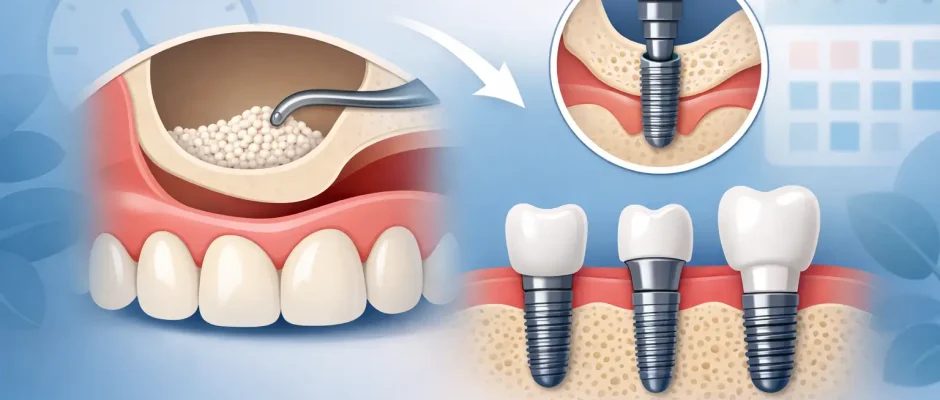
With a simultaneous approach, the implant is placed during the sinus lift procedure. This is often possible when enough native bone remains beneath the maxillary sinus to hold the implant securely at the time of surgery. As a general clinical reference, a residual bone height of approximately 4 to 6 mm may allow simultaneous placement, although millimeters alone never determine the decision.
With a delayed approach, the sinus is augmented first and the implant is placed after healing. A waiting period of 4 to 6 months is common for many grafting protocols. When the bone deficiency is more significant, the sinus membrane was difficult to manage, a larger graft volume was required, or healing factors call for extra caution, the interval may be closer to 6 to 9 months.
A smaller internal, or crestal, sinus lift may sometimes be combined with implant placement when the existing bone provides adequate initial fixation. A lateral window sinus lift, typically used when more bone gain is needed, more often requires staged treatment. Still, the surgical technique alone does not dictate the timeline. The quality of the residual bone and the stability of the planned implant matter more.
Why implant stability matters more than the calendar
An implant does not merely sit in the jaw. It must integrate with living bone through a process called osseointegration. At placement, the implant needs mechanical stability. Over the following months, the body gradually replaces and remodels bone around it, creating biological stability.
If an implant is placed into bone that is too thin or too soft to hold it securely, the risk is not just a longer recovery. The implant can move microscopically during healing, compromising osseointegration. This is why an experienced surgeon may recommend waiting even when a patient hopes to shorten the treatment schedule.
Conversely, waiting longer than necessary is not automatically better. Once the graft has matured sufficiently and the implant site can be planned accurately, unnecessary delay does not improve the result. A precise plan balances surgical safety, healing biology, and the patient’s need for a predictable timeline.
What determines whether implants can be placed immediately?
The decision starts with three-dimensional imaging, usually a CBCT scan. Conventional two-dimensional X-rays cannot fully show the width of the ridge, sinus anatomy, bone density, septa inside the sinus, or the exact position available for the implant.
During planning, the surgeon evaluates several connected factors:
- Residual bone height and width. More native bone generally makes simultaneous implant placement more feasible.
- Bone density and architecture. Even an acceptable height measurement may not provide reliable fixation if the bone is very porous.
- The size of the planned augmentation. A small elevation of the sinus floor is different from rebuilding a severely resorbed posterior maxilla.
- Sinus anatomy and membrane condition. Septa, a very thin membrane, mucosal thickening, or a history of sinus disease may change the surgical plan.
- General health and healing capacity. Smoking, poorly controlled diabetes, certain medications, active periodontal inflammation, and untreated sinus problems can affect healing and risk.
The condition of the neighboring teeth also matters. If there is active infection, a failing root canal, or advanced gum disease, these issues should be controlled before or as part of the implant treatment plan. Implant surgery is most predictable when it begins in a stable oral environment.
Typical timelines after a sinus lift
For a patient with moderate bone loss and good residual bone, an internal sinus lift and implant placement may be completed in one procedure. The implant is then usually left to heal for several months before it receives the final crown. Depending on the case, a temporary restoration may or may not be appropriate.
For more advanced bone loss, a lateral sinus lift may be performed first. After approximately 4 to 6 months, a CBCT scan or clinical assessment confirms that the graft has consolidated adequately. The implant is then placed, followed by another healing period before the final restoration.
In complex cases, treatment can extend beyond nine months from the first procedure to the final crown. That can feel like a long time, particularly when a missing tooth affects chewing or confidence. Yet a staged approach often prevents compromises in implant length, position, and long-term load distribution. The timeline is part of the treatment, not an avoidable inconvenience.
Does PRF make healing faster?
Platelet-rich fibrin, or PRF, is prepared from a small sample of the patient’s own blood and can be used during sinus augmentation. It may support soft-tissue healing and contributes growth factors to the surgical site. In selected cases, it is used alongside bone grafting materials and membranes as part of a biologically focused protocol.
PRF is valuable, but it is not a shortcut that guarantees earlier implant placement. It does not replace the need for sufficient bone volume, careful sinus membrane management, or a stable implant position. Healing should be judged clinically and radiographically, not by a preset promise.
What happens during the healing period?
After a sinus lift, mild swelling, pressure, and temporary congestion can occur. Most patients return to normal daily activities relatively quickly, but the sinus needs protection while the graft stabilizes. Your surgeon will provide specific instructions, which commonly include avoiding forceful nose blowing, sneezing with the mouth closed, scuba diving, and air travel for the period recommended for your case.
Postoperative visits are not a formality. They allow the surgeon to check soft-tissue healing, remove sutures when needed, assess for signs of sinus complications, and confirm that recovery is proceeding as planned. Contact the clinic promptly if you develop increasing pain after initial improvement, fever, persistent foul-tasting drainage, significant swelling, or fluid passing between the mouth and nose.
Good oral hygiene, avoiding smoking, and attending follow-up appointments are practical ways to protect the investment in grafting and implant treatment. If you use a removable temporary denture, it may need adjustment so it does not put pressure on the surgical area.
Can a sinus lift fail or need more time?
Sinus lift procedures have a strong record of success when they are planned and performed carefully, but no surgery is without risk. Membrane perforation, graft infection, sinus inflammation, inadequate graft maturation, or difficulty achieving implant stability can require a modified timeline. A membrane perforation during surgery does not always mean treatment must stop. Small perforations can often be managed with appropriate microsurgical techniques and membranes, while larger issues may lead the surgeon to stage the procedure for safety.
The most responsible plan is one that can adapt to what is found during surgery. Digital planning and surgical guides improve accuracy, but they do not replace clinical judgment. A surgeon should be prepared to change from a simultaneous to a delayed approach if the actual bone quality or stability is less favorable than expected.
Questions to ask at your consultation
Ask whether your implant can be placed at the time of the sinus lift and why. You should also understand the amount of remaining bone, the type of grafting planned, the expected healing interval, and how the result will be evaluated before implant placement.
It is reasonable to ask what happens if the sinus membrane is perforated or if the implant does not achieve sufficient stability during surgery. Clear answers reduce uncertainty and show that the treatment plan is based on protocols rather than assumptions.
At Implantolog.co.il, sinus lift and implant planning are based on CBCT diagnostics, surgical anatomy, and the biological conditions of the individual case. For patients with significant bone loss, this careful sequencing is often what makes a stable and natural-looking restoration possible.
The right time to place an implant is the point at which your bone, sinus, and overall health support a predictable result. A personalized plan may take longer than the fastest option, but it gives the final tooth its best foundation.


Comments (0)