Implant Supported Dentures Comparison Guide
A loose lower denture can turn ordinary meals and conversations into a daily concern. Adhesives may help for a few hours, but they do not stop the underlying problem: the denture rests on gums and a shrinking jawbone, so its fit changes over time. An implant supported dentures comparison helps clarify which approach can provide dependable stability without choosing a treatment plan before the clinical facts are known.
The best option is not automatically the one with the most implants or the most fixed teeth. It depends on bone volume, bite forces, medical history, oral hygiene, esthetic expectations, budget, and whether you prefer a restoration that stays in place or can be removed for cleaning. A proper plan begins with a clinical examination and 3D imaging, not with a one-size-fits-all package.
Implant Supported Dentures Comparison: What Is Being Compared?
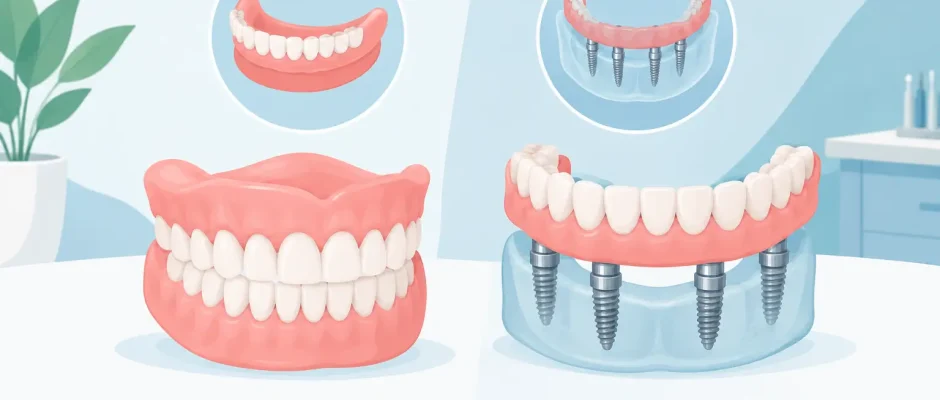
The terms are often used interchangeably, but they describe different types of support. A conventional full denture sits on the gum tissue. An implant-retained denture attaches to implants for stability but remains removable. A fixed implant-supported full-arch bridge is secured to implants and can only be removed by the dentist during maintenance.
Both implant-based options reduce movement and improve chewing compared with a conventional denture. The practical differences are in retention, cleaning, number and distribution of implants, laboratory design, treatment time, and long-term maintenance.
Removable implant-retained overdentures
An overdenture is a removable prosthesis that clicks onto implants using attachments. In the lower jaw, two implants can often provide a major improvement in stability for an existing or newly made denture. Four implants may be recommended when additional support, a more even load distribution, or a bar design is appropriate.
Attachments may use individual locator-type connections or a custom bar. Individual attachments are generally simpler and may have a lower initial cost. A bar can offer strong retention and helps distribute force across the implants, but it requires enough restorative space and meticulous daily cleaning underneath.
For many patients, a removable overdenture is a sensible balance. It is stable while eating and speaking, can be taken out at night if advised, and allows direct cleaning of the implants, attachments, and denture. The trade-off is that attachment components wear and need periodic replacement. The prosthesis may also feel bulkier than a fixed bridge, especially in the upper jaw where palate coverage can still be necessary in some designs.
Fixed full-arch implant bridges
A fixed full-arch bridge is commonly discussed under concepts such as All-on-4 or All-on-6. It replaces a full row of teeth with a screw-retained bridge supported by several strategically placed implants. When teeth cannot be saved, remaining teeth may be removed and implants placed in the same procedure if anatomy, infection control, and primary implant stability permit.
The primary benefit is psychological as well as functional: the restoration feels closer to having fixed teeth. There is no need to remove it daily, and an appropriately designed bridge often provides strong chewing function and lip support. In selected cases, angulated posterior implants can use available bone and avoid or reduce the need for sinus lifting or extensive bone grafting.
This approach is technically demanding. Implant position must be planned around bone anatomy and the final tooth position, often with digital planning and a surgical guide. The temporary bridge must be designed to protect healing implants from excessive forces. A final bridge is usually made after healing and stabilization of the tissues, not simply on the day of surgery.
Fixed does not mean maintenance-free. Patients need to clean around the bridge daily with specialized brushes, flossing aids, or an oral irrigator. Professional maintenance visits are essential because the bridge needs periodic removal for inspection, hygiene, and assessment of screws, implants, and surrounding tissues.
How Many Implants Are Needed?
There is no universal number. For a lower removable overdenture, two implants are widely used when anatomy and bite conditions are favorable. Four implants may offer more retention and support, particularly with a bar or when the jawbone has resorbed significantly.
Fixed full-arch restorations often use four to six implants. Four implants may be appropriate in a carefully selected jaw with good implant distribution and controlled bite forces. Six implants can provide additional support and more flexibility for the prosthetic design, especially in the upper jaw or in patients with stronger chewing forces. More implants are not automatically better if their position, bone quality, and ability to be cleaned are compromised.
The upper jaw usually presents more challenges because bone can be softer and the maxillary sinus limits available bone in the posterior regions. The lower jaw may have denser bone but requires careful planning around the inferior alveolar nerve. A CBCT scan allows the surgeon to evaluate these structures in three dimensions before selecting a protocol.
Bone Loss Changes the Treatment Plan
Tooth loss leads to gradual bone resorption. This is one reason dentures become loose, but it also affects implant placement. Some patients have enough bone for implants without grafting. Others benefit from guided bone regeneration, sinus lifting, or staged treatment before the final prosthetic plan can be carried out.
A fixed solution may still be possible in the presence of bone loss, but the design should not be forced. Tilted implants, short implants, bone augmentation, or a removable option can each be clinically appropriate depending on the anatomy. The safer choice is the one that provides stable implant placement and a restoration that can be cleaned and maintained predictably.
PRF, or platelet-rich fibrin, may be used as part of selected surgical protocols to support soft-tissue healing. It does not replace adequate bone volume, careful surgical technique, or a well-planned prosthetic design.
Comparing Daily Life, Cleaning, and Repairs
A removable overdenture is easier to inspect and clean outside the mouth. This can be especially helpful for patients with limited hand dexterity, reduced vision, or a history of gum inflammation. It also allows relatively straightforward repair if the denture tooth or acrylic base is damaged.
A fixed bridge offers the convenience of teeth that remain in place, but hygiene requires more technique. Food can collect beneath the bridge if cleaning is incomplete. Patients must be willing to spend time cleaning the undersurface every day and return for scheduled professional care.
Both options can need repairs over the years. Acrylic teeth can wear, attachments can lose retention, screws can loosen, and ceramic restorations can chip under excessive force. Night grinding raises the risk of mechanical complications, so a protective night guard may be recommended after final restoration.
Treatment Timeline and Immediate Teeth
Some patients can receive fixed temporary teeth on the day implants are placed. This is called immediate loading, but it is not guaranteed and should not be promised before surgery. It requires adequate implant stability, controlled bite conditions, and a temporary restoration designed to minimize stress during healing.
When infection, insufficient bone, poor implant stability, or medical factors create added risk, a staged approach may be safer. Healing may involve a temporary removable denture before the final restoration is delivered. Although this can feel slower, it may protect the long-term result.
Digital records, CBCT imaging, intraoral scanning, and surgical guides can improve precision and communication between the surgical and restorative stages. Technology supports planning, but it does not replace clinical judgment when anatomy or healing requires a change in the plan.
Cost: Look Beyond the Starting Price
A meaningful comparison includes all phases of care: diagnostic imaging, extractions, bone grafting if needed, implants, temporary teeth, final prosthesis, anesthesia, follow-up visits, and future maintenance. A quote that covers only implant placement does not describe the cost of a complete rehabilitation.
Removable overdentures often have a lower initial cost than fixed full-arch bridges. Fixed treatment usually involves more complex surgery, temporary restorations, and higher-cost laboratory materials. Over time, both options involve maintenance, so choosing solely by the initial figure can create disappointment.
At Implantolog.co.il, the planning process is centered on the surgical and restorative facts of the individual case. For patients considering treatment in Tel Aviv, this means defining what is clinically necessary, what can be staged safely, and what outcome is realistic before treatment begins.
The Right Question to Ask at Consultation
Instead of asking only, “Which denture is best?” ask which option will remain stable, hygienic, repairable, and comfortable for your specific anatomy and daily routine. Bring information about medications, smoking, diabetes control, previous dentures, clenching, and any history of gum disease. These details influence risk and long-term maintenance.
A clear plan should explain the number and position of implants, whether bone augmentation is likely, the type of temporary restoration, the expected healing phases, and what care will be needed after the final teeth are fitted. The most reassuring treatment is not the fastest or most advertised option. It is the one built around sound implant placement, careful healing, and a restoration you can confidently care for every day.


