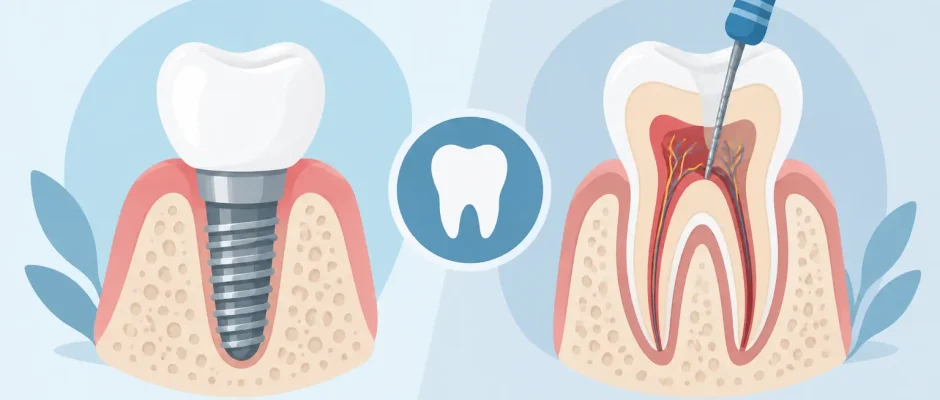
Implant Versus Root Canal Retreatment Compared
A tooth that has already had root canal treatment can become painful years later, develop swelling, or show a dark area near its root on an X-ray. At that point, patients often hear two very different recommendations: try again to save it, or remove it and place an implant. The implant versus root canal retreatment decision is not a matter of choosing the more modern procedure. It is a clinical decision about whether the natural tooth still has a predictable future.
The best treatment is usually the one that controls infection, restores comfortable chewing, and avoids a cycle of repeated procedures. Sometimes that means retreating the root canal. Sometimes it means microsurgery at the root tip. And sometimes a carefully planned extraction and implant is the safer long-term path.
Implant Versus Root Canal Retreatment: Start With the Tooth
A root canal-treated tooth can fail for several reasons. Bacteria may have remained in an untreated canal, entered through a leaking crown or filling, or reinfected the tooth after a fracture. Complex anatomy is common, especially in molars: narrow, curved, or extra canals can be difficult to clean during the original treatment.
Retreatment involves removing the existing filling materials from inside the roots, disinfecting the canal system again, and sealing it under magnification and isolation. If the source of infection can be reached and the tooth has enough healthy structure, retreatment may preserve a functioning natural tooth for many years.
But a root canal only addresses infection inside the tooth. It cannot repair every structural problem around it. A tooth with a vertical root fracture, deep decay below the gumline, severe loss of supporting bone, or insufficient remaining tooth structure may not be a good candidate for another attempt at preservation.
That distinction matters. A technically successful retreatment is not enough if the tooth cannot later support a durable restoration or if its root is cracked. The goal is not simply to keep a tooth in place for a few more months. The goal is a stable, comfortable result that makes sense biologically and financially.
When Root Canal Retreatment Is Often Reasonable
Retreatment is frequently worth considering when the tooth has a favorable foundation. For example, an X-ray or CBCT scan may show persistent inflammation near the root tip but no fracture, while the gum and bone support remain acceptable. The tooth may have a crown with a leaking margin or an old filling that allowed bacteria to enter, yet enough sound tooth structure remains for a new restoration.
In these situations, saving the tooth can offer real advantages. A natural tooth has its periodontal ligament, which provides fine sensory feedback during chewing. It also avoids extraction and the surgical stages of implant treatment. When the canal anatomy is accessible and the final crown can seal the tooth well, retreatment may be the more conservative option.
There are limits. Posts placed inside roots, separated instruments, heavily calcified canals, and crowns that cannot be removed without damaging the tooth can make nonsurgical retreatment more difficult. These factors do not automatically mean the tooth must be extracted, but they change the expected prognosis and should be discussed openly.
Root-End Microsurgery Can Be a Third Option
The choice is not always limited to retreatment or an implant. When a previous root canal filling is acceptable but inflammation persists at the root tip, apical microsurgery may be appropriate. During this procedure, the surgeon accesses the root through the gum, removes infected tissue and the end of the root, then seals the root tip from the surgical side.
Microsurgery can be particularly useful when retreatment would require removing a well-fitting crown or a complex post. It is also valuable when the cause of failure is localized near the root end. Like retreatment, however, it depends on the tooth being structurally restorable and free of a vertical root fracture.
When an Implant May Be the More Predictable Choice
An implant replaces the root of a missing tooth with a titanium fixture placed in the jawbone, followed by a crown after healing or, in selected cases, an immediate temporary restoration. It does not get cavities and does not need root canal treatment. But it is still a surgical reconstruction, not a universal upgrade over a natural tooth.
Extraction and implant placement may be the better option when the tooth has a confirmed vertical root fracture, decay extending too deeply beneath the gumline, extensive loss of tooth structure, or repeated infection after well-performed treatment. A tooth with severe periodontal disease or inadequate bone support may also have a poor long-term outlook even if the canals can be retreated.
In these cases, repeated efforts to preserve the tooth can prolong infection, discomfort, and uncertainty. Removing an unsalvageable tooth can protect surrounding bone and allow treatment to move forward with a defined plan.
Modern implant planning is based on three-dimensional imaging, bite analysis, and restorative planning rather than placing an implant “where there is space.” A CBCT scan helps assess bone volume, the maxillary sinus in the upper jaw, the nerve canal in the lower jaw, and the condition of adjacent teeth. Digital planning and, when indicated, a surgical guide improve precision in implant position.
If infection, bone loss, or the shape of the extraction socket creates a defect, bone grafting or guided bone regeneration may be needed. PRF can be used in appropriate cases to support soft-tissue and bone healing. For some patients, immediate implant placement after extraction is possible. For others, healing first creates a safer and more predictable foundation. The timing should follow the biology of the site, not a one-size-fits-all protocol.
What Actually Determines the Better Choice?
The decisive information comes from a focused examination, current dental imaging, and an honest assessment of prognosis. Pain alone is not a reliable guide. Some fractured teeth are nearly painless, while a tooth with a treatable infection may feel very uncomfortable.
Several questions clarify the decision:
- Is there a vertical root fracture or a crack extending below the gumline?
- Can the tooth be restored with a crown that has a reliable seal and enough supporting structure?
- How much healthy bone and gum support remain around the tooth?
- Is the root canal system accessible for retreatment, or is microsurgery more appropriate?
- What is the condition of the neighboring teeth, bite, and oral hygiene?
- If the tooth is extracted, will the implant site require grafting or sinus elevation?
These details influence both the prognosis and the treatment timeline. For example, a retreatment may be completed over one or several endodontic visits, followed by a new restoration. An implant can require months of integration before the final crown, particularly if bone regeneration is needed. Immediate protocols may shorten some stages, but they are not appropriate for every socket or bite.
Comparing Long-Term Maintenance
Neither option is maintenance-free. A retreated tooth needs a well-sealed filling or crown, regular examinations, and protection from excessive biting forces. If the tooth has lost substantial structure, a crown is often essential to reduce the risk of fracture.
An implant needs equally consistent care. Although it cannot decay, plaque can still cause inflammation around the implant. Untreated peri-implant disease can lead to bone loss and threaten the implant. Daily cleaning, professional maintenance, and control of risk factors such as smoking, poorly controlled diabetes, and night grinding are central to long-term success.
The comparison should therefore not be framed as “natural tooth versus permanent artificial tooth.” It is more accurate to compare two treatment plans with different risks, timelines, and maintenance requirements. A well-restored natural tooth can perform very well. A properly planned implant can also provide excellent function when the tooth cannot be predictably saved.
Avoid Decisions Based Only on a Single X-Ray or Price
A two-dimensional X-ray can reveal useful information, but it may not show a fracture, hidden canal anatomy, or the true extent of bone loss. In complex cases, CBCT imaging can change the diagnosis and prevent an unnecessary extraction or an unrealistic attempt at retreatment.
Cost also deserves a practical conversation. Retreatment may initially appear less expensive, but the full plan can include removal of an old crown, core buildup, a new crown, and possible surgery. Implant treatment may include extraction, grafting, implant placement, a healing component, and the final crown. The most meaningful comparison is not the price of one appointment. It is the expected cost of achieving a stable result over time.
At Implantolog.co.il in Tel Aviv, complex extraction and implant cases are planned with digital diagnostics and a surgical approach tailored to the available bone, gum condition, and restorative goal. When preservation is realistic, the value of keeping a natural tooth should be respected. When it is not, implant treatment should be planned precisely rather than treated as a quick replacement.
A confident choice begins with a diagnosis that answers one central question: is this tooth genuinely restorable with a reliable prognosis? If the answer is yes, saving it may be the right medicine. If the answer is no, replacing it thoughtfully can bring relief, function, and a clearer path forward.


