What Happens at an Implant Consultation?
A missing tooth affects more than appearance. It can change how you chew, place additional load on neighboring teeth, and gradually lead to bone loss in the area. For patients asking what happens at implant consultation, the first visit is not a sales appointment or a rushed decision about surgery. It is a clinical assessment designed to answer one central question: can an implant be placed safely and predictably in your specific situation?
A proper consultation turns uncertainty into a clear sequence of steps. It considers your general health, the condition of the teeth and gums, the volume of available bone, and the final restoration that will sit on the implant. Even when the case appears straightforward, this preparation matters.
What Happens at an Implant Consultation?
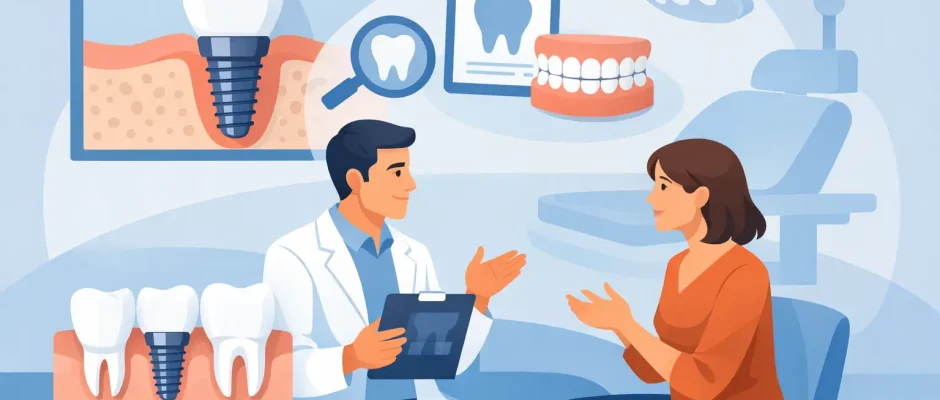
The appointment usually begins with a conversation about your concern and your goals. You may have lost a tooth recently, worn a removable denture for years, or been told that a tooth cannot be saved. These scenarios require different approaches, even if each may eventually involve an implant.
The surgeon will ask when the tooth was lost or when it is expected to be removed, whether there was infection, trauma, gum disease, or previous treatment in the area. You may also discuss practical concerns: how many appointments are likely to be needed, whether a temporary tooth is possible, how long healing may take, and what level of discomfort to expect.
This discussion is also the right time to be direct about anxiety. Fear of dental surgery is common and should influence how treatment is planned. Local anesthesia, the pace of the procedure, postoperative support, and, when appropriate, additional methods of anxiety control can all be discussed before any treatment begins.
Reviewing your medical history
Dental implants are highly successful when they are planned correctly, but they are still a surgical treatment. Your medical history helps determine the safest protocol.
The consultation may cover medications, allergies, diabetes, osteoporosis treatment, immune conditions, bleeding disorders, smoking or vaping, and previous radiation therapy in the head or neck area. Some factors do not prevent implant treatment, but they may change the timing, healing expectations, or need for coordination with your physician.
For example, uncontrolled diabetes can affect wound healing. Heavy smoking raises the risk of complications and implant failure. Certain medications used for bone disease require particular caution before extractions, bone grafting, or implant placement. An experienced surgeon does not treat these details as paperwork. They are part of risk management.
Examination of teeth, gums, and bite
Next comes the clinical examination. The surgeon evaluates the missing-tooth area as well as the entire mouth. An implant must function within your bite, not simply occupy an empty space.
The assessment may include the health of adjacent teeth, the thickness and condition of the gums, signs of periodontal disease, tooth mobility, bite forces, jaw movement, and the space available for the future crown or bridge. If you grind or clench your teeth, that information can affect the design of the final restoration and the need for a protective night guard.
When a tooth is still present but severely damaged, the consultation also considers whether it can be saved. In some cases, microsurgical root treatment, root-end surgery, or periodontal treatment may be a better choice than extraction. Removing a natural tooth should be recommended only when the prognosis is genuinely poor or when replacement offers a more reliable long-term result.
Why 3D Imaging Matters Before Implant Surgery
An ordinary dental X-ray provides useful information, but it cannot always show the full anatomy required for implant planning. For many cases, cone beam computed tomography, known as CBCT, is the most informative diagnostic tool.
A CBCT scan creates a three-dimensional view of the jaw. It allows the surgeon to measure bone height and width, evaluate bone density, identify the maxillary sinus in the upper jaw, and locate the inferior alveolar nerve in the lower jaw. These structures must be respected when selecting the implant position, length, and diameter.
The scan may reveal details that are not visible during a routine examination: a hidden infection, an old root fragment, a narrow ridge, sinus expansion, or bone loss after a tooth has been missing for many years. Finding these issues early is good news, not bad news. It makes it possible to plan around them rather than discover them during surgery.
In selected cases, the CBCT data can be combined with digital intraoral scans. This creates a virtual model of the future tooth and helps plan the implant from the restoration backward. The question is not only where the implant can fit in the bone, but where it needs to be to support a functional, natural-looking crown.
When a surgical guide is recommended
If digital planning shows that precision is especially important, a surgical guide may be recommended. This custom guide is designed from the 3D plan and helps transfer the planned implant position to the surgical procedure.
Guided surgery can be particularly valuable in the aesthetic zone, near anatomical structures, in cases with limited bone, and during full-arch rehabilitation such as All-on-4. It is not automatically necessary for every patient. The decision depends on anatomy, complexity, and the degree of precision needed for the restorative plan.
Deciding Whether Bone Grafting Is Needed
One of the most common questions during a consultation is whether there is enough bone for an implant. After a tooth is removed, the jawbone naturally begins to remodel. The longer a space has been empty, the more likely the bone volume has changed.
A lack of bone does not automatically mean that implants are impossible. It means the treatment plan may need an additional stage. Depending on the location and extent of the deficiency, options may include socket preservation at the time of extraction, guided bone regeneration with graft material and a membrane, a sinus lift in the upper jaw, or a different implant strategy.
Sometimes an implant can be placed at the same time as grafting. In other cases, healing must occur before implant placement. Immediate implantation after extraction can also be an excellent option in carefully selected cases, but it is not a shortcut to be used without regard for infection, bone walls, gum thickness, and primary stability.
Platelet-rich fibrin, or PRF, may be used as part of a surgical protocol in appropriate situations. Prepared from a small sample of the patient’s own blood, PRF can support soft-tissue and bone healing. It is an adjunct, not a substitute for sound surgical planning.
The Treatment Plan You Should Leave With
By the end of a thorough implant consultation, you should understand the recommended route forward and the reasons behind it. A plan should explain whether extraction is needed, whether the implant can be placed immediately or after healing, whether bone grafting is necessary, and when the final crown, bridge, or full-arch restoration can be completed.
The timeline varies. A simple single-tooth case may require fewer stages than a case involving infection, significant bone loss, or multiple missing teeth. Healing periods are not arbitrary delays. They allow bone and soft tissue to stabilize so the implant can integrate and the final restoration can be designed accurately.
You should also receive a transparent discussion of costs and what they include. Surgical treatment can involve diagnostics, anesthesia, extraction, grafting materials, membranes, an implant, a healing component, follow-up visits, and the final prosthetic restoration. Clarifying these components early prevents misunderstandings and allows you to compare treatment proposals fairly.
If there are several reasonable options, they should be presented honestly. A removable solution, a bridge, an implant-supported crown, or a full-arch approach may each have different costs, treatment times, maintenance needs, and biological trade-offs. The best choice is not always the fastest or least expensive one. It is the option that fits your health, anatomy, expectations, and long-term priorities.
Questions Worth Bringing to the Appointment
It helps to arrive with questions, especially if you have been advised to remove a tooth or have already received another treatment proposal. Ask what the scan shows, whether your gums and bone are adequate, what could make the treatment more complex, and what alternatives are clinically reasonable.
You may also ask who will perform the surgery, whether digital planning or a surgical guide is indicated, what happens if grafting is required, and how the result will be maintained over time. Implants require regular hygiene visits, monitoring of the gums and bone, and careful home care. An implant cannot develop a cavity, but the tissues around it can become inflamed if plaque control is inadequate.
For patients in Tel Aviv seeking treatment for complex extractions, bone loss, or implant rehabilitation, the consultation is where the clinical strategy begins. The goal is not to fit every patient into one protocol. It is to select the protocol that offers the greatest safety and predictability for that individual case.
A good consultation should leave you calmer, not pressured. You should know what is known, what still needs to be clarified, and what the next step is before making a decision about surgery.


