Wisdom Tooth Removal Procedure Explained
The words wisdom tooth removal procedure usually bring up the same worries: Will it hurt? How difficult will it be? And how long will recovery take? Those are reasonable questions, especially when the tooth is impacted, partially erupted, or already causing pressure, infection, or damage to the neighboring molar. In practice, the procedure is often much more controlled and predictable than patients expect when it is planned properly.
Wisdom teeth, or third molars, are the last teeth to develop. Some erupt into a functional position and never need treatment. Many do not. They may remain trapped under the gum, grow at an angle, press against the second molar, or create a pocket that repeatedly gets inflamed. This is why removal is not based on the tooth being a wisdom tooth alone. It is based on anatomy, symptoms, hygiene access, and long-term risk.
When a wisdom tooth removal procedure is recommended
Not every third molar has to be removed. If a wisdom tooth is fully erupted, easy to clean, not damaging adjacent teeth, and not involved in infection or decay, observation can be reasonable. Dentistry is not about removing teeth by default. It is about choosing the option with the best long-term prognosis.
Removal is commonly recommended when there is recurrent pericoronitis, pain, decay, gum inflammation around a partially erupted tooth, resorption or damage to the neighboring tooth, cystic changes, or clear lack of space. In some patients, the main issue is not constant pain but repeated flare-ups, food trapping, or chronic inflammation that slowly worsens over time.
Age matters too, but not in a simplistic way. Younger patients often heal faster and have more elastic bone, which can make surgery easier. On the other hand, an asymptomatic tooth in an older adult does not automatically need treatment. The decision should be based on imaging, symptoms, position of the roots, and the relationship to the mandibular nerve or maxillary sinus.
What happens before the procedure
The quality of planning often determines how straightforward surgery feels. A proper consultation starts with a clinical exam and imaging. In simple cases, a panoramic X-ray may be enough. In more complex lower wisdom teeth, especially when roots appear close to the inferior alveolar nerve, 3D imaging can add important detail and improve safety.
This stage is not paperwork for its own sake. It helps answer practical questions: Is the tooth fully or partially impacted? Is bone covering the crown? Are the roots curved, fused, or divergent? How close is the nerve canal? Is there active infection? These details affect the surgical approach, expected duration, and postoperative recovery.
A good surgical plan also includes discussion of medical history. Medications, smoking, diabetes, bleeding disorders, pregnancy, previous jaw issues, and a history of difficult anesthesia can all change the protocol. For anxious patients, it is useful to discuss comfort measures in advance rather than trying to solve anxiety in the chair at the last minute.
Wisdom tooth removal procedure step by step
In most cases, the procedure is done under local anesthesia. The area is numbed carefully, and the goal is profound anesthesia before surgery starts. Patients often expect to feel pain during the procedure, but with effective anesthesia they should feel pressure and movement rather than sharp pain. If pain is present, anesthesia needs to be reinforced.
When the tooth has fully erupted and has a favorable shape, removal may be relatively simple. The tooth is loosened and extracted with controlled instruments. The more involved scenario is an impacted or partially impacted wisdom tooth, especially in the lower jaw.
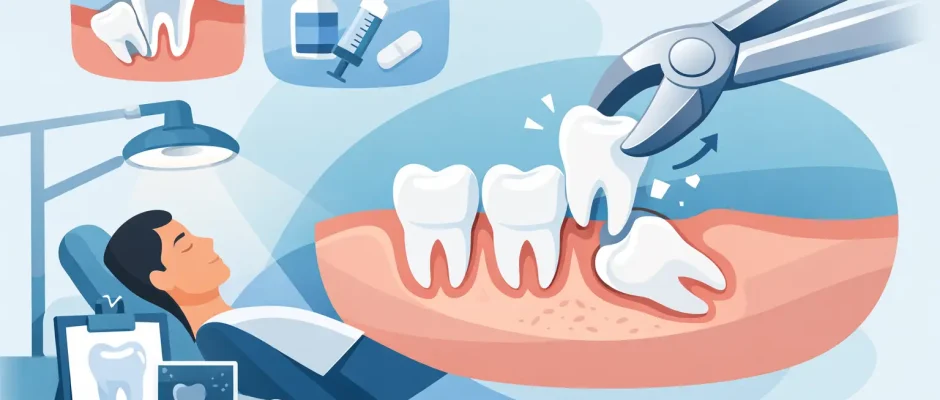
In a surgical extraction, the surgeon makes a small incision in the gum to expose the area. If bone covers the tooth, a limited amount of bone is removed to create access. Frequently, the tooth is sectioned into smaller parts rather than forced out in one piece. This is an important point: sectioning is not a complication. It is often the gentler and safer method because it reduces pressure on the surrounding bone and adjacent tooth.
Once the tooth is removed, the site is cleaned and inspected. If needed, the area is irrigated, sharp bone edges are smoothed, and the soft tissue is repositioned. Sutures are commonly placed to protect the socket and improve healing. Depending on the case, absorbable sutures may be used, or a short postoperative visit may be scheduled for removal.
In a modern surgical setting, atraumatic technique matters. Careful flap design, controlled bone removal, and precise handling of soft tissue help reduce swelling, pain, and delayed healing. In selected cases, biologic support such as PRF may be used to support tissue healing, particularly when the extraction is complex or the local tissues are inflamed.
Does it hurt and how long does it take?
During the procedure itself, pain should be controlled. The more realistic concern is postoperative discomfort. Most patients experience soreness, swelling, and limited mouth opening for several days. That does not mean something is wrong. It is the normal inflammatory response to surgery.
Procedure time varies. An erupted upper wisdom tooth can sometimes be removed quickly. A deeply impacted lower third molar with difficult root anatomy may take longer and involve more postoperative swelling. Faster is not always better. Careful surgery is better.
There is also a difference between technical difficulty and patient experience. A tooth may be surgically complex from the surgeon’s point of view but still feel manageable for the patient when anesthesia, communication, and postoperative instructions are handled well.
Recovery after wisdom tooth removal
The first 24 to 72 hours usually matter most. During this period, a stable blood clot needs to form in the socket, swelling typically rises, and mild bleeding or oozing may occur. Ice, rest, hydration, and taking medications exactly as prescribed make a real difference.
Patients often ask when they can return to normal activity. That depends on the complexity of surgery, the number of teeth removed, and the person’s healing response. Many return to desk work within a day or two after a straightforward extraction. More difficult lower wisdom teeth may require several days of reduced activity. Heavy exercise too early can increase throbbing and bleeding.
Diet should be soft at first, but not excessively restrictive for too long. The main goal is to avoid trauma to the site and avoid dislodging the clot. Gentle oral hygiene is still essential. A clean surgical area generally heals better than one left untouched out of fear.
Risks and complications to understand
Every surgical procedure has risks, and a credible discussion should be specific rather than alarming. The common short-term issues are swelling, bruising, trismus, and temporary discomfort with chewing or swallowing. These usually improve steadily.
Dry socket is one of the better-known complications, especially in lower teeth. It happens when the blood clot breaks down or is lost too early, exposing bone and causing significant pain. It is unpleasant but treatable. Smoking, vigorous rinsing, and certain local factors can increase the risk.
Infection is possible, though not common in healthy patients with appropriate care. Some cases require antibiotics, while others do not. Antibiotics are not a substitute for proper surgical technique and should be used when clinically indicated rather than automatically.
For lower wisdom teeth, nerve-related risk is part of informed consent when roots are close to the inferior alveolar nerve or lingual nerve. This may lead to temporary numbness, tingling, or altered sensation in the lip, chin, gums, or tongue. Permanent changes are much less common, but the risk has to be assessed honestly before surgery. This is one reason 3D planning can be valuable in selected cases.
For upper wisdom teeth, the relationship to the maxillary sinus can influence technique and healing. Again, this does not make surgery unsafe by default. It means the anatomy should be respected and planned for.
When timing matters
There is a tendency to wait until pain becomes severe, but that is not always the best moment for surgery. An acutely inflamed site can be more difficult to anesthetize and more uncomfortable after treatment. If imaging already shows a problematic position, damage to the adjacent tooth, or repeated episodes of infection, earlier planned removal can be easier than emergency treatment later.
That said, immediate removal is not always urgent. A symptom-free tooth may be monitored if the risks of surgery outweigh the likely benefit. This is where individualized assessment matters more than blanket advice.
Choosing the right surgeon for a difficult case
If the tooth is deeply impacted, close to the nerve, associated with a cystic lesion, or part of a broader treatment plan, experience matters. The difference is not only technical skill during extraction. It is the entire protocol: imaging, diagnosis, anesthesia, tissue handling, complication prevention, and a clear recovery plan.
For patients seeking surgical care in Tel Aviv, this is exactly where a focused oral surgery approach adds value. A clinician who routinely manages complex extractions, bone anatomy variations, and postoperative healing issues is better positioned to make treatment both safer and more predictable.
If you need a wisdom tooth removed, the most useful next step is not to guess how difficult it will be based on symptoms alone. Get the tooth examined, get the imaging right, and ask for a plan that explains what is happening now, what could happen if you wait, and what recovery is likely to look like in your specific case. Good surgery begins long before the tooth is actually removed.


Comments (0)