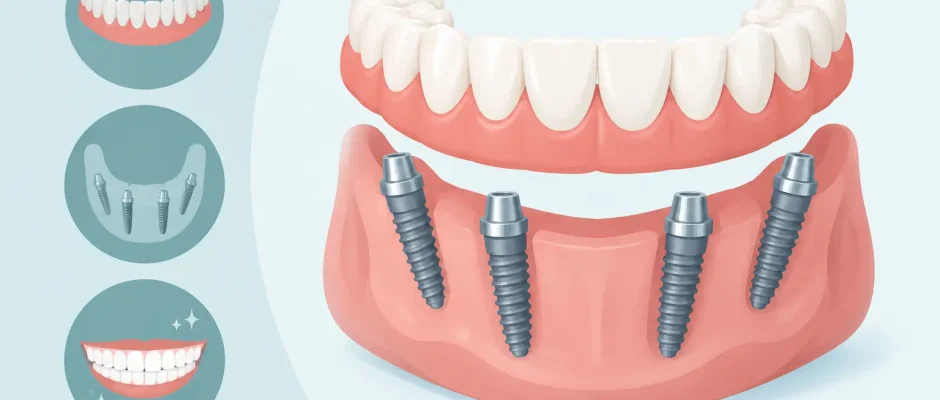
All-on-4 Implants: When Four Implants Are Enough
A loose denture changes more than the way a person eats. It can limit speech, make social meals stressful, and create a constant concern that the prosthesis may shift at the wrong moment. All-on-4 implants are designed for patients who need to restore a full upper or lower arch and want a fixed solution supported by implants rather than a removable denture.
The appeal is understandable: a full arch can be supported by four strategically placed implants, often with a temporary fixed bridge on the day of surgery or shortly afterward. But All-on-4 is not a shortcut and should not be presented as one. Its success depends on diagnosis, bone anatomy, bite forces, general health, and precise prosthetic and surgical planning.
What are All-on-4 implants?
All-on-4 is a full-arch rehabilitation concept. Instead of replacing each missing tooth with a separate implant, the surgeon places four implants in planned positions and uses them to support one fixed bridge. Typically, the two implants in the front are placed more vertically, while the posterior implants are angled to make better use of available bone and avoid important anatomical structures.
This arrangement can be particularly valuable when bone volume in the back of the jaw is limited. In selected cases, tilting the posterior implants may reduce the need for extensive bone grafting or a sinus lift. It does not eliminate the need for bone augmentation in every situation. Severe bone loss, infection, poor bone quality, or unfavorable jaw anatomy may still require grafting or a different treatment plan.
The final restoration usually includes a framework and a complete set of prosthetic teeth. It is fixed to the implants by the dental team, but it is designed to be serviceable during professional maintenance visits.
Who may be a candidate for All-on-4?
This treatment is most often considered for people who have already lost most or all teeth in one jaw, have failing teeth that cannot be predictably saved, or struggle with an unstable removable denture. It can also be appropriate when multiple individual implants would require a more complex reconstruction than a full-arch solution.
Candidacy is not determined by age alone. A healthy 70-year-old with stable medical conditions may be a better candidate than a younger patient with uncontrolled diabetes, heavy smoking, untreated gum disease, or severe grinding. The relevant question is whether surgery and long-term implant maintenance can be performed safely and predictably.
A careful evaluation should include a medical history, examination of the gums and bite, and three-dimensional imaging. A CBCT scan helps assess bone height and width, the location of the maxillary sinuses or mandibular nerve, and any chronic inflammation around failing teeth. Digital records also help the surgeon and restorative dentist plan where the final teeth should be positioned before deciding where implants belong.
Why planning comes before surgery
A beautiful temporary bridge is not the starting point of treatment. It is the result of planning the final prosthetic outcome first. The position of the lips, smile line, facial support, speech, opposing teeth, and bite all affect the design of a full-arch restoration.
For this reason, implant placement should be prosthetically guided whenever possible. Digital planning can combine CBCT data with intraoral scans and diagnostic tooth setup. A surgical guide may then help transfer the plan to the clinical setting with greater accuracy. It does not replace surgical judgment, but it can improve control of implant angulation, depth, and position.
At the consultation, the clinician should also determine whether teeth planned for extraction can be removed and implants placed in the same visit. Immediate implant placement and immediate loading can be excellent options in properly selected cases. They are not automatic. Active infection, inadequate primary stability, poor bone quality, or an unstable bite may make a staged approach safer.
What happens during All-on-4 treatment?
The surgical appointment may include extraction of remaining teeth, thorough cleaning of infected tissue, implant placement, and preparation of a temporary bridge. Treatment is performed under local anesthesia, with sedation options considered when appropriate for the patient’s health and anxiety level.
For an immediate fixed temporary bridge, the implants need to achieve sufficient initial stability. The temporary prosthesis is designed to protect the healing implants, not to function like natural teeth on day one. Patients are generally instructed to follow a soft-food diet during the early healing period and avoid biting hard foods with the temporary teeth.
Healing and integration of the implants with the jawbone usually take several months. During this period, the temporary bridge may need adjustments as swelling resolves and the gums heal. The final bridge is made only after the clinical team confirms that the tissues are stable, the bite is controlled, and the implant integration is satisfactory.
The temporary bridge and the final bridge are different stages
One common misunderstanding is that the teeth attached on the day of surgery are the final teeth. In most cases, they are a provisional restoration. Their role is highly valuable: they restore appearance, help the patient speak and smile, and provide a controlled transition through healing.
The final bridge is fabricated after the implants and soft tissues have stabilized. Depending on the clinical situation, it may be made from materials such as zirconia, ceramic layered over a framework, or high-strength acrylic composite. Each option has trade-offs involving esthetics, repairability, thickness, wear behavior, and cost.
For example, zirconia can be highly durable and esthetic, but it requires thoughtful design and careful bite adjustment. Acrylic-based solutions are often easier to repair and modify, but they may wear over time. The right choice depends on the patient’s bite, parafunctional habits, smile expectations, available space, and ability to attend maintenance visits.
What risks and limitations should be discussed?
All-on-4 treatment has a strong clinical track record when diagnosis, surgery, prosthetic design, and hygiene are managed carefully. Still, it is a surgical and restorative treatment, not a lifetime guarantee without maintenance.
Possible surgical complications include swelling, bruising, temporary discomfort, bleeding, infection, sinus-related issues in the upper jaw, or altered sensation in the lower jaw. Implant failure is uncommon in well-selected cases, but it can occur. Smoking, uncontrolled metabolic disease, poor hygiene, untreated periodontal infection, and excessive grinding can increase risk.
There are also prosthetic considerations. Temporary teeth can chip or fracture if overloaded. Screws can loosen, and the final bridge may eventually need repair, polishing, or replacement. Because all teeth are connected in one bridge, a problem with one component deserves timely attention rather than waiting for pain to develop.
Long-term success requires daily cleaning under the bridge, regular professional hygiene appointments, and periodic examination of the bite and implant tissues. A fixed bridge feels much more secure than a denture, but it still needs disciplined care.
When another approach may be better
Four implants are not always the ideal number. Some patients benefit from additional implants because of jaw shape, bone quality, bite force, or the planned design of the final bridge. Others may be better served by treating one arch first, preserving healthy teeth, or using individual implants and shorter bridges rather than a full-arch reconstruction.
In cases of advanced bone loss, staged bone regeneration may offer a more favorable foundation. In other cases, a removable implant-supported overdenture can provide excellent stability with a lower surgical and financial burden. The best plan is the one that balances biological safety, function, esthetics, treatment time, and the patient’s ability to maintain the result.
For patients considering care in Tel Aviv, a full-arch consultation should end with a written plan: which teeth are salvageable, whether grafting is needed, how the temporary restoration will be managed, what the final bridge will be made from, and what follow-up care is included.
The most useful next step is not choosing a treatment name. It is obtaining a complete diagnostic evaluation and asking whether four implants offer the right foundation for your specific jaw, bite, health, and long-term goals.


