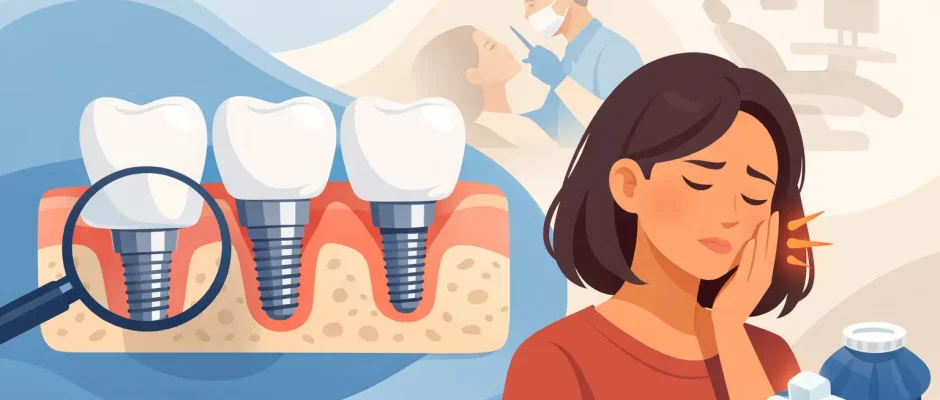
Most patients asking are dental implants painful are not really asking about the implant itself. They are asking something more personal: Will I be able to get through the surgery calmly, and what will the first few days feel like afterward? That is the right question. In modern implant dentistry, the goal is not to prove that surgery can be tolerated. The goal is to make it controlled, predictable, and as comfortable as possible.
The short answer is this: during the procedure, patients should not feel pain. After the procedure, some soreness, pressure, and swelling are normal, but severe pain is not the standard outcome. If treatment is properly planned, anesthesia is effective, and the surgical technique is precise, recovery is usually easier than many people expect.
Are dental implants painful during the procedure?
A dental implant is placed under local anesthesia, so the area is numb before the surgeon starts. Patients typically feel pressure, vibration, and movement, but not sharp pain. That distinction matters. Many people are surprised by the sounds and sensation of work being done, yet the tissue itself should be anesthetized.
If a patient feels actual pain during surgery, that is not something to push through. It usually means the anesthesia needs to be reinforced or the approach adjusted. Good surgical care depends on communication as much as technique. The patient should know that discomfort can be managed in real time.
Anxiety often makes people expect the worst. In practice, implant placement is frequently less uncomfortable than removing an infected tooth. A planned implant site, especially when guided by digital imaging and a surgical template, is a controlled surgical field. There is less guesswork, less unnecessary trauma, and often a smoother postoperative course.
What does an implant feel like afterward?
After the numbness wears off, it is normal to feel tenderness in the gum and underlying bone. Most patients describe it as soreness rather than pain. It may feel similar to having bruised the area or having had a difficult dental cleaning focused on one region, except deeper and more localized.
The first 24 to 72 hours are usually the most noticeable. During that period, patients may experience swelling, mild throbbing, sensitivity when chewing near the area, and limited mouth opening if the implant was placed in the back of the mouth. These symptoms are part of normal healing. They do not automatically mean something is wrong.
By contrast, intense pain that worsens each day, significant bad taste, fever, or swelling that keeps increasing after day three deserves prompt evaluation. The key point is not that every recovery feels the same. It is that normal healing follows a recognizable pattern, and good follow-up helps separate expected discomfort from a developing problem.
Why pain levels vary from patient to patient
Not all implant cases are equal. A single implant placed into healthy bone with a straightforward flapless or minimally invasive approach is very different from a full-arch reconstruction, immediate implantation after extraction, or surgery combined with bone grafting or a sinus lift.
Pain perception also varies because biology varies. Patients with thin gum tissue, active inflammation, a history of clenching, or a low pain threshold may feel more postoperative discomfort. Smokers and patients with poorly controlled diabetes may heal more slowly, which can make the recovery feel longer even if the procedure itself went smoothly.
Technique matters just as much as anatomy. Gentle tissue handling, careful irrigation, proper implant positioning, and stable primary fixation all influence postoperative symptoms. In experienced hands, precise surgery tends to be less traumatic, and less trauma usually means less swelling and less pain.
Are dental implants more painful than extractions?
In many cases, no. Patients often assume an implant must hurt more because it involves placing something into the jawbone. In reality, a clean, planned implant placement can be easier to recover from than removing a badly damaged or infected tooth.
Extractions often involve inflammation that already exists before the appointment. Bone may be fragile, roots may be curved, and the surrounding tissue may be irritated. That preexisting disease can make both the procedure and the healing feel worse. Implant surgery, especially when performed in a stable site with digital planning, is often more controlled.
That said, if the implant is placed at the same time as a difficult extraction, recovery may be more noticeable. It is still manageable, but the patient should expect a little more swelling and tenderness than with a simple implant alone.
What helps reduce discomfort after implant surgery
Pain control starts before the first incision. Good imaging, thoughtful planning, and selecting the right protocol for the specific case reduce unnecessary trauma. This is where digital workflows genuinely matter. A CBCT scan, surgical guide, and careful assessment of bone volume allow the surgeon to work more precisely and avoid avoidable manipulation.
After surgery, the basics still matter. Taking medications as prescribed, using cold compresses in the first day, avoiding heavy physical exertion, and following instructions about food and oral hygiene all influence how the area feels. Patients who try to return to normal eating too quickly often create irritation that feels like a surgical problem when it is really a recovery mistake.
Adjuncts such as PRF can also support soft tissue healing in selected cases. They do not make surgery magical or pain-free by themselves, but in the right setting they may improve the quality of healing and reduce postoperative inflammation.
When the procedure is more involved
Some patients need more than a straightforward implant. If there is major bone loss, a sinus lift, guided bone regeneration, or staged reconstruction may be needed. These procedures can still be done comfortably, but the recovery profile changes. More swelling, more pressure, and a longer healing window are common.
This does not mean the experience is necessarily painful in an alarming way. It means expectations should be realistic. A complex case should not be presented as identical to a single implant in ideal bone. Patients usually do better when they know exactly what is being done, why it is necessary, and which part of recovery is likely to be the most noticeable.
That level of clarity often reduces fear more effectively than vague reassurance. If a surgeon says, “You will probably feel pressure for a few days, the swelling may peak on day two, and chewing on that side should wait,” the patient can track recovery with confidence instead of guessing.
Signs of normal healing vs signs to call the surgeon
A normal recovery usually includes mild to moderate soreness, some swelling, and gradual improvement over several days. Slight bruising can happen, especially in the lower jaw or after grafting. Small traces of blood in saliva on the first day can also be normal.
What is less typical is pain that sharply intensifies after initially improving, pus, persistent bleeding, fever, or a feeling that the bite has suddenly changed around a temporary restoration. These signs do not always indicate a serious complication, but they are good reasons to contact the clinic instead of waiting.
One of the advantages of working with a surgeon who follows a clear protocol is that postoperative care is not treated as an afterthought. The operation is only one part of the treatment. Monitoring healing and responding early if something feels off is part of achieving a predictable result.
The fear is often worse than the surgery
For many adults, the hardest part is not the implant. It is arriving with memories of a bad extraction, delayed treatment, or years of avoiding surgery because they expected pain. Once they understand how local anesthesia, minimally traumatic technique, and structured follow-up work together, the procedure becomes less abstract and less threatening.
That is especially true in complex cases. Patients with missing teeth, failing bridges, or bone deficiency are often told they need advanced treatment and immediately imagine a long, painful ordeal. Sometimes treatment is indeed more extensive. But extensive is not the same as unbearable. With proper planning and microsurgical discipline, even demanding implant cases can be approached in a calm, organized, and patient-centered way.
If you are hesitating because you keep returning to the same question – are dental implants painful – the most useful next step is not to search for a universal answer. It is to get a diagnosis, understand your specific case, and ask exactly what the procedure, anesthesia, and recovery will look like for you. Fear tends to grow in the absence of details. Good treatment planning replaces that uncertainty with something much more reassuring: a clear plan.


