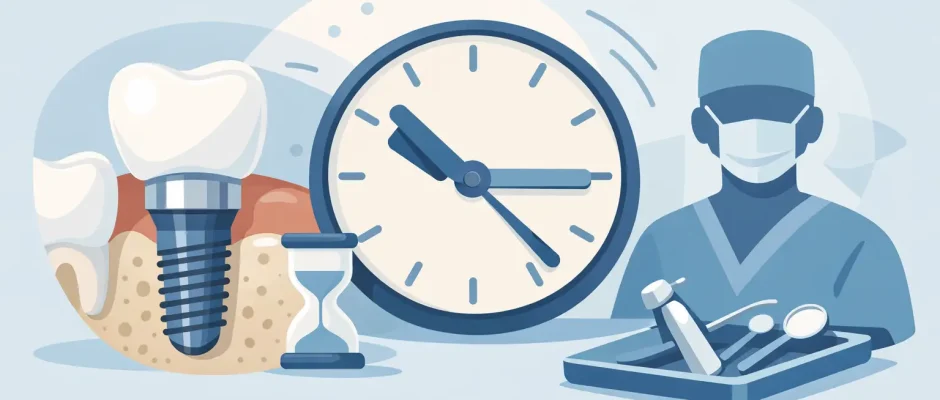
Most patients ask about pain first. The second question is usually, how long does implant surgery take? The honest answer is that the procedure itself is often shorter than people expect, but the full treatment timeline depends on bone quality, the number of implants, whether a tooth needs to be removed, and whether additional procedures such as bone grafting or a sinus lift are required.
For a straightforward case, placing one dental implant can take about 20 to 45 minutes of surgical time. If the treatment is carefully planned with 3D imaging and a surgical guide, the procedure may be even more efficient and more predictable. That said, surgery time is only one part of the process. Consultation, diagnostics, healing, and the final crown all have their own schedule.
How long does implant surgery take for one tooth?
In a simple single-tooth case, the appointment is often around 60 to 90 minutes in total. This includes preparation, anesthesia, sterile setup, the implant placement itself, and immediate post-operative instructions. The actual placement of the implant into the bone usually takes less time than the patient spends in the chair.
If the tooth has already been removed and the bone volume is adequate, treatment tends to be faster. If the tooth must be extracted at the same visit and an immediate implant is planned, the appointment becomes longer. In that setting, the surgeon is not only placing the implant but also performing a careful extraction, evaluating the socket walls, managing soft tissue, and sometimes adding grafting material to preserve contour and stability.
This is why two patients who both need “one implant” can have very different appointment lengths. The label sounds the same. The biology is not.
What affects how long implant surgery takes?
The main factor is complexity. A routine implant in healed bone is different from an implant placed in an area with infection, bone loss, or limited space near the sinus or nerve.
Number of implants matters. One implant may take under an hour of surgical time, while two or three implants can often be placed in a single session lasting 60 to 120 minutes. A full-arch case such as All-on-4 takes longer because it combines extractions when needed, implant placement, bite planning, and coordination with the restorative phase. These cases can take several hours, even when the workflow is highly organized.
Bone quality also changes the pace. Softer bone may require a more delicate drilling protocol and additional checks for primary stability. Dense bone can also slow the procedure because the site preparation must be controlled carefully to avoid overheating or excessive compression.
Additional procedures extend the appointment. Bone grafting, guided bone regeneration, sinus elevation, soft tissue grafting, or PRF preparation can all be done during the same visit when indicated, but they add time for a good reason. The goal is not speed alone. The goal is a stable implant placed in the right position with the best chance of long-term success.
The difference between surgical time and total treatment time
Patients often mean two different things when they ask this question. They may be asking how long they will be in the chair on surgery day, or they may be asking how many months it takes until the final tooth is in place.
These are very different timelines.
The surgical appointment is usually measured in minutes or hours. The full implant process is measured in weeks or months. After placement, the implant needs time to integrate with the bone. In many cases this healing period is around 2 to 4 months, though it may be shorter or longer depending on stability, location, and the treatment protocol.
If immediate loading is appropriate, a temporary tooth may be placed very quickly after surgery, sometimes the same day. This improves comfort and appearance, especially in the front of the mouth. But immediate loading is not suitable for every case. It depends on insertion torque, implant position, bite forces, and patient-specific risk factors.
What happens at the implant surgery appointment?
A well-organized implant procedure begins before the patient sits in the chair. Clinical examination, CBCT imaging, digital planning, and selection of the proper implant dimensions are what make surgery efficient. When planning is precise, the surgical stage becomes more controlled and less traumatic.
On the day of treatment, local anesthesia is administered first. Most patients are surprised that this part is more familiar than dramatic. Once the area is numb, the surgeon prepares the site and places the implant according to the planned angulation and depth. In guided surgery, a surgical template helps transfer the digital plan accurately to the mouth.
If needed, grafting material or PRF may be used to support healing and preserve tissue volume. The gum is then sutured if the protocol requires closure. After that, the patient receives instructions about swelling, diet, hygiene, and follow-up.
For many people, the emotional build-up before surgery is longer than the surgery itself.
Does a tooth extraction make the appointment longer?
Usually, yes. If an implant is placed immediately after extraction, the surgeon must remove the tooth atraumatically, preserve the surrounding bone, clean the area thoroughly, and decide whether the implant can achieve good primary stability. If there is acute infection, a root fracture, or bone damage, the plan may need to be modified.
An immediate implant can save time overall because it may reduce the number of surgical stages. But it is not automatically the best choice. In some cases, delayed placement after healing is safer and more predictable. A careful surgeon does not force immediacy when the tissues are not favorable.
How long does implant surgery take for full-mouth treatment?
Full-arch treatment has a different rhythm from a single implant. If several teeth need to be removed and 4 to 6 implants placed, the surgery may last 2 to 4 hours, sometimes longer. This depends on anatomy, stability, the need for bone reduction, and whether a temporary fixed prosthesis is delivered the same day.
Even in advanced cases, speed should never come at the expense of accuracy. Implant positioning in full-arch rehabilitation affects hygiene, speech, esthetics, and the long-term behavior of the prosthesis. Digital planning and guided protocols can shorten some parts of treatment and reduce uncertainty, but careful execution still matters more than a fast clock.
For patients traveling for treatment, this distinction is especially important. The surgery may be completed in one visit, but prosthetic milestones and follow-up must still be scheduled realistically.
Recovery time is not the same as surgery time
Many patients feel well enough to return to non-physical work within 24 to 48 hours after a straightforward implant placement. Mild swelling, tenderness, and limited chewing in the area are normal. More extensive procedures such as multiple implants, sinus lift, or bone grafting usually require a longer recovery window.
Healing of the gum is relatively quick. Healing of the bone is slower and biologically more important. Even if the area feels comfortable after a few days, the implant is still integrating. That is why follow-up visits and adherence to instructions matter.
Smoking, uncontrolled diabetes, heavy clenching, and poor oral hygiene can all slow healing or increase complication risk. Time is not only a surgical variable. It is a healing variable as well.
Can implant surgery be done faster with modern technology?
Yes, but only when technology is used correctly. CBCT imaging, digital planning, intraoral scanning, and surgical guides can make treatment more efficient and more predictable. They help reduce guesswork, protect anatomical structures, and support minimally invasive approaches when appropriate.
Still, technology is not a shortcut that replaces judgment. A guided case planned poorly is still a poorly planned case. The value of digital workflow comes from combining it with surgical experience, anatomical understanding, and disciplined protocols.
In practice, the best result usually comes from a balance of precision and restraint. Some cases benefit from flapless, guided implant placement. Others require open access because the tissues or bone need direct management.
A realistic way to think about timing
If you need one straightforward implant, expect a relatively short surgical appointment and a longer healing phase before the final crown. If your case involves extraction, grafting, or full-arch rehabilitation, the appointment will be longer and the sequence more individualized.
The right question is not only how long does implant surgery take. It is also how much time is needed to do it safely, comfortably, and in the correct position for a durable result. In implant dentistry, a predictable hour is usually better than a rushed half hour.
A good treatment plan should leave you with fewer surprises, not more. When the surgeon explains both the chair time and the healing timeline clearly, the procedure becomes easier to understand and much less intimidating.


