Bone Graft Healing Time: What to Expect
If you were told you need a bone graft before a dental implant, the first question is usually not technical. It is practical: how long is this going to take? Bone graft healing time depends on how much bone is missing, where the graft is placed, what material is used, and how your body heals. In straightforward cases, early healing takes a couple of weeks, but full integration of the graft often takes several months before the site is ready for an implant or the next surgical step.
That range can feel frustratingly broad, but it is honest. In implant surgery, speed matters less than stability. A graft that looks fine on the surface after two weeks is not the same as a graft that has matured enough to support long-term implant success.
What bone graft healing time really means
Patients often use one phrase to describe several different stages of recovery. From a surgical standpoint, these stages are not the same.
The first stage is soft tissue healing. The gum closes over the area, swelling gradually settles, and daily discomfort becomes manageable. This usually happens over 1 to 3 weeks, depending on the size of the procedure and whether additional techniques were used, such as membrane placement or PRF.
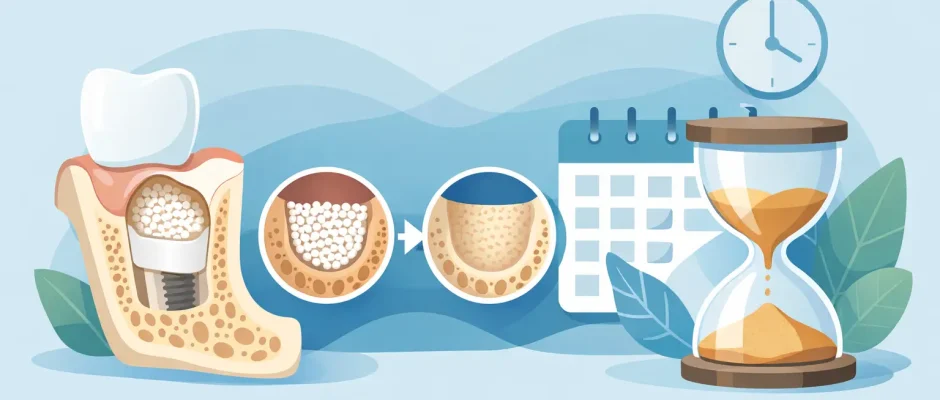
The second stage is biologic integration. During this period, your body replaces or remodels the graft material and starts building living bone in the area. This is the part that determines real bone graft healing time, and it usually takes much longer than the first stage. For many dental grafts, that means around 3 to 6 months. In larger reconstructions, sinus lifts, or severe bone loss cases, healing may take 6 to 9 months and sometimes longer.
This is why a site can feel normal while still not being ready for implant placement. Symptoms and true readiness are not the same thing.
Typical bone graft healing time by procedure
A small socket graft after tooth extraction may heal faster than a larger ridge augmentation. If the goal is to preserve bone for a future implant, the waiting period is often around 3 to 4 months. That is common when the defect is limited and the surrounding bone walls are relatively intact.
For guided bone regeneration around an implant site or in an area with horizontal bone deficiency, healing is often closer to 4 to 6 months. The exact timeline depends on graft volume, blood supply, membrane stability, and whether the graft was placed alone or together with an implant.
Sinus augmentation usually requires more patience. In a minor internal sinus lift, the healing window may be shorter, especially if an implant is placed simultaneously. In a larger lateral sinus lift, the maturation period is often 6 months or more before the site is considered fully ready for loading or for the next stage.
Block grafts and more advanced reconstructions can take even longer. These are not routine timeline cases, and treatment planning should reflect that from the start.
What affects healing time most
The size of the defect matters. A small contained graft surrounded by healthy bone heals more predictably than a large non-contained defect. Blood supply matters just as much. Bone is living tissue, and grafts heal best where the biology is favorable.
The graft material also plays a role. Autogenous bone, taken from your own body, has strong biologic potential but can remodel faster. Xenografts and allografts often maintain volume well, but they may integrate at a different pace. There is no single best material for every case. The right choice depends on the defect, implant plan, soft tissue condition, and the need for long-term volume stability.
Technique matters too. A graft placed with careful flap management, tension-free closure, and membrane stabilization generally heals better than one placed under mechanical stress. This is where microsurgical principles and precise planning make a real difference. The less trauma to tissue and the more stable the wound, the more predictable the healing.
Your general health matters as well. Smoking, uncontrolled diabetes, poor oral hygiene, active gum disease, and certain medications can slow or complicate recovery. Even bruxism can become relevant if it creates excessive pressure in the area.
What you feel during recovery
Most patients expect pain to be the main issue, but after bone grafting, swelling and pressure are often more noticeable than severe pain. Discomfort is usually strongest in the first 48 to 72 hours and then starts to decrease. Mild bleeding or oozing early on can be normal, especially after combined extraction and grafting.
If the graft was taken from a second surgical site, recovery may feel more involved. If the graft was placed in the upper jaw near the sinus, you may notice pressure, congestion, or sensitivity with head movement. These symptoms do not automatically mean something is wrong, but they do require proper postoperative instructions and follow-up.
What should improve with time is pain, swelling, and the feeling of tightness. What should not be ignored is worsening pain after initial improvement, fever, pus, a bad taste that persists, or wound opening with visible graft particles and increasing redness. Some small loss of surface granules can happen and is not always a failure, but it is something your surgeon should assess.
When can an implant be placed?
This depends on whether the graft is done at the same time as implant placement or as a separate preparatory step. In some cases, especially when enough primary stability can be achieved, the implant and graft are placed together. That shortens the total treatment time, but it is only appropriate when the anatomy allows it and the risk is controlled.
In other cases, staged treatment is safer. If there is significant bone loss, placing an implant too early can compromise both the graft and the implant. Waiting 4 to 6 months may feel slow, but it often creates a much more reliable foundation.
The decision is not based on the calendar alone. It is based on imaging, clinical examination, and how the grafted site behaves over time. A careful surgeon looks for volume, density, soft tissue quality, and the ability to place the implant in a prosthetically correct position rather than simply finding enough bone to make it fit.
Can bone graft healing be made faster?
Healing can be supported, but not forced. Good surgery, careful tissue handling, and proper case selection do more than any supplement marketed for “fast recovery.” PRF can be helpful in selected cases because it supports clot stability and early healing. Precise planning, atraumatic technique, and strict postoperative protocols are just as important.
From the patient side, the basics matter more than people think. Do not smoke. Do not disturb the area with your tongue or fingers. Keep the mouth clean as instructed, but do not brush aggressively over the surgical site. Follow dietary recommendations, avoid pressure changes when relevant after sinus surgery, and attend follow-up visits even if you feel fine.
There is also a psychological piece here. Patients sometimes compare themselves to someone who had “the same procedure” and healed faster. In reality, two grafts can have completely different biology. The same label does not mean the same defect, the same surgical complexity, or the same healing capacity.
Why patience improves the final result
In implant dentistry, rushed timelines are a common source of preventable problems. Bone grafting is not just about filling a space on a scan. It is about creating a stable, vascularized foundation that can support an implant in the right position for years.
That is why experienced surgeons plan around predictability, not optimism. In more complex cases, especially when there is advanced atrophy, sinus involvement, or a need for simultaneous soft tissue management, a slightly longer healing phase is often the price of a safer and more durable result.
For patients seeking treatment in complex implant cases, this is one of the most important mindset shifts. Fast treatment is attractive. Stable treatment is better.
A realistic timeline to keep in mind
For many patients, the practical version looks like this: the first week is about swelling control and wound protection, the first 2 to 3 weeks are about soft tissue closure and comfort, and the next 3 to 6 months are about the bone doing the real work. Some sites mature sooner. Others need more time.
The right question is not only, “How long is bone graft healing time?” It is, “When will the site be ready for the next step without compromising the result?” That is the question your surgeon should answer with imaging, examination, and a treatment plan built around your anatomy rather than a generic timeline.
A well-healed graft is rarely dramatic. It is quiet, stable, and uneventful – and in surgery, that is exactly what you want.


