Types of Bone Grafts for Implants
Being told you need a bone graft before a dental implant can feel like the treatment plan just got more complicated. In practice, the question is usually more specific: which of the types of bone grafts for implants gives the best balance of stability, healing time, and predictability for your anatomy?
That answer depends on how much bone is missing, where the defect is located, the condition of the soft tissue, and whether the implant is being placed immediately or in stages. A small defect after extraction is a very different problem from advanced bone loss in the back upper jaw. The graft material matters, but the surgical plan matters just as much.
Types of bone grafts for implants: what they really mean
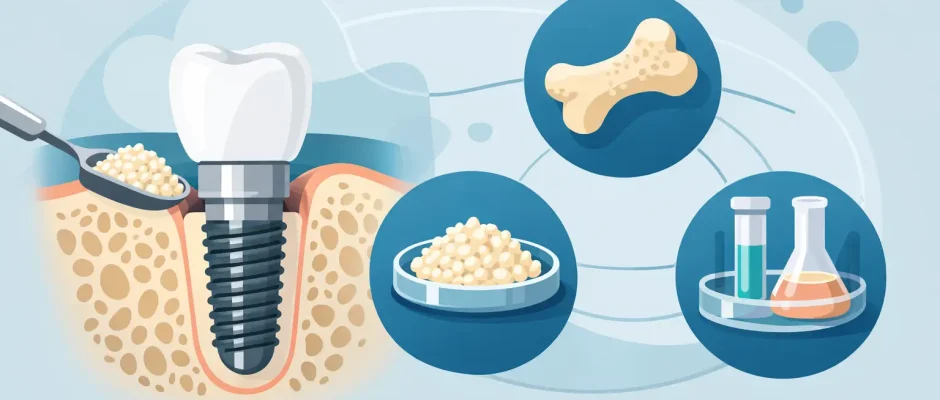
When patients hear different names for grafts, it can sound like there are dozens of unrelated options. In reality, most grafts used in implant dentistry fall into four main categories: your own bone, donor human bone, animal-derived bone, and synthetic materials. Each has a role. None is “best” in every case.
The surgeon’s goal is not simply to fill space on an X-ray. The goal is to rebuild a site that can support an implant in the correct position, with healthy surrounding tissue and long-term stability under function.
Autograft
An autograft uses your own bone. It may be collected from a nearby area in the mouth, such as the mandibular ramus, chin, or a local drilling site during implant preparation. In more extensive cases, bone can be harvested as a small block graft or as particulate material.
The main advantage is biology. Your own bone contains living cells and natural growth factors, so it has strong regenerative potential. For significant horizontal or vertical deficiencies, autogenous bone is often very effective, especially when primary stability and faster integration are priorities.
The trade-off is that it requires a donor site. That means a second surgical area, more postoperative discomfort, and a technique-sensitive procedure. For small or moderate defects, many surgeons prefer to reduce morbidity by combining a limited amount of autogenous bone with another graft material rather than harvesting a large volume.
Allograft
An allograft is processed human donor bone obtained from a tissue bank. It is commonly used in particulate form for ridge preservation, guided bone regeneration, and implant site development.
For many patients, this is a practical middle ground. It avoids a second surgical site and is available in forms that are easy to adapt to the defect. Depending on processing, allografts can provide a scaffold for new bone formation and integrate predictably when used in the right indication.
The limitation is that it does not behave exactly like your own fresh bone. Remodeling dynamics vary, and in larger defects it may need to be combined with other materials or protected carefully with a membrane. Still, for many routine implant-related grafting procedures, allograft is a very common and sensible choice.
Xenograft
A xenograft is usually a bovine-derived graft material processed to be biocompatible and safe for medical use. It acts mainly as a scaffold and is widely used in socket preservation, sinus lift procedures, and contour augmentation.
One reason xenografts are popular is volume stability. They tend to resorb slowly, which can help preserve ridge shape over time. In areas where maintaining contour is important, especially in the esthetic zone or in sinus augmentation, this can be an advantage.
But slow resorption is also the trade-off. If a site needs rapid turnover into the patient’s own bone, another material or a mixture may be preferable. Again, this is where treatment planning matters more than product labels.
Alloplast
Alloplasts are synthetic graft materials, often based on calcium phosphate, hydroxyapatite, beta-tricalcium phosphate, or combinations of these. They are manufactured rather than harvested from a human or animal source.
Their main advantages are consistency, availability, and the absence of donor-site surgery or biologic sourcing concerns. They can work well in selected defects, especially when the site is contained and the biology is favorable.
Their performance depends heavily on the specific material, particle size, porosity, and surgical indication. Some resorb relatively quickly, others more slowly. In daily implant practice, synthetic grafts are often used as part of a broader regenerative strategy rather than as a universal solution.
How surgeons choose among the types of bone grafts for implants
The material is only one part of the decision. A more useful question is what the graft must accomplish.
If the goal is ridge preservation right after extraction, the surgeon may prioritize maintaining volume and limiting post-extraction collapse. If the goal is to rebuild a thin ridge before placing an implant, the need may be for stronger regeneration and space maintenance. If the problem is the maxillary sinus with limited vertical bone, the biology and mechanics are different again.
Small defects around an implant
When an implant is placed and a minor gap remains between the implant surface and surrounding bone, particulate grafts are often used to support healing. In these cases, allograft, xenograft, or a combination may be enough, especially when the implant has good primary stability and the defect is well contained.
Ridge preservation after extraction
After a tooth is removed, the bone naturally shrinks. This is one of the most common reasons patients later hear that they do not have enough bone for an ideal implant position. Ridge preservation places graft material into the socket at the time of extraction to reduce that collapse.
Here, the priority is preserving architecture rather than rebuilding a major defect. Xenografts and allografts are both widely used, often with a collagen plug or membrane depending on the socket anatomy.
Horizontal or vertical ridge augmentation
When the jaw is too narrow or too low, regeneration becomes more demanding. These cases may require guided bone regeneration with particulate graft and membrane, a block graft, or staged reconstruction before implant placement.
For larger deficiencies, autogenous bone often plays a stronger role because of its regenerative capacity. In many real clinical cases, surgeons mix autogenous chips with allograft or xenograft to combine biologic activity with volume stability.
Sinus lift procedures
In the posterior upper jaw, the sinus can limit available bone height. A sinus lift creates space under the sinus membrane and fills it with graft material so implants can be placed either at the same time or later.
This is a setting where xenografts are commonly used because of their space-maintaining behavior, though allografts, alloplasts, or mixed grafts may also be appropriate. The right choice depends on residual bone height, implant stability, and the surgeon’s protocol.
The graft is important, but technique is decisive
Patients often compare graft materials as if the label alone determines the outcome. In reality, success depends on case selection, flap design, tension-free closure, blood supply, membrane stabilization, and infection control. A technically excellent procedure with a suitable material usually performs better than an aggressive plan built around the wrong indication.
This is also where digital planning and microsurgical discipline improve predictability. Precise implant positioning, careful management of soft tissue, and atraumatic handling of the site all affect how well the graft heals and whether the final implant restoration will be stable and esthetic.
In some practices, PRF is used as an adjunct to support healing and improve handling of grafted sites. It is not a substitute for bone, but in selected cases it can support the biologic environment around the graft.
What patients should ask before agreeing to grafting
A useful consultation is not just “Do I need a graft?” It is “What problem are we solving with this graft, and what happens if we do not solve it?”
You should understand whether the purpose is to preserve bone after extraction, create enough width or height for an implant, improve long-term esthetics, or increase the safety margin for implant stability. You should also know whether the implant can be placed at the same appointment or whether staged treatment is wiser.
Healing time varies. A small graft around an immediately placed implant is different from a vertical augmentation that must mature for months before the implant can be inserted. Faster is not always better. In more complex defects, staged treatment may be the more predictable option.
Cost can also vary based on the material and the complexity of the surgery. The real value is not choosing the cheapest graft. It is choosing the treatment plan that reduces the chance of implant compromise, soft tissue recession, or the need for repeat surgery.
If you are considering treatment in a center experienced with complex implant reconstruction, including cases with bone deficiency, the discussion should be specific and imaging-based. A CT scan, a clear explanation of defect type, and a step-by-step plan usually reduce anxiety far more than broad promises.
The best graft for implants is the one that fits your defect, your biology, and the final restorative goal. When the indication is correct and the surgery is executed carefully, bone grafting is not an extra obstacle – it is often the step that makes a stable, well-positioned implant possible.


