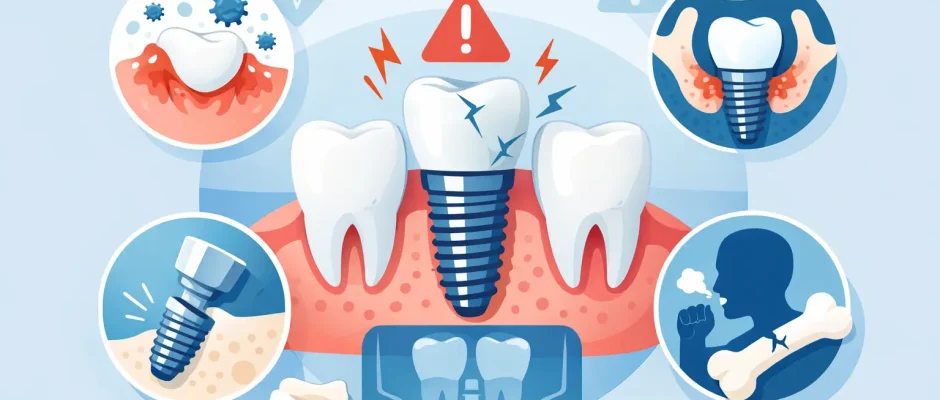
A dental implant that feels loose, stays sore, or never seems to settle is not just frustrating – it usually means something in the biology, planning, or healing process has gone off track. When patients search for dental implant failure causes, they are often trying to answer two urgent questions: why did this happen, and can it be fixed?
The short answer is yes, many failed implants can be treated. But the right next step depends on when the problem started, what caused it, and how much bone and soft tissue remain around the implant. Implant failure is rarely random. In most cases, there is a clear chain of factors behind it.
What counts as implant failure?
Not every difficult recovery means failure. Mild swelling, temporary soreness, and a few days of discomfort can be normal after surgery. True failure means the implant does not integrate with the bone, loses stability after initial success, or becomes surrounded by infection and bone loss significant enough to threaten long-term function.
Clinically, failure tends to fall into two groups. Early failure happens before the implant fully bonds with bone. Late failure happens after the implant has already been in function, sometimes months or years later. This distinction matters because the causes are often different.
The most common dental implant failure causes
Failure of osseointegration
For an implant to succeed, bone must heal tightly against its surface. This process, called osseointegration, is the foundation of stability. If it does not occur, the implant can remain mobile or become painful during healing.
Why does osseointegration fail? Sometimes the bone quality is poor, especially in areas with significant atrophy or low density. Sometimes the implant was placed into a site with residual infection, overheating of bone during drilling, or inadequate primary stability. In other cases, the issue is not the surgery itself but the healing environment – smoking, uncontrolled diabetes, or excessive pressure on the implant too early can all interfere with bone attachment.
This is one reason careful diagnostics matter. A 3D scan, evaluation of bone volume, and a clear loading protocol reduce guesswork. In complex cases, guided placement and bone augmentation are not marketing terms – they are tools to improve predictability.
Peri-implantitis and infection
Late implant failure is often linked to peri-implantitis, an inflammatory process around the implant associated with bacterial contamination and progressive bone loss. Patients sometimes describe bleeding during brushing, bad taste, swelling, or the feeling that the gum around the implant is changing shape.
Peri-implantitis does not always begin because a surgeon made an error. It can develop over time from poor plaque control, untreated gum disease, excess cement around the crown, an implant position that makes hygiene difficult, or a prosthetic design that traps bacteria. A history of periodontitis raises the risk significantly.
This is where long-term maintenance becomes as important as surgery. Even a perfectly placed implant can run into trouble if the tissues are chronically inflamed and the patient cannot clean the area effectively.
Poor treatment planning
Some implant failures begin before the first incision. If the implant is placed in the wrong position, at the wrong angle, or in insufficient bone without proper augmentation, the case may be compromised from day one.
Planning errors can show up in different ways. The implant may be too close to neighboring teeth, too close to another implant, or placed where the final crown receives unfavorable forces. In the esthetic zone, poor planning can also lead to soft tissue recession and visible metal components, which is not always a biological failure but can still be a clinical failure from the patient’s perspective.
Good implantology is prosthetically driven. The surgeon should not simply place a fixture where bone happens to be available. The final tooth position, bite, smile line, soft tissue architecture, and hygiene access all need to guide the plan.
Overload and bite-related problems
An implant does not have the same shock absorption as a natural tooth. If the bite is poorly distributed, or if the patient clenches and grinds heavily, mechanical overload can damage the bone-implant interface or the prosthetic components.
Sometimes overload causes screw loosening or ceramic fracture before the implant itself fails. Sometimes repeated overload contributes to marginal bone loss and eventual instability. This is especially relevant in full-arch cases, in patients with parafunctional habits, and in situations where the prosthetic design is too long or unsupported.
The trade-off here is practical. Immediate loading can be an excellent option in selected patients, but it requires strict control of stability and occlusion. Done well, it is efficient and comfortable. Done in the wrong case, it can raise the risk of failure.
Smoking and systemic risk factors
Patients often want to know whether smoking really makes that much difference. Clinically, yes. Nicotine reduces blood flow, affects soft tissue healing, and increases complications around both bone grafts and implants. Heavy smokers have a higher risk of early healing problems and late peri-implant disease.
Other systemic factors matter too. Poorly controlled diabetes, immune suppression, previous radiation therapy to the jaws, and some medications can affect healing. This does not mean implants are impossible in these patients. It means the treatment plan must be more deliberate, the timing may need adjustment, and the risk discussion should be honest.
There is no single rule that applies to everyone. A healthy nonsmoker with good bone and excellent hygiene is a very different surgical candidate than a patient with active periodontal disease, severe bruxism, and long-term tobacco use.
Surgical and prosthetic mistakes that can contribute
When patients hear the word failure, they often assume it must mean the implant itself was defective. In reality, true material defects are uncommon. Far more often, complications relate to execution.
Excessive trauma during extraction, poor handling of soft tissue, inadequate irrigation during drilling, contamination of the implant surface, or unstable suturing can all impair healing. On the restorative side, poorly fitting components, retained cement, and a crown shape that blocks cleaning can create chronic inflammation around an otherwise well-integrated implant.
This is why experience matters most in borderline cases. Straightforward implant placement is one thing. Immediate implants in infected sites, severe bone loss, sinus augmentation, or esthetic zone reconstruction require a higher level of surgical judgment and discipline with protocols.
Early warning signs patients should not ignore
Pain alone is not a reliable marker, because some failing implants are not painful at first. More useful warning signs include mobility, persistent swelling, bleeding around the implant, pus, gum recession, a crown that suddenly feels high when biting, or a sensation that the implant area is changing.
A bad odor or bad taste can also indicate infection. If symptoms appear after years of stability, do not assume it is minor irritation. Late problems are often more manageable when caught early, before major bone loss develops.
Can a failed implant be saved?
Sometimes yes, sometimes no. If the issue is limited inflammation without major mobility, treatment may include professional decontamination, correction of the prosthetic design, bite adjustment, improved hygiene access, and in selected cases surgical therapy to clean the surface and regenerate lost bone.
If the implant is mobile, removal is usually necessary. That sounds discouraging, but removal is not the end of the story. In many cases, the site can be reconstructed with bone grafting and later re-implanted under better conditions. The important point is not to rush the replacement without understanding why the first implant failed.
How to lower the risk from the start
Most failures are not prevented by luck. They are prevented by careful diagnosis, realistic case selection, and disciplined follow-up. That includes evaluating bone volume with 3D imaging, identifying active periodontal disease before implant placement, designing the future crown before surgery, and using a loading protocol that matches the biology of the case.
For some patients, additional steps improve safety significantly. Surgical guides can help place implants more precisely. PRF may support soft tissue healing. Bone grafting and sinus lift procedures can create the anatomy needed for stable placement rather than forcing an implant into a compromised site.
Just as important is patient participation. Daily hygiene, smoking reduction or cessation, regular maintenance visits, and wearing a night guard when indicated are part of implant treatment, not optional extras.
At a surgical practice focused on implantology and complex cases, the real goal is not simply placing implants. It is creating conditions where the implant has the best chance to remain stable, functional, and cleanable for years.
If you are worried that an implant is failing, the most useful next step is a focused evaluation, not guesswork. A careful exam and imaging usually reveal whether the problem is biological, mechanical, or both – and that clarity is what turns anxiety into a treatment plan.


