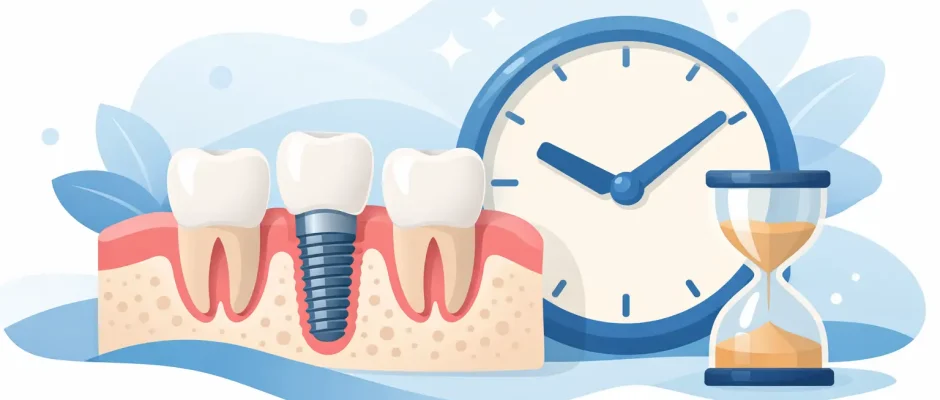
If you are planning implant treatment, the question usually comes before cost and sometimes even before fear: how long will this take? Dental implant healing time is not one fixed number. It includes two different processes that patients often mix together – soft tissue recovery after surgery and deeper bone healing around the implant.
That distinction matters. Your gums may feel much better within days, while the implant itself continues integrating with the bone for weeks or months. When patients understand that difference, the entire treatment plan becomes easier to follow and far less stressful.
What dental implant healing time really means
In everyday conversation, people use one phrase for several stages. After implant placement, the gum tissue starts closing and calming down almost immediately. Swelling, tenderness, and chewing limitations are usually most noticeable in the first few days. This is the part patients feel.
At the same time, a quieter and more important process begins inside the bone. The implant surface must bond biologically with the surrounding bone in a process called osseointegration. This phase cannot be judged by feeling alone. An implant may look fine and feel comfortable before it is actually ready for full functional load.
For that reason, dental implant healing time is best understood as a timeline, not a date. One patient may return to normal daily routine quickly but still need additional time before the final crown. Another may receive a temporary tooth early yet still be following a carefully controlled healing protocol beneath the surface.
Typical healing timeline after implant placement
During the first 24 to 72 hours, mild bleeding, swelling, and soreness are common. Most patients manage this period well with prescribed or recommended medication, cold application, and a softer diet. If the surgery was limited and the bone was favorable, discomfort is often less than expected.
By the end of the first week, the soft tissues usually look calmer. If sutures are present, they may be removed or checked around this time depending on the technique used. Many patients feel substantially better by days 5 to 7, although the area may still be sensitive to pressure.
Between 2 and 6 weeks, the gum continues maturing. Daily life generally feels normal again, but this does not mean the implant is fully healed. The critical bone response is still underway.
In straightforward cases, osseointegration often takes about 2 to 4 months. In denser bone, especially in the lower jaw, healing may be faster. In softer bone, often found in the upper jaw, more time may be needed. If bone grafting, sinus lift surgery, infection, or immediate placement after extraction is involved, the timeline can extend further.
This is why two patients can both say they had an implant placed, while one receives a final crown in a shorter period and the other follows a longer staged plan. Neither approach is automatically better. The correct timeline is the one that protects stability and long-term prognosis.
What affects dental implant healing time
Bone quality is one of the biggest variables. Strong, well-preserved bone gives the implant better primary stability at placement and often supports a more predictable healing course. Thin bone, low-density bone, or areas affected by long-term tooth loss may require a slower approach or additional grafting.
The location also matters. Lower jaw implants often heal differently from upper jaw implants because the bone architecture is not the same. Front teeth bring another layer of complexity because esthetics and soft tissue shape are critical, not just integration.
Timing of placement changes the picture as well. An implant placed in a healed site may follow one protocol. Immediate implant placement into a fresh extraction socket can reduce the number of surgeries and shorten the overall treatment journey, but only when infection control, bone anatomy, and primary stability allow it safely. In selected cases, this is an excellent solution. In others, trying to move too fast creates avoidable risk.
General health also influences healing. Smoking, uncontrolled diabetes, active periodontal disease, immune compromise, and poor oral hygiene can slow recovery and reduce predictability. Teeth grinding does not directly prevent healing, but excessive overload on an implant during the integration period can become a serious problem.
Surgical technique matters more than many patients realize. Gentle handling of tissue, precise 3D planning, atraumatic extraction when needed, and controlled implant positioning all support a smoother healing response. In modern implantology, digital planning and surgical guides are not just technical extras. In the right case, they help reduce guesswork, improve positioning, and support a more predictable postoperative course.
Immediate teeth versus complete healing
One of the most common misunderstandings is this: if a temporary tooth is placed right away, the implant must already be healed. Not necessarily.
Immediate temporization can be a very good option in carefully selected cases, especially in the esthetic zone. It helps preserve soft tissue contours and reduces the psychological burden of leaving without a tooth. But that temporary restoration is often designed to protect the implant during healing, not to test it with full chewing force.
In other words, you may look finished long before the biology is finished. This is why follow-up instructions about diet, pressure, and oral hygiene remain so important even when the tooth appears to be already in place.
Signs of normal healing and signs to watch closely
A normal recovery usually includes mild to moderate swelling, tenderness when chewing, temporary difficulty brushing near the site, and gradual day-by-day improvement. Slight bruising can also happen, especially after grafting or more extensive surgery.
What deserves closer attention is increasing pain after the first few days, bad taste or discharge, persistent heavy bleeding, fever, pronounced swelling that worsens instead of settling, or a feeling that the implant or temporary tooth is moving. None of these signs automatically mean failure, but they do justify prompt clinical evaluation.
Patients are often reassured to learn that occasional setbacks can be managed effectively when addressed early. Healing is not always perfectly linear. The key is supervision, not guesswork.
How to support faster and safer recovery
The goal is not to force healing to happen faster than biology allows. The goal is to create the best conditions for uncomplicated healing.
Follow the postoperative instructions exactly, especially during the first week. Keep the surgical area clean using the method your surgeon recommends. Avoid smoking if at all possible, and ideally stop before surgery rather than only after it. Choose soft foods at the beginning and return to harder chewing gradually, not based on confidence but based on the actual protocol for your case.
Do not test the implant. Patients sometimes press on the area with the tongue, chew on the temporary side too early, or repeatedly inspect the gum because they are anxious. That is understandable, but repeated mechanical irritation is not helpful.
If PRF, bone grafting, or membrane techniques are part of treatment, that does not automatically mean something is wrong or unusually severe. In many cases, these are planned steps to improve tissue quality and long-term stability, especially where bone volume is limited. More advanced treatment can mean a longer healing timeline, but often for a very good reason.
Why treatment plans vary from one clinic to another
Patients sometimes compare timelines online and get confused. One clinic says three months. Another says six. A third offers same-day teeth. The difference is not always marketing. Often, the cases are simply not equivalent.
A healthy patient with good bone and a single implant in a non-load-bearing area is not the same as a patient who needs extraction, infection control, sinus augmentation, or full-arch rehabilitation. Even within the same diagnosis, the surgeon’s protocol may differ based on implant stability, bite forces, soft tissue condition, and esthetic demands.
That is why a careful consultation matters. A precise answer about healing time usually requires imaging, examination, and a treatment sequence designed for your anatomy rather than a generic estimate. In a surgical implant practice that emphasizes digital planning and microsurgical principles, the timeline is built around predictability, not speed alone.
The part patients care about most
Most people are not asking about bone remodeling because they love medical details. They want to know when they can eat normally, smile confidently, stop worrying, and move on with life.
In many straightforward cases, you can expect the first week to be the main recovery window for comfort, and the following months to be the real healing window for implant stability. If your case is more complex, needing grafting or staged treatment, the process can be longer, but also safer and more durable when done properly.
The most helpful mindset is this: do not judge implant success by how quickly the soreness fades. Judge it by whether the treatment is planned and executed in a way that gives the implant the best chance to remain stable for years. A few extra weeks at the beginning are often a reasonable price for a result you can trust.


