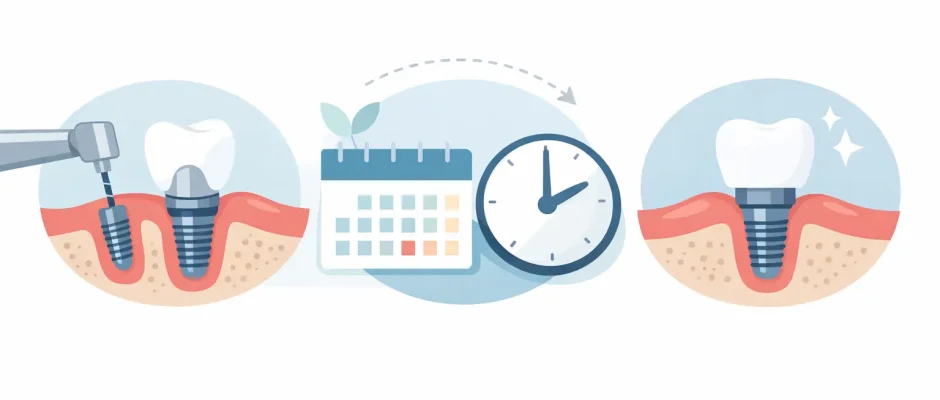
Most patients ask the same question after implant surgery: what will the dental implant recovery timeline actually look like in real life? Not the simplified version, but the one that tells you when swelling peaks, when chewing feels normal again, and why the implant may feel “fine” long before it is truly ready for the final crown.
That question matters because recovery after implant placement happens in layers. The gum heals first. Daily discomfort usually settles next. Bone integration takes much longer. If you understand those phases, the process feels more predictable and much less stressful.
The dental implant recovery timeline at a glance
For most healthy adults, the first 3 to 7 days are about soft tissue healing and controlling swelling. By 10 to 14 days, the gum is usually significantly calmer, and if sutures need removal, that often happens in this period. The deeper phase, called osseointegration, typically takes several weeks to a few months, depending on bone quality, implant stability, smoking status, medical history, and whether bone grafting was performed.
A straightforward single implant in good bone often follows the most comfortable course. Recovery can be slower after immediate implant placement into a fresh extraction socket, sinus lift surgery, guided bone regeneration, or full-arch treatment. None of this automatically means a problem. It simply means the biology and the surgical workload are different.
First 24 hours: controlled inflammation, not failure
The first day is usually less dramatic than patients expect, especially when surgery is done carefully and with stable primary implant placement. Local anesthesia wears off gradually. Mild oozing, pressure, soreness, and a sense of tightness in the area are common.
Swelling does not usually peak immediately. It tends to build over the first 24 to 72 hours. That is why many patients feel reasonably comfortable on the day of surgery and more puffy the next morning. If the implant was placed with flap elevation, bone grafting, or multiple implants, that swelling can be more noticeable.
During this period, the goal is simple: protect the clot, reduce trauma, and avoid unnecessary pressure on the surgical site. If a temporary denture or provisional restoration is used, it may need careful adjustment so it does not overload the implant during the earliest healing phase.
What is usually normal on day one
Tenderness, mild bleeding on gauze, limited chewing on the treated side, and reduced mouth opening after longer procedures are all common. Numbness should gradually resolve as the anesthetic wears off. Pain that is manageable with prescribed or recommended medication is also expected.
What is not typical is heavy uncontrolled bleeding, rapidly increasing asymmetry with severe pain, fever, or persistent numbness that does not follow the expected anesthetic timeline. Those situations deserve direct communication with your surgeon.
Days 2 to 3: the peak swelling window
This is often the hardest part of the dental implant recovery timeline emotionally, because it can feel as if things are getting worse before they get better. In reality, this is often the normal inflammatory peak. Swelling and bruising may be most visible now. The area can feel firm, and chewing can still be limited.
If the implant was placed in the upper posterior jaw, especially with sinus augmentation, pressure and congestion can also be part of recovery. If surgery was done in the lower jaw near a difficult extraction site, tissue stiffness can be more pronounced.
At this stage, patients often worry that the implant is failing because the gum looks swollen or the area feels strange. In most cases, those early sensations reflect tissue healing, not implant loss. True implant stability is not judged by how comfortable it feels on day three.
Days 4 to 7: early turning point
By the second half of the first week, most patients notice a clear improvement. Swelling begins to come down. Bruising may spread and then fade. Pain usually decreases rather than increases. Speaking and eating become easier, although hard or crunchy foods can still irritate the site.
This is also the phase when people are tempted to test the area with chewing or touching it with the tongue. That is not helpful. A dental implant needs mechanical stability during healing, and repeated pressure from chewing on a temporary tooth too early can create micromovement. That matters because osseointegration depends on quiet healing between bone and implant surface.
If PRF or other biologically supportive protocols were used, soft tissue recovery may feel more comfortable, but the biological principle stays the same: early comfort does not mean the implant is ready for load.
Weeks 2 to 4: gums look better before bone is ready
By two weeks, the gum usually appears much more settled. If non-resorbable sutures were placed, they are often removed around this time. Many patients feel close to normal in daily life and start wondering why the final crown cannot be placed immediately.
The reason is simple. Soft tissue healing is visible. Bone healing is not. Under the gum, the implant is moving through a biologic sequence in which old bone remodels and new bone forms around the implant surface. This process is slower and far more important than how the gum looks in the mirror.
That is why follow-up timing is based on biology, not impatience. In some cases with excellent stability and favorable bite conditions, an immediate temporary tooth is possible. But even then, the implant is usually being protected from heavy functional load during early healing.
When recovery takes longer
Some timelines are intentionally slower. If there was active infection before extraction, limited bone volume, a simultaneous graft, or a thin soft tissue biotype, your surgeon may choose a more conservative restorative schedule. That is not a setback. It is often the safer path to a more predictable result.
Smokers, patients with poorly controlled diabetes, and patients with a history of periodontal disease may also heal more slowly. Again, slower does not mean unsuccessful. It means the treatment plan should respect real risk factors rather than ignore them.
One to three months: the quiet phase of osseointegration
This part of the dental implant recovery timeline is often the least eventful from the patient’s perspective and the most important from the surgeon’s perspective. Discomfort is usually minimal or absent. The site may feel completely normal. But the implant is still in the phase where biologic fixation is maturing.
In dense mandibular bone, integration can progress faster than in softer posterior maxillary bone. Immediate implants placed into extraction sockets can do very well, but their timeline depends on initial stability and defect morphology. Cases involving bone augmentation may require a longer interval before restorative loading.
This is why a precise diagnosis matters more than generic internet timelines. Two patients can both receive implants and have completely different healing schedules for valid clinical reasons.
Three to six months: readiness for the final restoration
For many standard cases, this is the period when the implant is evaluated for prosthetic completion. Clinical stability, tissue condition, radiographic appearance, and bite planning all matter. If everything looks favorable, the final crown, bridge, or full-arch prosthesis can be fabricated and connected according to the planned protocol.
Patients are often surprised that the “recovery” is not over the day pain ends. In implant dentistry, recovery is really complete when the implant is integrated, the soft tissue is healthy, and the restoration is functioning without overload.
That final point matters. A beautifully placed implant can still run into trouble if the bite is poorly distributed, oral hygiene is inadequate, or maintenance is ignored.
Signs of normal healing versus warning signs
Normal healing usually follows a reassuring pattern: discomfort improves, swelling peaks and then fades, the gum closes gradually, and function expands step by step. Mild temperature sensitivity in adjacent teeth, temporary pressure from a healing abutment, or awareness of the surgical area can all be part of a normal course.
Warning signs behave differently. Pain that intensifies after several improving days, bad taste or pus, persistent mobility of a temporary restoration that should feel secure, fever, or a sudden opening of the wound should not be observed passively. The earlier these issues are assessed, the easier they are to manage.
One point deserves emphasis: an implant itself should not feel mobile. Temporary components can loosen, but true implant mobility is not a normal recovery finding.
What most affects your timeline
The biggest variables are not age alone. They are surgical complexity, bone quality, implant primary stability, smoking, systemic health, home care, and whether additional procedures were required. A simple flapless guided implant in a well-preserved site may recover faster than an implant placed together with extraction, ridge preservation, and membrane stabilization.
This is where experience and protocol discipline matter. Digital planning, surgical guides, careful soft tissue handling, and a clear postoperative plan do not make biology instantaneous. They make healing more controlled and more predictable.
For patients seeking treatment in complex cases, that predictability is often the real difference. At Implantolog in Tel Aviv, that same principle guides the surgical process: reduce avoidable trauma, respect biology, and never rush the restorative phase just to make the calendar look better.
A helpful way to think about recovery is this: the first week is about comfort, the first month is about visible healing, and the months that follow are about stability. If your surgeon gives you a timeline that feels slower than you expected, that is not necessarily bad news. It may be the sign of a plan built for long-term success rather than short-term reassurance.


