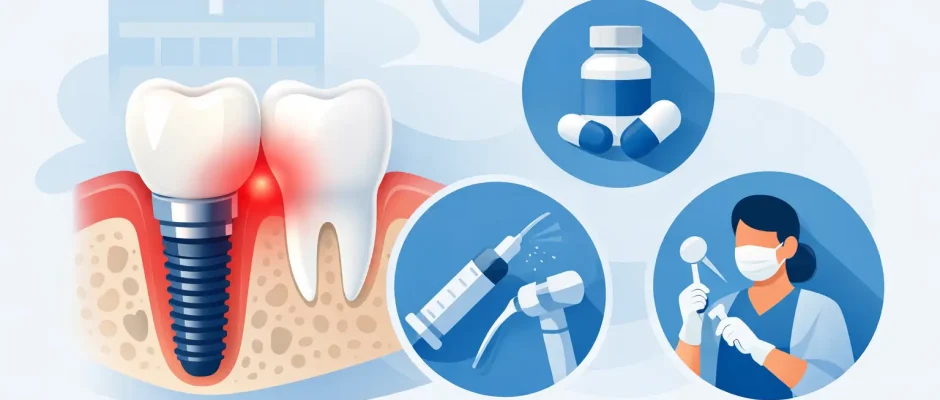
A dental implant that was healing well and then starts to hurt, bleed, feel swollen, or develop a bad taste is not a problem to watch for weeks. In many cases, dental implant infection treatment is more successful when the issue is identified early, before bone loss progresses and the implant loses stability.
Patients often assume that any discomfort around an implant means failure. That is not always true. Some infections are limited to the soft tissue and can be controlled without removing the implant. Others involve progressive bone loss around the implant surface and require a more aggressive surgical approach. The difference matters, because the treatment plan depends on the cause, the timing, and the condition of the surrounding bone.
What an implant infection actually means
The word “infection” is used broadly, but clinically there are two main scenarios. The first is peri-implant mucositis, where inflammation affects the gum around the implant without bone loss. The second is peri-implantitis, where inflammation is accompanied by loss of supporting bone.
This distinction is not academic. Mucositis is usually more reversible when treated promptly. Peri-implantitis is more serious because the implant depends on surrounding bone for long-term stability. Once that bone support is reduced, treatment becomes more complex and the prognosis becomes more variable.
In practical terms, an infected implant site may present with redness, swelling, bleeding on brushing, soreness when chewing, pus discharge, bad breath, or a feeling that the gum around the implant looks different than before. In advanced cases, the implant may feel mobile. Mobility is a concerning sign because a healthy integrated implant should not move.
Why implant infections happen
Most implant infections are not caused by a single mistake. They usually develop from a combination of bacterial plaque, difficult hygiene conditions, excess cement around a restoration, overload from bite forces, smoking, uncontrolled diabetes, a history of periodontal disease, or implant positioning that makes cleaning difficult.
Timing also gives clues. Early infection, shortly after placement, may be related to healing complications, residual infection at the site, lack of primary stability, or contamination during the healing phase. Late infection, months or years later, is more often associated with plaque-related inflammation, prosthetic factors, and maintenance problems.
This is why a proper evaluation matters more than guessing. Two patients can describe the same symptom, but one may have superficial inflammation while the other has crater-like bone loss hidden under the gum.
How dental implant infection treatment is planned
Dental implant infection treatment should start with diagnosis, not antibiotics alone. The exam usually includes clinical probing, assessment of bleeding and suppuration, checking implant mobility, evaluation of the prosthetic design, and radiographs to measure bone levels.
In more complex cases, three-dimensional imaging may be useful, especially if the defect shape will affect surgical planning. The anatomy of the bone loss matters. A contained defect with preserved surrounding walls may be more favorable for regenerative procedures than a broad, non-contained defect.
The clinician also needs to identify what is maintaining the inflammation. If the crown contour traps plaque, if cement is left below the gumline, or if occlusion is overloading the implant, treatment will be incomplete unless those factors are corrected.
Non-surgical dental implant infection treatment
When inflammation is limited and bone loss is minimal or absent, non-surgical treatment may be appropriate as the first step. This usually involves professional decontamination of the implant surface and surrounding tissues, instruction in home care, and correction of local contributing factors.
Depending on the case, the restoration may need to be removed temporarily to improve access. If excess cement is present, it should be eliminated. If the prosthetic design prevents effective cleaning, it may need modification or replacement.
Antiseptic rinses can support local control, and antibiotics may be considered in selected situations, but they are not a stand-alone solution. A short course of medication may reduce acute symptoms, yet the infection often returns if the implant surface remains contaminated or the prosthetic problem is unchanged.
This is where expectations should stay realistic. Non-surgical therapy can reduce inflammation and stabilize some cases, especially mucositis. In established peri-implantitis, however, it often has limited long-term predictability when used alone.
When surgery is necessary
If there is deeper pocketing, ongoing bleeding or pus, radiographic bone loss, or a defect that cannot be cleaned adequately without flap access, surgical treatment is often indicated. The goal is to gain visibility, decontaminate the implant surface, remove infected tissue, and manage the bony defect according to its morphology.
Surgical treatment is not one single technique. In some cases, resective surgery is used to reduce pocket depth and create a more maintainable environment. In other cases, regenerative surgery may be considered to rebuild lost support around the implant with bone graft materials and barrier membranes.
Whether regeneration is appropriate depends on several details: the implant position, the shape of the defect, the amount of remaining bone, soft tissue quality, and the patient’s ability to maintain excellent plaque control afterward. Regenerative procedures can be valuable, but they are not equally effective in every defect.
Implant surface decontamination is another key part of surgery. Different protocols may include mechanical cleaning, chemical agents, and adjunctive methods selected according to the clinical situation. What matters is not using the longest list of instruments, but applying a disciplined protocol to reduce bacterial contamination while preserving surrounding tissues.
When implant removal is the better option
Some implants should be treated, and some should be removed. That decision can be emotionally difficult for patients, especially after they have already invested time, surgery, and money. Still, preserving a severely compromised implant at any cost is not always the best medicine.
Removal is more likely to be recommended when the implant is mobile, when bone loss is advanced and circumferential, when the implant position is prosthetically unfavorable, or when repeated inflammation persists despite treatment. In those cases, explantation followed by site management may offer a cleaner path to a predictable rebuild.
That does not necessarily mean the area can never be restored again. Often, the site can be reconstructed with guided bone regeneration and later re-implanted under better conditions. Sometimes delayed replacement is safer than trying to rescue a poor foundation.
The role of bone grafting and soft tissue management
Infection treatment is not only about eliminating bacteria. Long-term success often depends on rebuilding anatomy that supports healthy maintenance. If bone has been lost, guided bone regeneration may be part of the plan. If the soft tissue is thin, unstable, or difficult to clean, soft tissue augmentation may improve both comfort and long-term control.
These decisions are case-specific. A patient with a shallow, accessible area and stable tissues may not need grafting. Another patient with significant collapse of the ridge and thin gum tissue may benefit from a staged surgical approach. The more advanced the defect, the more important careful planning becomes.
In surgical implantology, precision improves predictability. Digital planning, high-quality imaging, and microsurgical technique can reduce unnecessary trauma and help align the treatment with the biology of the site.
What patients should do if they suspect infection
Do not wait for the implant to “settle down” if symptoms are getting worse. Bleeding, swelling, pus, increasing tenderness, or a new bad taste around an implant should be evaluated promptly.
Do not start pressing on the gum, using sharp tools at home, or taking leftover antibiotics. Home measures can delay proper diagnosis and sometimes mask progression without solving the cause.
A timely exam is especially important if you have risk factors such as smoking, diabetes, a history of periodontitis, teeth grinding, or previous grafting around the implant. These factors do not guarantee failure, but they can change both treatment intensity and prognosis.
Can an infected implant be saved?
Sometimes yes, sometimes no. That answer is more honest than promising that every infected implant can be rescued.
An implant with early inflammation, no mobility, limited bone loss, and correct prosthetic design has a better chance of stabilization. An implant with major bone destruction, poor position, mobility, or repeated recurrent infection has a less favorable outlook.
The goal is not simply to keep the implant in place. The goal is a healthy, maintainable, comfortable restoration with stable bone and soft tissue over time. If saving the implant does not support that goal, then replacement under improved conditions may be the better result.
Preventing another infection after treatment
After successful treatment, maintenance becomes part of the therapy, not an optional extra. Patients need professional follow-up, radiographic monitoring when indicated, and a home care routine that matches the implant design.
This may include changes in cleaning technique, more regular hygiene visits, adjustment of bite forces, or redesign of the restoration to make plaque control easier. Prevention is rarely dramatic, but it is what protects the surgical result.
For patients seeking implant care in complex situations, that is where experience matters most – not only placing or treating the implant, but planning a system the patient can maintain safely for years. In a well-managed case, the right decision at the right time can turn a stressful complication into a controlled and predictable next step.


