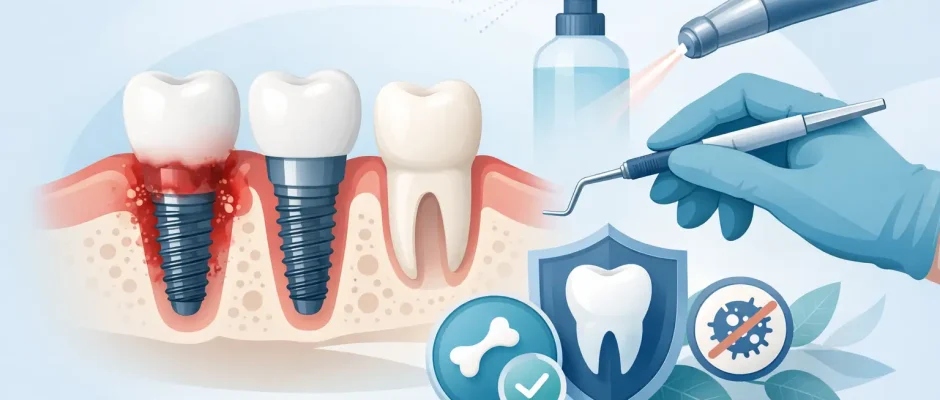
Bleeding around an implant is not a minor detail to watch “for later.” If the gum is inflamed, the pocket is deepening, or brushing causes bleeding or a bad taste, the question is no longer whether something is happening. The question is how quickly and how precisely peri-implantitis treatment should begin to stop further bone loss.
Peri-implantitis is an inflammatory process around a dental implant that affects both soft tissue and supporting bone. It is different from simple peri-implant mucositis, where inflammation is limited to the gum and there is no radiographic bone loss. That distinction matters because mucositis is usually reversible, while peri-implantitis can progress silently and threaten the implant itself.
Patients often expect a single standard solution – a cleaning, an antibiotic, or “laser treatment.” In practice, there is no one-size-fits-all protocol. Treatment depends on how much bone has already been lost, whether the implant surface can be accessed and decontaminated, the design and position of the implant, the quality of home care, and systemic risk factors such as smoking, diabetes, or a history of periodontitis.
When peri-implantitis treatment is really needed
Not every sore implant is failing, but not every stable implant is healthy either. A proper diagnosis starts with symptoms, probing depths, bleeding on probing, suppuration, mobility, and radiographic evaluation of bone levels. In many cases, the implant still feels firm because osseointegration is only partially lost. That can create a false sense of safety and delay care.
The earlier the problem is identified, the more conservative the intervention can be. If the inflammation is still limited to the soft tissue, professional debridement, correction of plaque-retentive factors, and strict hygiene may be enough. Once there is established peri-implant bone loss, however, treatment usually has to go beyond simple cleaning.
This is also where clinical precision matters. A crown contour that traps plaque, excess cement around the implant, an implant placed too deep, or insufficient keratinized tissue can all contribute to ongoing inflammation. If these factors are not addressed, even a technically well-executed procedure may give only temporary improvement.
What peri-implantitis treatment usually involves
The first goal is straightforward – reduce the bacterial load and stop the inflammatory process. The second goal is more complex – preserve the implant if the prognosis is reasonable. In selected cases, a third goal is possible: reconstruct part of the lost support.
Non-surgical treatment has a role, but its limits should be stated clearly. Mechanical debridement with implant-safe instruments, irrigation, local antimicrobial measures, and professional hygiene can reduce inflammation, especially in shallow defects. It may also be used as the first phase before surgery to improve tissue condition. But when there is deep circumferential bone loss or a rough implant surface that is difficult to access, non-surgical care alone rarely resolves the disease predictably.
Antibiotics can be helpful in some protocols, but they are not a substitute for local control of the infected surface. If biofilm remains on the implant and the defect anatomy protects it from thorough cleaning, the effect of antibiotics is limited and often temporary. This is one of the most common misunderstandings patients have – medication can support treatment, but it usually cannot replace it.
Non-surgical care: when it helps and when it does not
For early lesions, non-surgical therapy may stabilize the situation. This includes professional cleaning around the implant, reinforcement of home hygiene, management of prosthetic factors, and regular follow-up. If the soft tissue responds with less bleeding and reduced pocket depth, that is a good sign.
Still, expectations must be realistic. In moderate to advanced peri-implantitis, the implant threads are often exposed within a bony defect that cannot be adequately cleaned through the gum line alone. The deeper and more irregular the defect, the less likely a non-surgical approach will be enough.
Surgical peri-implantitis treatment
Surgery is often indicated when bone loss is established and access is required for proper decontamination. The flap is opened so the defect and implant surface can be visualized directly. Granulation tissue is removed, the surface is cleaned, and the morphology of the defect is assessed.
From that point, treatment generally follows one of two directions. In a resective approach, the aim is to reduce the pocket and create a more maintainable architecture. This may include implantoplasty in selected cases, where exposed rough threads are mechanically smoothed to reduce plaque retention. The advantage is improved long-term hygiene access. The trade-off is that this does not rebuild lost bone.
In a regenerative approach, the goal is to reconstruct the defect around the implant using grafting materials, membranes, or biologic adjuncts when defect anatomy is favorable. This is not suitable for every case. Regeneration works best when the defect walls can contain the graft and when implant position and prosthetic design are compatible with long-term maintenance. If those conditions are poor, attempting regeneration may look attractive on paper but lead to unstable results.
Can the implant be saved?
Sometimes yes, sometimes no. A useful treatment plan is based on prognosis, not wishful thinking.
If the implant is mobile, the osseointegration is lost to a degree that usually makes removal the correct option. If bone loss is extensive but the implant remains stable, salvage may still be possible. The decision then depends on defect configuration, implant surface characteristics, esthetic demands, patient risk factors, and whether the restorative design can be corrected.
There are also cases where saving the implant is technically possible but not biologically smart. For example, an implant with recurrent inflammation, poor position, and difficult hygiene access may continue to consume time, money, and bone. Removal and replacement after site development can offer a more predictable long-term result than repeated rescue attempts.
That is not a failure of treatment planning. It is often the more responsible choice.
Why peri-implantitis happens in the first place
Most cases are multifactorial. Bacterial biofilm is central, but the reason the biofilm becomes destructive is often linked to local and systemic conditions.
A patient with a history of periodontitis carries a higher risk. Smoking impairs healing and increases disease progression. Poor plaque control plays an obvious role, but so do prosthetic overcontours that make cleaning difficult. Residual cement is a classic trigger in cement-retained restorations. In some cases, the problem begins with implant positioning that compromises tissue health from the start.
This is why good peri-implantitis treatment does not stop at debridement. It also asks what created the disease environment. If the crown needs to be modified or removed, if the patient needs periodontal stabilization, or if maintenance intervals need to be shortened, those are not secondary details. They are part of treatment.
What to expect during recovery
Recovery depends on the extent of intervention. After non-surgical therapy, discomfort is usually limited. After surgical treatment, mild to moderate swelling, tenderness, and temporary brushing restrictions are common. The gum needs time to mature, and the final response is not judged in a few days.
Follow-up is essential. Tissue healing is evaluated clinically, and bone stability is monitored over time. Patients often want to know whether one procedure solves the issue permanently. The honest answer is that long-term success depends on both the surgery and what happens afterward – daily home care, professional maintenance, and control of risk factors.
In complex implant cases, digital planning and microsurgical principles can improve precision and reduce unnecessary trauma to the tissues. When treatment is performed with careful access, controlled decontamination, and a plan for maintenance, outcomes are more predictable and patient comfort is better. That combination of precision and practicality is what matters most, whether the implant is being preserved or the site is being prepared for a more reliable reconstruction.
How to choose the right timing
Waiting for pain is a mistake. Peri-implantitis can progress with little discomfort, especially in the early and moderate stages. Bleeding, swelling, recurrent bad taste, deeper pockets, or radiographic changes are enough to justify evaluation.
Prompt assessment is especially important if the implant was placed years ago and has been stable until recently. A late change in tissue behavior deserves explanation. In a surgical implant practice, these cases are evaluated not only as “inflammation around an implant,” but as a full biologic and prosthetic problem with a specific cause, a measurable extent, and a realistic treatment goal.
If you notice bleeding, swelling, or bone loss around an implant, the best next step is not to guess whether it will settle on its own. It is to get a precise diagnosis early, while there is still more to save and more options on the table.


