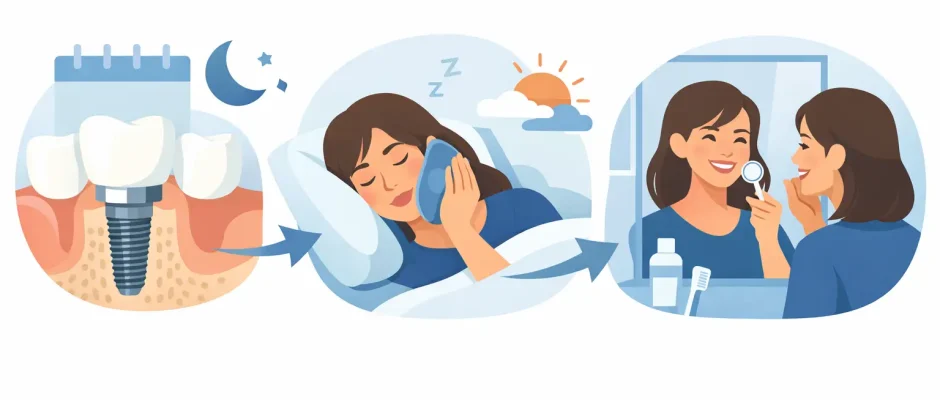
Dental Implant Recovery Day by Day
The hardest part for many patients is not the implant itself. It is the waiting afterward – wondering whether the swelling is normal, whether the tenderness should still be there, and when chewing will feel natural again. A clear dental implant recovery day by day timeline reduces that uncertainty and helps you separate expected healing from signs that deserve a call to your surgeon.
Recovery is not identical for every patient. A single straightforward implant placed with a surgical guide usually heals differently from an implant combined with extraction, bone grafting, sinus lift, or immediate provisional teeth. Your biology matters too: smoking, diabetes, thin gum tissue, previous infection, and bite forces can all change the pace. Still, most patients follow a pattern.
Dental implant recovery day by day: the first 24 hours
On the day of surgery, numbness wears off gradually. Mild bleeding or pink saliva is common in the first several hours. The goal is not to make the area look perfect on day one. The goal is to protect the blood clot and keep pressure off the surgical site.
Discomfort is usually most noticeable once the anesthetic fades. For a simple implant, many patients describe this as soreness or pressure rather than sharp pain. If the procedure included flap elevation, bone contouring, multiple implants, or grafting, the first evening can feel more substantial.
Swelling often begins during the first day but may still be limited. Ice on the outside of the face can help during the early postoperative window. Soft foods, careful hydration, and avoiding hot foods, alcohol, smoking, forceful rinsing, and strenuous exercise matter more than people expect. Small mistakes in the first 24 hours can prolong recovery.
Days 2-3: usually the peak of swelling
This is the stage that worries patients most. In many cases, day two and day three are harder than day one. That does not mean something is wrong. Swelling typically peaks here, and the area may feel tighter, bruised, or more tender. Opening wide can be uncomfortable, especially after surgery in the back of the mouth.
If a bone graft was performed together with implant placement, the tissues can feel fuller and firmer. If PRF or microsurgical techniques were used, soft tissue response may be more controlled, but some swelling is still expected. Bruising of the gum or skin can also appear now and then drift in color over the next several days.
Pain should remain manageable with the prescribed regimen. Severe throbbing pain that is rapidly getting worse, especially if combined with bad taste, fever, or increasing swelling after initial improvement, deserves attention. Recovery is not judged by one symptom alone. It is judged by the pattern.
Days 4-7: turning the corner
By the fourth day, many patients notice the recovery trend changing. Swelling starts to decrease, facial tightness improves, and eating becomes easier. The site is still healing, but the sense of surgical trauma begins to fade.
This is often when patients become too confident and test the area with crunchy food, vigorous brushing, or chewing on the implant side. That is a common mistake. The implant is not “fragile,” but the surrounding gum and early clot stabilization still need respect. A good recovery is often the result of restraint, not toughness.
If stitches were placed, they may begin to feel more noticeable as swelling goes down. Depending on the material, sutures may dissolve or may need removal at a follow-up visit. Mild itching, awareness of the stitches, and a slightly uneven gum contour can all be normal during this phase.
Week 2: the mouth feels better before the implant is healed
By the second week, most patients with uncomplicated cases feel significantly better. Daily activities are close to normal, tenderness is reduced, and the gum usually looks calmer. This is also the point where expectations need to be realistic.
The fact that you feel better does not mean the implant has finished integrating. What the patient experiences and what the bone is doing are different timelines. Soft tissue comfort returns relatively quickly. Osseointegration – the bond between implant surface and bone – takes much longer.
At this stage, your surgeon may evaluate healing, remove sutures if needed, and confirm whether the implant is healing under the gum, with a healing abutment, or with an immediate temporary crown. Each option changes what you see in the mirror, but not the basic biology of bone healing.
Weeks 3-6: quiet healing
This phase is less dramatic but clinically important. Most of the visible signs of surgery are gone. Patients often report only occasional sensitivity when brushing or chewing nearby. If a temporary tooth is present, the main issue is usually learning how to function without overloading the implant.
For immediate implants and immediate temporization, the trade-off is convenience and esthetics versus stricter bite control. A temporary tooth can improve comfort and appearance, especially in the smile zone, but it must be protected from excessive force. In selected cases this approach is excellent. In others, delayed loading is safer and more predictable.
If grafting was part of treatment, the timeline can feel longer even when everything is going well. Bone regeneration is not something a patient can feel directly. That is why follow-up and imaging matter. A calm mouth is reassuring, but it is not the only measure of success.
Months 2-4 and beyond: bone integration and final restoration
For many standard cases, the implant continues integrating over several months before the final crown is delivered. In denser bone, integration may progress faster. In softer bone, after sinus augmentation, or in larger regenerative cases, more healing time may be appropriate.
This period can test patience. The site may feel normal, but your surgeon may still advise waiting before final loading. That is not delay for the sake of delay. It is part of protecting long-term stability, gum architecture, and bite balance.
When the implant is ready, the restorative phase begins. This may include scanning, impressions, evaluation of gum contour, and fabrication of the final crown or bridge. A well-timed restoration is part of recovery too. A technically excellent surgery can be compromised by a poorly controlled prosthetic phase.
What is normal during dental implant recovery day by day
Some findings are common and usually not alarming: mild bleeding in the first hours, swelling that peaks around day two or three, bruising, soreness when chewing nearby, a feeling of pressure in the jaw, and temporary sensitivity in adjacent teeth. If the implant was placed in the upper back jaw, sinus pressure can sometimes be felt for a short period.
The exact mix depends on the procedure. A flapless guided implant may have minimal swelling. A complex case with extraction, grafting, and contour management may produce a longer and more visible recovery. Better surgery does not always mean less swelling. Sometimes it means the anatomy was difficult and the procedure was handled correctly.
When to call your implant surgeon
Patients do best when they know what deserves early review. Call if bleeding is persistent and heavy, if swelling increases sharply after several days instead of improving, if pain is severe and not controlled by medication, or if you develop fever, pus, foul odor, or difficulty swallowing. Numbness that does not improve should also be reported.
A loose temporary crown is different from a loose implant, and patients often confuse the two. Do not try to judge this yourself by pushing on the area. If something feels mobile or unusual, it should be examined professionally.
What helps recovery go smoothly
The best recoveries usually come from three things: a precise surgical plan, low-trauma technique, and disciplined postoperative behavior. Digital planning, surgical guides, careful soft tissue handling, and adjuncts such as PRF can improve predictability in selected cases, especially where anatomy is limited or esthetics matter.
From the patient side, the basics matter. Take medications exactly as prescribed. Keep the area clean without aggressive brushing. Choose soft, non-irritating food for the first days. Avoid smoking if at all possible, because it remains one of the most consistent factors behind delayed healing and implant complications.
If your case is complex, ask for the recovery timeline specific to your procedure, not just a generic implant handout. A single implant in healed bone is one recovery path. Full-arch treatment, immediate loading, and regenerative surgery are another.
Good implant treatment is not only about placing titanium in bone. It is about controlling healing so the final result is stable, functional, and comfortable. If you understand what recovery should look like day by day, the process becomes much less stressful – and much more predictable.


