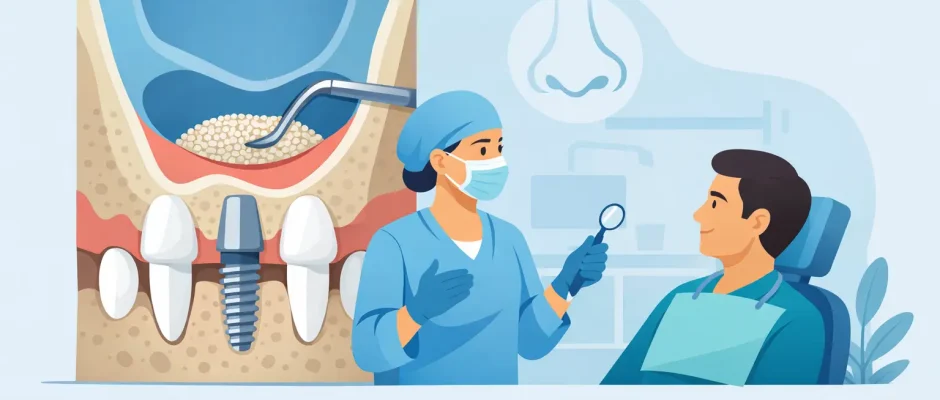
What Is Sinus Lift Surgery?
Losing an upper back tooth often creates a second problem patients do not expect: there may not be enough bone left to place an implant safely. That is usually the moment the question comes up – what is sinus lift surgery, and why would it be needed before dental implants?
A sinus lift is a bone augmentation procedure performed in the upper jaw, usually in the area of the premolars and molars. In simple terms, the surgeon gently raises the sinus membrane and places bone graft material underneath it to create more vertical bone height. That added bone can make implant placement possible in cases where the natural bone is too thin.
This is not a cosmetic procedure and not an “extra” step added without reason. It is a reconstructive part of implant treatment when anatomy leaves too little room for stable, long-term implant support. In the right case, it changes a compromised plan into a predictable one.
What is sinus lift surgery in dental implant treatment?
The maxillary sinus is an air-filled space located above the upper back teeth. After tooth loss, the bone in this area tends to shrink over time. At the same time, the sinus can expand downward. The result is less available bone between the mouth and the sinus cavity.
Dental implants need enough bone for initial stability and long-term load distribution. When that bone is missing, simply placing a shorter implant is not always the best answer. Sometimes it works. Sometimes it creates mechanical or anatomical compromises. A sinus lift is designed to rebuild the missing foundation rather than force the implant into a borderline situation.
That is why sinus augmentation is often part of treatment planning for the posterior upper jaw. It is not about making surgery more complex. It is about making the result more reliable.
When a sinus lift is needed
The most common reason is bone loss after a tooth has been missing for a while. The longer the gap remains, the more likely the bone volume has decreased. Periodontal disease, previous infections, trauma, and naturally large sinuses can also contribute.
In practice, the need for a sinus lift is determined by imaging, not guesswork. A CBCT scan shows the height and width of the bone, the shape of the sinus floor, the presence of sinus septa, and the overall anatomy that affects surgery. This is where careful planning matters. Two patients may both be missing an upper molar, but one can receive an implant immediately while the other first needs bone augmentation.
There is also an important middle ground. Not every patient with reduced bone needs a major sinus graft. If the deficiency is mild, a less invasive internal sinus elevation may be enough. If the bone loss is severe, a lateral window approach may be the safer and more predictable option. The correct procedure depends on the starting anatomy and the prosthetic plan.
How the procedure is performed
There are two main approaches to sinus lift surgery.
Internal sinus lift
This method is used when a modest increase in bone height is needed. The surgeon prepares the implant site and gently elevates the sinus floor from below through the same opening. In many cases, the implant can be placed at the same time.
This approach is less invasive, but it is only appropriate when enough native bone remains to stabilize the implant. It is not the right choice in every case.
Lateral window sinus lift
This is the more classical approach for larger bone deficiencies. A small access window is created in the side wall of the upper jaw. Through that window, the sinus membrane is carefully lifted, and the graft material is placed beneath it. Depending on the available native bone, the implant may be placed during the same procedure or after healing.
The surgical goal is precise and controlled: protect the membrane, create a stable space, and place the graft where new bone can form. Microsurgical technique, good visibility, and disciplined protocol reduce trauma and improve predictability.
What material is placed during a sinus lift?
The graft can come from different sources. In many modern protocols, the material may be a xenograft, allograft, synthetic graft, or a combination, depending on the clinical situation. Some surgeons also incorporate biologic support such as PRF to optimize healing conditions.
Patients often ask whether the graft “turns into real bone.” The better way to explain it is that the graft serves as a scaffold. Over time, the body remodels the area and forms new vital bone around and within that structure. The final result is not identical in every case, which is why the choice of graft and timing must be individualized.
Does the implant go in at the same time?
Sometimes yes, sometimes no.
If there is enough residual bone to anchor the implant securely at the time of surgery, simultaneous implant placement can be a very efficient option. It reduces the number of procedures and shortens the overall timeline.
If the remaining bone is too limited, placing the implant immediately may reduce primary stability and increase risk. In that situation, staging the treatment is often the more responsible decision. First the sinus lift, then healing, then implant placement.
This is one of the most important examples of where “faster” is not always “better.” A sound treatment plan is based on biology and mechanics, not on trying to compress every case into one visit.
What recovery is usually like
For most patients, recovery is manageable and less dramatic than the name of the surgery suggests. Swelling, mild bleeding, pressure, and soreness in the first few days are common. Many patients describe it as more of a sinus pressure sensation than severe pain.
You are usually advised to avoid blowing your nose, sneezing with your mouth closed, drinking through a straw, smoking, or creating pressure changes that could disturb the grafted area. These instructions matter because the sinus membrane needs time to seal and heal without disruption.
Healing time varies. Soft tissue recovery is relatively quick, but bone maturation takes longer. If implants are not placed simultaneously, they are often inserted after several months, once the graft has integrated sufficiently.
Risks and limitations patients should understand
A sinus lift is a well-established procedure, but it is still surgery. The most common intraoperative issue is perforation of the sinus membrane. Small perforations can often be managed successfully during the same procedure. Larger tears may require a change of plan or staged treatment.
Other possible risks include infection, graft failure, bleeding, postoperative sinus symptoms, delayed healing, or insufficient bone formation. Smoking, uncontrolled diabetes, poor oral hygiene, and untreated sinus disease can increase the chance of complications.
This is also why proper diagnosis matters. If a patient has chronic sinus problems, allergy-related inflammation, or ENT issues, those factors should be evaluated before surgery. Safe implant treatment in the posterior maxilla depends on seeing the whole picture, not just the missing tooth.
Is sinus lift surgery painful?
During the procedure, it should not be painful because local anesthesia is used, and additional sedation may be considered when appropriate. After surgery, discomfort is usually controlled with standard postoperative medication.
What patients often fear most is not the pain itself, but the lack of control. Knowing the steps, understanding the recovery rules, and having a clear follow-up plan reduces that stress significantly. In surgical dentistry, calm communication is not a luxury. It is part of good treatment.
What makes a sinus lift more predictable
Predictability comes from planning and execution. High-quality imaging, a careful review of sinus anatomy, atraumatic technique, and the right indication all matter. So does the decision of whether to place the implant immediately or in stages.
In more advanced implant practice, digital planning helps connect the surgical step to the final restoration rather than viewing the graft as an isolated procedure. That matters because the goal is not simply to add bone. The goal is to create the right bone in the right position for a stable, functional, long-term implant result.
For patients seeking treatment in more complex situations, this distinction is important. A sinus lift is not just about filling space under the sinus. It is about rebuilding support in a way that respects anatomy, healing biology, and the final prosthetic load.
Who is a good candidate?
Most healthy adults with insufficient bone in the upper posterior jaw can be candidates, but candidacy is never based on one X-ray alone. The surgeon considers general health, smoking status, sinus condition, bone anatomy, bite forces, and the broader restorative plan.
If you have been told you do not have enough bone for an implant in the upper jaw, that does not automatically mean treatment is off the table. It may simply mean the foundation has to be rebuilt first. In experienced hands, sinus augmentation is often the step that makes implant treatment possible rather than impossible.
The right next step is not to guess whether you need it. It is to get a proper surgical evaluation with 3D imaging, a clear explanation of your anatomy, and a treatment plan that balances safety, comfort, and long-term stability.


