Losing one tooth creates a bigger decision than most patients expect. The question behind “implant vs bridge” is not just how to fill a gap. It is how to restore chewing, protect the neighboring teeth, keep the result stable for years, and avoid turning one missing tooth into a larger problem later.
For some patients, a dental bridge is a reasonable solution. For others, an implant is the more conservative and longer-lasting choice, even though it sounds like the more involved treatment. The right answer depends on bone volume, the condition of the adjacent teeth, bite forces, timeline, budget, and what matters most to you: lower upfront cost, shorter treatment, or better long-term preservation.
Implantation vs bridge – what actually changes
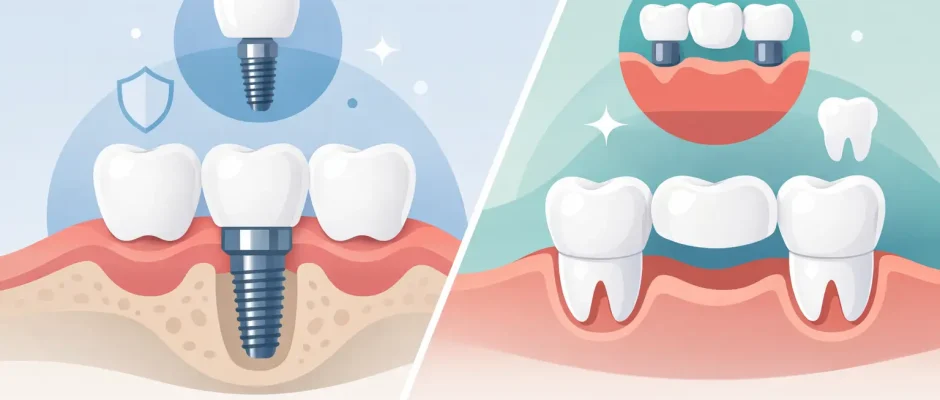
A bridge replaces a missing tooth by using the teeth on each side as support. Those supporting teeth are reshaped, and a connected restoration is placed over them with a false tooth in the middle.
An implant replaces the missing tooth differently. A titanium implant is placed into the bone where the root used to be, and after healing, a crown is attached to it. In practical terms, the bridge rests on neighboring teeth, while the implant stands on its own.
That difference affects almost everything: how the treatment is performed, what happens to the bone, how easy it is to clean, how long the result may last, and whether healthy teeth need to be altered.
When an implant is usually the better choice
If the teeth next to the gap are healthy or only minimally restored, an implant is often the more biologically favorable option. It allows us to replace the missing tooth without grinding down two neighboring teeth that may otherwise not need treatment.
There is another major advantage: bone preservation. After a tooth is removed, the jawbone in that area begins to shrink because it no longer receives functional load through a root. A bridge fills the space above the gum, but it does not stimulate the bone underneath. An implant does. That does not mean implants stop every degree of bone change forever, but they generally preserve the site far better than a bridge.
Implants also tend to feel more like a separate tooth. Chewing forces are directed into the bone rather than transferred through connected crowns. In many cases, this improves comfort and function, especially in the back of the mouth where biting load is higher.
From a long-term perspective, a single implant can be an excellent investment when planned well. If one crown later needs maintenance, it is usually managed on that one unit. With a bridge, a problem involving one support tooth can affect the whole structure.
When a bridge may still be the smarter option
Implants are not automatically the answer in every case. If the neighboring teeth already have large fillings, root canal treatment, or crowns and need restoration anyway, a bridge can make good clinical and financial sense. In that situation, we are not sacrificing healthy enamel just to support the bridge because those teeth already require coverage.
A bridge can also be the faster option when a patient wants to avoid surgery or cannot undergo implant placement immediately. For example, if there is severe bone loss and the patient is not ready for grafting, or if systemic and local factors need to be stabilized first, a bridge may serve as a practical solution.
There are also situations where anatomy, bite pattern, parafunction, or medical history make implant treatment less straightforward. That does not always rule implants out, but it may shift the balance. Good treatment planning means recognizing when a simpler path is safer and more predictable.
implant vs bridge if cost matters most
This is where many consultations become more nuanced. A bridge often costs less upfront than an implant, especially when no bone grafting is needed for the bridge and the case can be completed relatively quickly.
But upfront price and long-term value are not the same thing. With a bridge, the supporting teeth carry extra load and remain vulnerable to decay at the margins, fracture, periodontal changes, or future endodontic issues. If one support tooth fails years later, replacing the bridge may become more complex and more expensive than treating a single implant crown.
An implant can cost more at the start, particularly if digital planning, surgical guides, bone augmentation, or soft tissue management are needed for a stable esthetic result. Yet in many well-selected cases, it preserves adjacent teeth and reduces the chance that one missing tooth will compromise several teeth over time.
For that reason, the cost discussion should be framed around the whole treatment horizon, not only the first invoice.
Healing time and treatment timeline
A bridge is usually faster. Once the supporting teeth are prepared, the restorative phase often moves efficiently, assuming the gums and teeth are stable.
An implant usually requires more time because healing matters. After implant placement, the bone must integrate with the implant surface before definitive loading in many cases. Sometimes immediate implant placement is possible right after extraction, and sometimes even immediate provisionalization is appropriate. In other cases, staged treatment is safer, especially where infection, bone defects, or soft tissue deficiencies are present.
This is one reason detailed diagnostics matter. Cone beam imaging, bite analysis, and evaluation of the extraction site help determine whether an implant can be placed immediately, whether bone grafting is needed, and whether the final result will be predictable.
Esthetics, comfort, and daily cleaning
For front teeth, esthetics can be excellent with either option, but the path to that result differs. Implant esthetics in the smile zone depend heavily on bone and gum architecture, implant positioning, and soft tissue management. This is where guided surgery, micro-surgical technique, and careful provisionalization can make a real difference.
A bridge may initially look very good, but over time, tissue changes under the missing tooth area can create a shadow or a space beneath the pontic. That is more likely when ridge resorption progresses.
Cleaning is another practical point. A bridge requires cleaning under the pontic with floss threaders or interdental aids. It is manageable, but it is not the same as cleaning around separate teeth. An implant crown is often easier for patients to understand and maintain, although implants also require disciplined hygiene and professional follow-up.
Situations where the answer truly depends
Some cases are not obvious, and that is exactly why a generic online answer can mislead. If the adjacent teeth are heavily restored, a bridge may be entirely reasonable. If they are untouched and the bone is adequate, an implant is often the more conservative route.
If there is advanced bone loss, an implant may still be the best option, but only if the surgical plan includes augmentation when needed. In experienced hands, bone grafting, sinus elevation, PRF protocols, and guided implant placement can expand what is possible safely. That does not mean every patient needs those procedures. It means treatment should be built around anatomy, not around a one-size-fits-all preference.
Bruxism also matters. Heavy clenching increases risk for both bridges and implants, but the restorative design, occlusion, and protective strategy become especially important. Smokers, patients with uncontrolled periodontal disease, and patients with poorly controlled diabetes need careful evaluation before either option is selected.
How I explain the choice to patients
I usually reduce the decision to three questions. First, are the neighboring teeth healthy enough that we would prefer not to touch them? Second, is the bone and soft tissue situation favorable for a predictable implant result, either now or after site development? Third, what balance of timeline, budget, and long-term goals fits the patient best?
That framework keeps the conversation practical. It avoids selling a procedure and focuses instead on preserving biology, controlling risk, and selecting a treatment that still makes sense years from now.
For many single missing teeth, an implant is the option that best protects adjacent teeth and preserves the jaw. For some patients, a bridge is still an excellent treatment because it aligns better with the condition of the surrounding teeth, the treatment timeline, or the overall plan.
A good consultation should leave you with more than a price. It should show you the scan, explain the trade-offs, and tell you not only what can be done, but why that approach is the safer and more predictable one in your specific case. That clarity is often what turns a stressful decision into a confident one.


