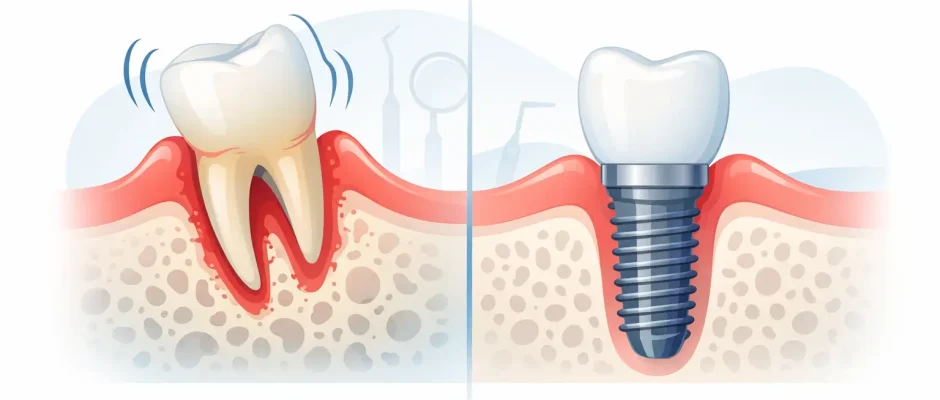
When teeth start to move, the question is usually not cosmetic anymore. It is about function, infection, comfort, and whether the dentition can still be predictably saved. In that context, dental implants for periodontitis with loose teeth is not a quick replacement procedure. It is a carefully staged treatment strategy in which the first goal is disease control, and only then stable implant rehabilitation.
Patients often come in with a similar concern: “My teeth are loose, my gums bleed, and I was told I may need implants. Can this be done right away?” Sometimes yes, but often only after a very precise diagnostic phase. Mobility is not the diagnosis itself. It is a sign that the supporting tissues have already been damaged, and the reason for that damage determines what can be done next.
When is implantation at periodontitis with tooth mobility realistic?
Periodontitis is a chronic inflammatory disease that destroys the attachment around teeth and, over time, the surrounding bone. Once support is lost, teeth may become mobile. The key issue is not just whether a tooth moves, but why it moves, how much support remains, and whether the disease is currently active.
Implant placement can be a very good solution in periodontally compromised patients, but only under the right conditions. If active infection is still present, plaque control is poor, bleeding is generalized, and the patient has not gone through periodontal stabilization, implant treatment carries a higher risk. The same bacterial environment that damaged the natural teeth can also threaten implants later.
That is why the decision is never based on mobility alone. A mobile tooth may still be maintainable if bone loss is limited, the defect pattern is favorable, and the tooth has strategic value. On the other hand, a tooth with severe attachment loss, recurrent abscesses, advanced mobility, and poor long-term prognosis may be better removed and replaced with an implant-supported restoration.
What has to be evaluated before dental implants for periodontitis with loose teeth
A predictable plan starts with diagnostics, not with extraction. Clinical examination, periodontal charting, radiographic imaging, and occlusal analysis all matter. In many cases, 3D imaging helps assess the real volume of remaining bone and whether augmentation will be required.
Several details influence the choice of treatment. One is the degree of mobility. Another is the amount and architecture of bone loss. A third is whether the tooth is mobile because of periodontal destruction alone or because trauma from biting forces is adding instability. Endodontic problems, root fractures, and old prosthetic overload can complicate the picture.
Equally important is the patient factor. Smoking, uncontrolled diabetes, inconsistent hygiene, and a history of irregular maintenance all affect outcomes. None of these automatically exclude implant treatment, but they do change the risk profile and the sequence of care.
Not every loose tooth should be removed
This is a point worth emphasizing. In experienced hands, periodontal and microsurgical treatment can sometimes preserve teeth that were assumed to be hopeless. If a tooth can be saved with a reasonable prognosis and stable periodontal support, preserving it may be the better biologic option.
The opposite is also true. Trying to keep severely compromised teeth for too long can lead to additional bone loss, repeated inflammation, and a worse future implant site. The right decision is rarely emotional. It should be based on prognosis.
The usual treatment sequence
In most cases, treatment begins with controlling the periodontal disease. That means professional debridement, reduction of inflammation, home-care instruction, and, when indicated, correction of local factors such as defective restorations or traumatic occlusion. If mobile teeth make chewing painful, temporary splinting can sometimes improve comfort during this phase.
Only after inflammation decreases can the real prognosis be judged. Teeth that initially appeared unsalvageable may become less symptomatic after periodontal therapy. Others remain unstable and show why extraction is the more rational option.
If extraction is needed, the next decision is timing. Immediate implant placement on the day of extraction can be possible, but only when the socket anatomy, infection status, soft tissue condition, and implant stability allow it. In periodontitis patients, this decision must be selective. Immediate treatment is attractive because it can shorten the process and help preserve tissue contours, but it should not be used just to speed things up.
Delayed implant placement is often safer when there is active infection, major bone destruction, or a need for site development first. In those cases, the goal is not speed. It is long-term stability.
Bone loss changes the surgical plan
Advanced periodontitis often leaves behind vertical and horizontal defects. That matters because implants need sufficient bone in three dimensions, not just enough height on a two-dimensional X-ray. If the defect is significant, bone grafting or guided bone regeneration may be required before or during implant placement.
This is where surgical planning becomes especially important. Digital imaging, prosthetically driven positioning, and, in many cases, surgical guides help place the implant in the correct axis and depth. That accuracy is not just technical detail. It affects load distribution, hygiene access, esthetics, and the risk of future complications.
In complex cases, biologic support methods such as PRF may be used as part of the healing protocol. They do not replace sound surgical principles, but they can support soft tissue management and postoperative recovery when used appropriately.
One implant is not the whole treatment
Patients sometimes think the difficult part is getting the implant in. In reality, long-term success depends just as much on what happens before and after surgery. Soft tissue quality, bite stability, prosthetic design, and maintenance all influence whether the implant remains healthy.
A patient who lost teeth to periodontitis is, by definition, a patient with a history of periodontal susceptibility. That does not mean implants will fail. It means the maintenance protocol has to be stricter. Regular follow-up, professional cleaning, radiographic monitoring, and excellent daily hygiene are not optional.
Risks and trade-offs patients should know
Implants in patients with a history of periodontitis have good success rates when the disease is controlled and follow-up is consistent. But the risk of peri-implant inflammation is higher than in patients without periodontal history. This should be discussed openly, not minimized.
There are also functional trade-offs. If several mobile teeth are removed at once, the patient may need a temporary solution during healing. If bone augmentation is required, treatment time becomes longer. If immediate loading is possible, convenience improves, but only when primary stability and prosthetic conditions are favorable. A faster protocol is not automatically the better protocol.
Another important point is esthetics. In areas where long-standing periodontitis has already caused gum recession and loss of papillae, implants can restore function very effectively, but they may not recreate untouched natural gum architecture. In the front zone especially, realistic planning matters.
Who is a good candidate?
A good candidate is not simply someone missing teeth. It is someone whose periodontal infection can be brought under control, who understands the maintenance commitment, and whose bone and soft tissue conditions allow a stable reconstruction. Sometimes that means a single implant after selective extraction. Sometimes it means a larger rehabilitation after removing multiple hopeless teeth. In more advanced cases, a full-arch fixed solution may be considered if the remaining dentition has poor prognosis.
The best outcomes usually come from individualized planning rather than from choosing a standard package. Two patients can have “loose teeth from gum disease” and need completely different solutions.
What patients should ask at the consultation
A useful consultation should answer a few very practical questions. Which teeth have a realistic long-term prognosis, and which do not? Is the periodontal disease currently active? Can any teeth be retained to support function during treatment? Will implants be immediate or delayed? Is grafting likely? What does the maintenance schedule look like after final restoration?
Clear answers lower anxiety because they turn a vague surgical fear into a defined treatment pathway. That is especially important in complex periodontal cases, where the right sequence is often more important than the speed of treatment.
If you are considering implant treatment because your teeth have become mobile from periodontitis, the most important step is not choosing the implant itself. It is getting a precise diagnosis and a plan that respects biology, infection control, and long-term function. When those parts are done well, even difficult cases can be treated with a high level of predictability and comfort.


